


Introduction
Grid instability is a growing concern for modern homeowners and businesses alike. If your lights flicker every time the refrigerator kicks on, or your air conditioner hums and stutters during a voltage dip, you already know the real question is not “do I need a stabilizer?” Instead, the choice is between protecting your entire property with a single machine or guarding each high-value appliance individually. This comprehensive guide breaks down the debate between main line and individual equipment stabilizers, incorporating insights from electrical engineering standards, modern smart appliance requirements, and real-world cost-benefit analyses.
Why Voltage Fluctuation Protection Is Critical Today
Grid fluctuations are no longer isolated incidents. Rural, semi-urban, and even rapidly developing urban areas routinely experience severe voltage swings—ranging from 160V to 260V on a nominal 220V line—particularly during peak summer loads, winter heating seasons, or severe monsoon storms.
The Vulnerability of Modern Electronics
Older analog appliances were remarkably forgiving of voltage sags and surges. In contrast, modern appliances rely heavily on sensitive microprocessors and precision engineering:
- Inverter ACs and Refrigerators: Feature digital compressors and sophisticated electronic control boards that easily fry under sudden surges.
- Washing Machines and Microwaves: Rely on complex digital interfaces and sensor arrays that degrade rapidly under chronic undervoltage.
- Long-Term Damage: While a sudden spike causes immediate failure, chronic undervoltage silently bakes compressor windings over months, drastically shortening equipment life spans.
Choosing the right voltage protection setup is no longer a luxury; it is a vital strategy for reducing maintenance and replacement costs.
Deep Dive: Main Line Stabilizers (Whole-House Protection)
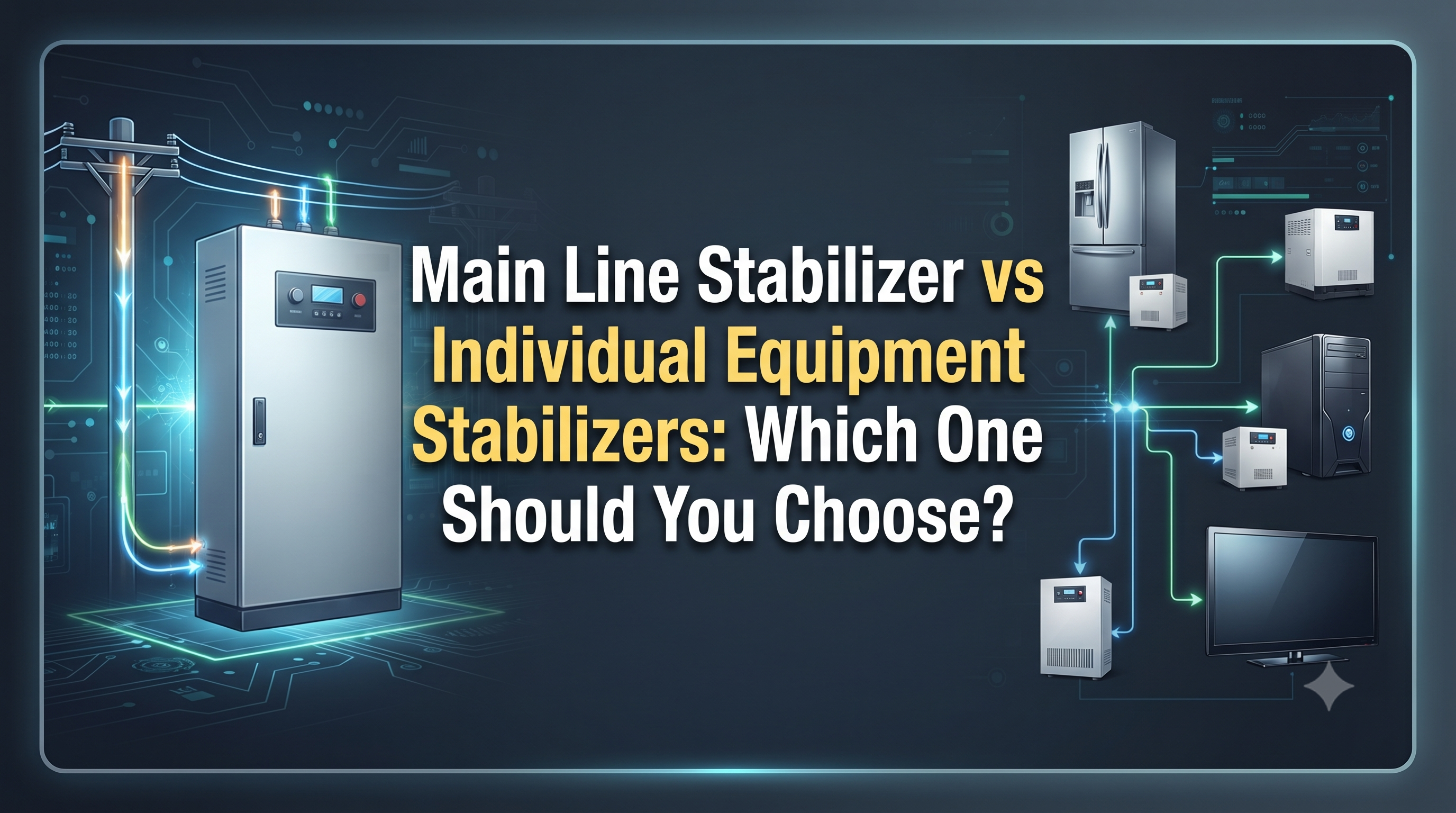
A main line stabilizer (often referred to as a whole-house or mainline stabilizer) is installed directly after your utility meter, regulating the voltage for your entire property before the electricity reaches your internal distribution board.
How It Works
Every appliance in your home—lights, fans, TVs, refrigerators, washing machines, and water pumps—draws power through this single checkpoint. Electricians size these units according to your home’s total connected load in kVA (Kilovolt-Amperes).
The Pros and Cons
- The Pros:
- Unified Convenience: One purchase, one professional installation, and one centralized unit to monitor.
- Comprehensive Coverage: Every circuit and wall outlet receives protected power automatically.
- Ideal for Older Wiring: Perfect for properties with aging wiring infrastructure that suffer from widespread brownouts.
- The Cons:
- Single Point of Failure: If the main unit trips or breaks down due to an overload (such as running multiple AC units simultaneously during a heatwave), your entire house loses stabilized power instantaneously.
- Sizing Challenges: Miscalculating peak simultaneous load can lead to frequent thermal tripping.
Deep Dive: Individual Equipment Stabilizers (Targeted Defense)
Individual equipment stabilizers are dedicated units hardwired or plugged directly into a single high-value appliance. They are most commonly deployed for heavy motor- or compressor-driven devices like air conditioners, large double-door refrigerators, and high-capacity washing machines.
How It Works
Each device gets a stabilizer engineered specifically for its wattage draw, startup surge capacity, and precise response-time requirements.
The Pros and Cons
- The Pros:
- Redundancy by Design: If an AC’s stabilizer fails, your refrigerator, television, and washing machine continue operating normally on their own units.
- Precision Tuning: Provides exact voltage correction tailored to a specific device’s tolerance levels.
- Essential for Specialized Environments: Highly recommended for home offices, medical clinics, or server rooms housing sensitive diagnostic or computing equipment.
Head-to-Head Comparison Table
| Factor | Main Line Stabilizer | Individual Equipment Stabilizers |
| Coverage Area | Entire property (all circuits) | One specific appliance per unit |
| Upfront Investment | Higher single purchase; economical for large homes | Lower per unit; multiplies quickly across many devices |
| Failure Risk | Single point of failure for the whole building | Isolated failure; other appliances remain unaffected |
| Response Precision | Generalized correction optimized for mixed loads | Finely tuned to a single appliance’s exact requirements |
| Installation Setup | Professional installation near the main electricity meter | Multiple DIY plug-in installs or dedicated wall mounting |
| Best Suited For | Homes with widespread grid instability and modest budgets | Properties housing high-value, sensitive, or critical equipment |
| Maintenance | Single unit requiring annual inspection | Multiple units requiring periodic monitoring and servicing |
Real-World Scenarios: Which Should You Choose?
Scenario A: The Suburban Family Home
A family living in a semi-urban town experiences daily voltage dips during peak evening hours, but runs a standard complement of household appliances.
- The Verdict: A main line stabilizer delivers the best return on investment. The simplicity of a single centralized device outweighs the redundancy concern for standard household loads.
Scenario B: The Modern Urban Apartment (The Hybrid Approach)
Many urban homeowners implement a hybrid strategy. They install a modest main line stabilizer to handle baseline lighting and general wall sockets, paired with a dedicated individual servo stabilizer specifically for a high-end inverter air conditioner or a smart French-door refrigerator. This captures the best of both worlds without doubling every expense.
Scenario C: The Medical Clinic or Home Office
A small office or medical practice running diagnostic machines, vaccine refrigerators, and sensitive computing infrastructure.
- The Verdict: Individual equipment stabilizers are mandatory here. A single centralized failure that takes down vaccine storage and diagnostic computers simultaneously introduces unacceptable operational and financial risk.
Cost, Longevity, and Long-Term Math
When evaluating the financial impact, homeowners often focus solely on the sticker price while ignoring total cost of ownership:
- Appliance Lifespan: Replacing a single burnt refrigerator compressor or an advanced washing machine control board frequently costs more than purchasing a dedicated individual stabilizer.
- Unit Durability: Main line stabilizers generally feature a longer functional lifespan (8 to 10 years) because they are engineered for heavy-duty, continuous industrial-grade regulation rather than intermittent cycling.
Summary
Choose an individual equipment stabilizer if you are renting, working with a strict budget, or only need to protect a few high-priority devices. Choose a main line stabilizer if you own your property, experience chronic grid volatility, and want a streamlined, clean solution that protects everything under your roof.
Before making a purchase, consult a licensed electrician to review your property’s historical load data and local utility grid behavior.
FAQ
- Is a main line stabilizer enough to protect sensitive appliances like ACs and refrigerators? It provides strong general baseline protection, but highly sensitive or heavy motor-driven appliances often benefit from an additional dedicated stabilizer for finer voltage regulation.
- Can I use both a main line stabilizer and individual equipment stabilizers together? Yes. This hybrid setup is increasingly popular, offering whole-house baseline protection alongside extra safety margins for high-value appliances.
- Which option is more cost-effective in the long run? It depends entirely on your appliance inventory. Main line units are more cost-effective for whole homes with many rooms, while individual units save money when protecting only a few high-cost electronics.
- How do I properly size a main line stabilizer for my home? Calculate your home’s total connected load in kVA, factoring in peak simultaneous usage (all major appliances running together), and select a stabilizer rated slightly above that total for a safety buffer.
- Do individual equipment stabilizers lower monthly electricity bills? Not directly, but they prevent inefficient motor operation and electrical stress caused by low voltage, which indirectly helps preserve appliance energy efficiency over time.
- What happens if a main line stabilizer fails unexpectedly? Every connected appliance loses stabilized voltage protection simultaneously, which is why proper initial sizing and routine annual servicing are critical.
- Are individual stabilizers necessary for LED lights, fans, and TVs? Generally, no. Modern electronics and LED drivers feature internal switching power supplies that tolerate minor fluctuations well, so individual units are usually reserved for compressors and heavy motors.
- How frequently should voltage stabilizers be serviced? Stabilizers should undergo a professional inspection annually, with internal relays, wiring connections, and transformer contacts checked every two to three years.