
Industrial operations across India rely heavily on uninterrupted and stable electricity supply to maintain productivity, protect machinery, and ensure safety. Voltage fluctuations, power surges, and inconsistent grid supply can cause significant damage to equipment, production delays, and financial losses. For industries, choosing the right servo stabilizer manufacturer is critical to safeguard electrical assets and ensure smooth operations.
Two of the most common types of industrial stabilizers are oil cooled stabilizers and air cooled stabilizers. Both have distinct features, benefits, and applications. This comprehensive guide helps industries understand the differences, benefits, applications, and buying considerations, so you can choose the best solution for your facility.
What is a Servo Voltage Stabilizer?
A servo voltage stabilizer in India is an advanced electrical device designed to regulate voltage in real-time. Using a servo motor-controlled transformer mechanism, it constantly monitors incoming voltage and adjusts the output voltage to a stable level. Unlike relay-based stabilizers that operate in steps, servo stabilizers provide continuous voltage correction, high accuracy, and enhanced protection for sensitive industrial equipment.
Key Benefits of Servo Voltage Stabilizers
- Protects industrial machinery from voltage fluctuations
- Reduces equipment downtime and operational disruptions
- Improves energy efficiency and power factor
- Extends the lifespan of electrical equipment
- Supports continuous heavy-duty industrial operations
Introduction to Oil Cooled Stabilizers
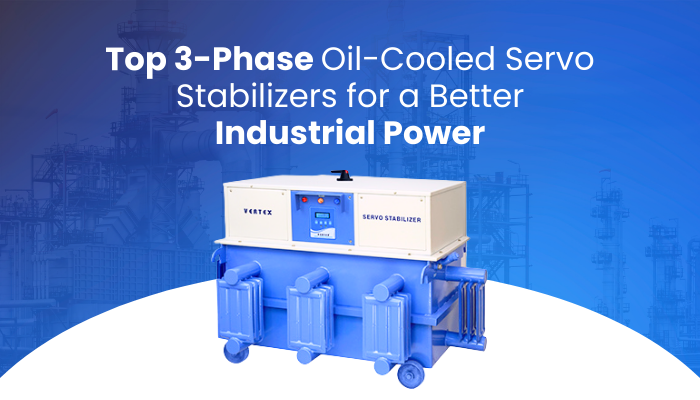
An oil cooled servo stabilizer uses transformer oil as a cooling medium. The oil absorbs heat generated during voltage regulation and distributes it evenly, ensuring efficient cooling. These stabilizers are ideal for high-load industrial applications and operate effectively in challenging environmental conditions.
Key Features of Oil Cooled Stabilizers
- Superior heat dissipation capacity
- Ideal for high-capacity industrial loads
- Continuous heavy-duty performance
- Durable and long-lasting design
- Suitable for harsh industrial environments
Industrial Applications of Oil Cooled Stabilizers
- Steel and cement manufacturing units
- Large textile mills and spinning units
- CNC machining centers and automotive plants
- Pharmaceutical industries
- Large commercial and industrial complexes
- Power-intensive manufacturing plants
Advantages of Oil Cooled Stabilizers
- Can handle higher KVA capacities (100 KVA – 5000+ KVA)
- Minimal risk of overheating during continuous operation
- Reduced maintenance frequency with proper oil monitoring
- Long operational life of 15–20 years in industrial conditions
Introduction to Air Cooled Stabilizers
An air cooled servo stabilizer relies on ambient air circulation and built-in cooling fans to dissipate heat. Air cooled stabilizers are compact, cost-effective, and suitable for medium-capacity loads, making them ideal for small to medium industrial and commercial setups.
Key Features of Air Cooled Stabilizers
- Lightweight and compact design
- Easy installation and maintenance
- Energy-efficient operation for moderate loads
- Cost-effective solution for small and medium industries
- Reliable protection against voltage fluctuations
Industrial Applications of Air Cooled Stabilizers
- Small and medium manufacturing units
- IT offices, server rooms, and data centers
- Hospitals, clinics, and laboratories
- Printing and packaging units
- Commercial complexes and office buildings
Advantages of Air Cooled Stabilizers
- Lower upfront investment compared to oil cooled stabilizers
- Minimal maintenance and easy servicing
- Suitable for environments with moderate heat load
- Ideal for intermittent and medium-capacity electrical loads
Oil Cooled vs Air Cooled: Comparison Table
Feature | Oil Cooled Stabilizer | Air Cooled Stabilizer |
Cooling Mechanism | Transformer oil (heat absorption) | Ambient air & internal fans |
Load Capacity | High (100 KVA – 5000+ KVA) | Medium/Low (5 KVA – 500 KVA) |
Durability | High; built for harsh conditions | Moderate; built for indoor/clean environments |
Heat Dissipation | Excellent | Moderate |
Maintenance | Requires oil quality/level checks | Minimal (cleaning fans/dusting) |
Footprint | Larger floor space required | Compact and space-saving |
Best For | Heavy manufacturing, CNC, Steel plants | Hospitals, IT Parks, Printing units |
Which Stabilizer is Better for Industrial Use?
Choose Oil Cooled Stabilizer If:
- Your industry operates 24/7 with continuous load
- You have heavy industrial machinery (CNC, steel, textile motors)
- The environment is hot, dusty, or harsh
- You need long-term durability and minimal operational downtime
- High KVA capacity is required
Choose Air Cooled Stabilizer If:
- You have medium or light industrial loads
- Budget is limited or upfront investment is a consideration
- Space is restricted for installation
- Machinery runs intermittently or has low power requirements
- You need a compact and economical solution
Benefits of Using Industrial Servo Stabilizers
1. Equipment Protection
Servo stabilizers prevent machinery damage caused by voltage spikes, sags, and surges, safeguarding expensive industrial equipment.
2. Enhanced Productivity
Stable voltage ensures continuous industrial operation, reducing downtime and improving production efficiency.
3. Energy Efficiency
A best servo voltage stabilizer in India reduces energy wastage and enhances overall power efficiency.
4. Cost Savings
Proper voltage regulation minimizes maintenance and repair costs, resulting in substantial long-term savings.
5. Electrical Safety
Protects workers and equipment from electrical hazards and ensures compliance with safety standards.
Factors to Consider Before Buying a Stabilizer
- Load Capacity – Ensure the stabilizer can handle total connected load plus a safety margin.
- Input Voltage Range – Choose stabilizers that can tolerate expected fluctuations.
- Cooling Type – Decide between oil cooled or air cooled based on load, environment, and budget.
- Voltage Regulation Accuracy – Industrial stabilizers should maintain accuracy.
- Protection Features – Look for overload protection, surge protection, phase failure detection, and thermal safety.
- Manufacturer Reliability – Partner with a trusted servo stabilizer manufacturer for quality and after-sales support.
- Maintenance Requirements – Consider how frequently the stabilizer needs servicing.
- Space & Installation – Oil cooled stabilizers need more space; air cooled stabilizers are compact.
- Cost vs ROI – Higher upfront investment in oil cooled stabilizers often results in better long-term savings.
- Warranty & Service – Ensure the manufacturer provides comprehensive warranty and AMC options.
Industrial Applications for Oil & Air Cooled Stabilizers
- Manufacturing & CNC Units: Protect machines from voltage fluctuation
- Textile Mills & Spinning Units: Ensure motor consistency and production efficiency
- Hospitals & Healthcare: Safeguard MRI, CT, and life-saving equipment
- Data Centers & IT Parks: Prevent server failure and data loss
- Printing & Packaging Industries: Maintain operational quality and efficiency
- Commercial Complexes: Stabilize elevators, lighting, and HVAC systems
FAQ
- What is the main difference between oil cooled and air cooled stabilizers?
The primary difference lies in the cooling medium. Oil cooled stabilizers use transformer oil to dissipate heat, making them suitable for heavy loads, while air cooled stabilizers use internal fans and ambient air for smaller to medium loads.
- Which stabilizer is better for a CNC machine?
An oil cooled servo stabilizer is generally recommended for CNC machining centers due to their high precision requirements and the heavy-duty nature of the operation.
- Does an air cooled stabilizer require more maintenance?
No. Air cooled stabilizers actually require less maintenance because they don’t need oil level checks or filtration. You only need to ensure the fans are clean and the vents are free of dust.
- Can I install an oil cooled stabilizer indoors?
Yes, but they require a larger footprint and proper ventilation to ensure the heat dissipated from the oil doesn’t overheat the room.
- How long do these stabilizers last?
A high-quality servo voltage stabilizer in India can last 15–20 years (oil cooled) or 10–15 years (air cooled), depending on maintenance and usage conditions.
- Which cooling type is more cost-effective?
Air cooled stabilizers have a lower upfront investment, making them economical for small businesses. However, oil cooled units offer a better long-term ROI for heavy industries.
- Are oil cooled stabilizers safe for the environment?
Modern stabilizers use high-grade transformer oil, but they do require proper handling to prevent leaks. Air cooled units are considered “greener” as they use no fluids.
- What KVA range is typical for air cooled models?
They are generally used for loads between 5 KVA and 500 KVA. Beyond that, oil cooling becomes necessary to manage the heat.
- Do these stabilizers protect against lightning strikes?
While they include surge protection, a dedicated lightning arrestor is usually recommended for complete protection against direct strikes.
- Why is ±1% accuracy important for industries?
Most industrial equipment, especially pharmaceutical industries and textile mills, is designed for a specific voltage. Accuracy ensures the machinery runs at peak efficiency without overheating.