
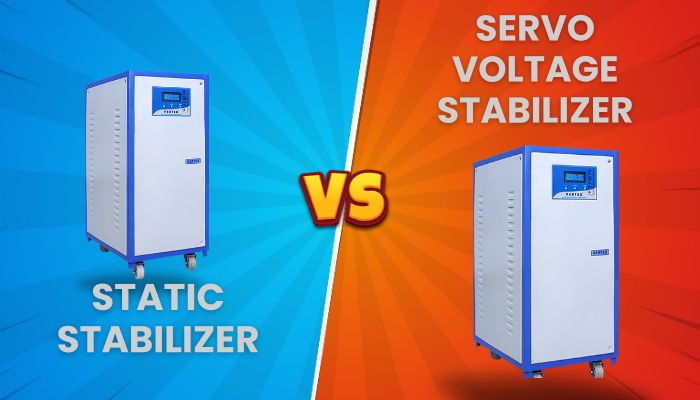
In the modern industrial landscape, “dirty power” is a silent killer of expensive machinery. Whether you are running a high-end medical diagnostic center, a textile mill, or a sophisticated data center, the stability of your voltage determines the lifespan of your equipment. When looking for a robust power solution, you will likely encounter two dominant technologies: the static stabilizer and the servo voltage stabilizer.
While both devices serve the same ultimate purpose—correcting voltage fluctuations—their internal mechanisms, response speeds, and ideal applications differ significantly. As a leading servo stabilizer manufacturer, we understand that making the right choice between these two can save your business lakhs in maintenance costs. In this guide, we break down the key differences to help you decide which technology suits your specific needs.
What is a Servo Voltage Stabilizer?
The servo-controlled stabilizer has been the industry workhorse for decades. It is an electromechanical device that utilizes a motor-driven system to regulate voltage.
How it Works
A servo voltage stabilizer consists of a buck-boost transformer, a variac (autotransformer), and a servo motor controlled by an electronic circuit. When the input voltage fluctuates, the control circuit detects the change and triggers the servo motor to move a carbon brush along the windings of the variac. This physical movement adjusts the voltage to the desired output level.
Because of this mechanical movement, servo stabilizer manufacturers in India often recommend these units for heavy-duty industrial loads where high inrush currents are common.
What is a Static Stabilizer?
The static stabilizer represents the next generation of voltage regulation. Unlike its servo counterpart, it contains no moving parts. Instead, it uses purely electronic components to achieve stabilization.
How it Works
Instead of a motor and a carbon brush, a static stabilizer uses high-speed Insulated Gate Bipolar Transistors (IGBTs) and Pulse Width Modulation (PWM) technology. It “adds” or “subtracts” voltage electronically in real-time. Because there is no mechanical friction or inertia to overcome, the correction speed is nearly instantaneous. This makes it a favorite among servo voltage stabilizer suppliers catering to ultra-sensitive laboratory and IT equipment.
Key Differences: Static vs. Servo Technology
To truly understand which unit fits your facility, we must compare them across several critical performance metrics.
1. Correction Speed (Response Time)
This is the most significant differentiator.
Servo: Since it relies on a physical motor moving a brush, it has a correction speed of roughly 20V to 40V per second.
Static: Because it is entirely electronic, a static stabilizer can correct voltage at speeds exceeding 500V to 1000V per second. If your facility experiences “flicker” or micro-second transients, static is the clear winner.
2. Maintenance Requirements
Servo: Moving parts mean wear and tear. The carbon brushes and the servo motor require periodic inspection and replacement.
Static: With zero moving parts, a static stabilizer is virtually maintenance-free, provided the cooling fans are kept clean.
3. Precision and Accuracy
Most servo stabilizer manufacturers in chennai provide units with ±1% accuracy. Static units also offer ±1% accuracy, but they provide a much smoother waveform correction without the mechanical “overshoot” that can sometimes happen with motors.
4. Reliability and Lifespan
While static units seem superior, the servo voltage stabilizer is famously rugged. In harsh Indian industrial environments—where dust, heat, and high humidity are prevalent—a servo unit often proves more resilient than delicate power electronics.
Comparison Table: At a Glance
| Feature | Servo Voltage Stabilizer | Static Voltage Stabilizer |
| Technology | Electromechanical (Motorized) | Solid State (IGBT/PWM) |
| Moving Parts | Yes (Motor, Brushes) | No |
| Correction Speed | Slow (Milliseconds to Seconds) | Ultra-Fast (Micro-seconds) |
| Efficiency | High (96-98%) | Very High (98-99%) |
| Maintenance | Periodic (Brush/Motor check) | Negligible |
| Ideal Load | CNC, Motors, Large Factories | Medical, IT, Labs, Robotics |
Choosing the Right Manufacturer in India
India’s power grid presents unique challenges, from neutral-line shifts to extreme brownouts. Therefore, your choice of a servo stabilizer manufacturer is just as important as the technology itself.
Why Chennai is a Hub for Power Solutions
If you are looking for high-quality engineering, servo stabilizer manufacturers in chennai are known for their stringent quality control and adherence to international electrical standards. Chennai’s industrial corridor, featuring automobile and electronics giants, has driven local manufacturers to innovate rapidly, creating stabilizers that can withstand 24/7 operations in tropical heat.
Applications: Where Should You Use Which?
When to Choose a Servo Stabilizer
You should consult with servo stabilizer manufacturers in India for a servo unit if you are dealing with:
Large Industrial Motors: The heavy startup torque of industrial motors is handled perfectly by the rugged transformers in a servo unit.
CNC Machining Centers: These require high precision but also generate significant electrical noise that servo units can withstand.
Textile and Flour Mills: Dusty environments where sensitive electronics might fail.
When to Choose a Static Stabilizer
A static stabilizer is the preferred choice for:
Medical Imaging (MRI/CT Scanners): These machines cannot tolerate even a millisecond of voltage fluctuation.
Data Centers: Where servers require ultra-pure power.
High-End Printing Presses: Where precision timing is dictated by voltage consistency.
How to Evaluate Servo Voltage Stabilizer Suppliers
When vetting servo voltage stabilizer suppliers, look beyond the price tag. Consider these factors:
Winding Material: Ensure they use 100% electrolytic grade copper.
Protection Suite: Does the unit include high/low voltage cutoff, overload protection, and single-phase prevention?
After-Sales Support: Since a servo voltage stabilizer has moving parts, ensure the supplier has a service team in your city.
Conclusion
The battle between static stabilizer and servo technology doesn’t have a single winner—it depends on your specific application. If speed and zero maintenance are your priorities, go static. If you need a cost-effective, rugged workhorse for a factory floor, a unit from a reputable servo stabilizer manufacturer is your best bet.
Whatever your choice, ensure you partner with experienced servo voltage stabilizer suppliers who understand the nuances of the Indian power grid. Stable voltage isn’t just a technical requirement; it is the foundation of your business’s operational continuity.