
Introduction
This is exactly where a main line stabilizer earns its reputation as the smartest single investment an Indian industrial or commercial operator can make. Installed at the incoming power supply point the main line protects every piece of equipment downstream simultaneously. Whether you are looking at a main line stabilizer 3kVA for a small business or a heavy-duty 3 phase main line stabilizer for a large factory, the principle is the same: stabilize once at the source, protect everything downstream.
The damage this does is not always dramatic. Sometimes it is a CNC machine throwing a random fault. Sometimes it is a server rebooting unexpectedly. Sometimes it is a motor winding burning out after months of running on undervoltage. And sometimes when a spike arrives without warning it is an entire production line going dark. The common thread in all these incidents is a power supply that was never properly conditioned at the entry point of the building or facility.
What Is a Main Line Stabilizer and How Does It Differ from a Regular Stabilizer?
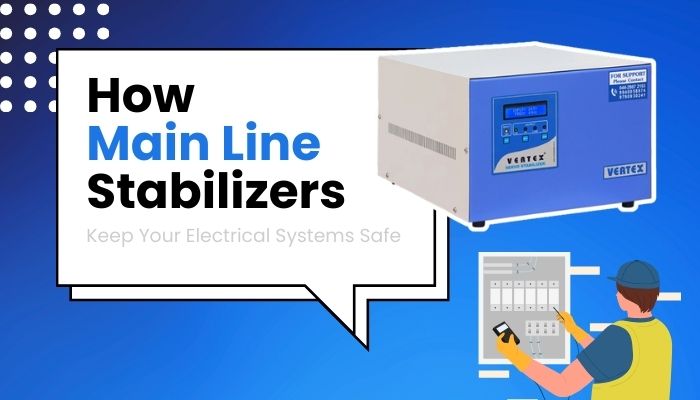
Most people are familiar with the small stabilizers placed behind refrigerators or air conditioners. These are point-of-use stabilizers that protect a single appliance. A main line stabilizer, by contrast, is installed at the main distribution board or at the point where electricity enters the premises. It conditions the entire incoming supply before it is distributed to individual circuits, sub-boards, and connected loads.
This distinction matters enormously in an industrial or large commercial setting. Instead of buying and maintaining a dozen individual stabilizers for individual machines, a single well-sized best main line stabilizer in India handles the job for the entire facility. The result is uniform power quality across every outlet, socket, panel, and machine with a single point of monitoring and maintenance rather than a scattered collection of units.
Technically, a main line stabilizer uses either a servo motor-driven variac mechanism or a relay/IGBT switching mechanism to sense deviations in input voltage and correct them before they reach the load. Servo-type units offer smooth, continuous correction and tighter regulation (typically ±1%), making them the preferred choice for sensitive industrial loads. The voltage stabilizer 5kVA 90V for main line copper variants built with copper windings for lower losses and longer life are particularly popular for medium-load commercial setups in India where input voltages can dip as low as 90 volts during peak agricultural pumping seasons.
Understanding Capacities: 3kVA, 5kVA, 10kVA, 15kVA and Three-Phase Options
Main Line Stabilizer 3kVA For Small Businesses and Residences
A main line stabilizer 3kVA is designed for premises with a connected load of up to approximately 2.4 kW at unity power factor, or 3 kVA of apparent power. This covers small shops, clinics, boutique offices, and medium-sized residences with multiple appliances. The 3 kVA rating accommodates the simultaneous operation of computers, fans, lights, a small AC unit, and a few other loads without overloading. These units typically handle an input range of 90V to 270V and deliver a stabilized 230V output, making them reliable even in areas with frequent low-voltage problems.
Main Line Stabilizer 5kVA The Most Popular Commercial Choice
The main line stabilizer 5kVA price segment is the most competitive and widely purchased category in India’s commercial stabilizer market. A 5 kVA unit comfortably handles small to medium commercial establishments, diagnostic centers, restaurants, mid-sized offices, retail stores, and two-to-three floor residential buildings. The voltage stabilizer 5kVA 90V for main line copper specification indicates a unit wound with copper conductors (rather than aluminium) and rated to work even when input voltage falls to 90V, a crucial feature for premises in semi-urban or rural grid areas where low voltage is chronic.
10kVA Stabilizer for Main Line Voltage Light Industrial Grade
When the connected load exceeds what a 5 kVA unit can handle, the 10kVA stabilizer for main line voltage steps in. This capacity range covers small manufacturing units, large commercial buildings, hotels, educational institutions, and mid-sized healthcare facilities. Ten kVA units are often available in both single-phase and three-phase configurations, with air cooling or oil cooling depending on the installation environment. They form the bridge between commercial-grade and industrial-grade power conditioning.
Main Line Stabilizer 15kVA Mid-Scale Industrial Power
A main line stabilizer 15kVA is the entry point into serious industrial power conditioning. These units handle medium-scale manufacturing facilities, large hospitals, commercial complexes with lifts and heavy HVAC systems, and data center antechambers. Three-phase 15 kVA units with oil-cooled designs are particularly effective in environments where continuous heavy loading and high ambient temperatures make thermal management a priority. They typically offer a wide input range of 85V to 270V per phase with output maintained at 415V ±1%.
Three-Phase Main Line Stabilizer Industrial Backbone
For facilities running three-phase motors, industrial presses, compressors, large HVAC systems, and production equipment, a 3 phase main line stabilizer is not optional, it is essential. Three-phase units balance the load across all three phases while simultaneously correcting voltage on each, preventing the phase imbalance that is a leading cause of three-phase motor burnouts in Indian industrial environments. Available from 15 kVA to several hundred kVA, three-phase main line stabilizers are the backbone of reliable power distribution in Indian factories, textile mills, food processing plants, and engineering workshops.
Main Line Stabilizer Capacity Comparison Table
Use this quick-reference table to match your facility’s requirements with the right main line stabilizer specification:
| Model / Capacity |
Input Range |
Output Voltage |
Cooling Type |
Phase | Best For |
|---|---|---|---|---|---|
| 3 kVA Main Line | 90V – 270V | 230V ±1% | Air Cooled | Single | Small shops, homes |
| 5 kVA Main Line | 90V – 270V | 230V ±1% | Air Cooled | Single | Offices, clinics |
| 10 kVA Main Line | 90V – 270V | 230V ±1% | Air / Oil | Single / 3-Ph | Small factories |
| 15 kVA Main Line | 85V – 270V | 415V ±1% | Air / Oil | 3-Phase | Mid-scale industry |
| 25–50 kVA | 80V – 270V | 415V ±1% | Oil Cooled | 3-Phase | Large plants |
| 100 kVA & above | Custom range | Custom output | Oil / ONAN | 3-Phase | Heavy industry |
How to Connect a Stabilizer to the Main Line
Understanding how to connect a stabilizer to the main line is important both for facility managers commissioning a new installation and for procurement teams evaluating the installation complexity. The basic principle is straightforward: the main line stabilizer is wired in series with the incoming supply, between the energy meter output and the main distribution board (MDB).
Step 1 Location Selection: Mount the stabilizer as close to the main incomer as possible, in a well-ventilated space with adequate clearance on all sides for heat dissipation. Oil-cooled units should be installed on a firm, level surface capable of bearing their weight.
Step 2 Incoming Wiring: The output of the energy meter (or the main incoming MCCB, whichever is the entry point) is connected to the stabilizer’s input terminals. For single-phase units, this is the phase and neutral. For a 3 phase main line stabilizer, all three phases and the neutral are connected to the input side.
Step 3 Outgoing Wiring: The stabilizer’s output terminals feed the main distribution board. From the MDB, power is distributed to sub-circuits as normal. This means the stabilizer sits transparently in the supply chain and every downstream load receives stabilized voltage without any change to existing wiring beyond the MDB.
Step 4 Earthing: Proper earthing of the stabilizer cabinet is mandatory. A dedicated earth connection from the stabilizer chassis to the facility’s earthing system prevents shock hazards and ensures the correct operation of protection devices within the stabilizer.
Step 5 Testing: Before energizing connected loads, test the output voltage at no load and at full load. Verify that the stabilizer’s output regulation meets specification and that protection functions over-voltage cut-off, under-voltage cut-off, and thermal protection are operational. Reputable manufacturers of the best main line stabilizer in India provide commissioning checklists and technical support for this process.
The Real Cost of Not Installing a Main Line Stabilizer
Many facility owners delay investing in a main line stabilizer because they do not perceive an immediate crisis. The voltage fluctuates, equipment occasionally trips or faults, productivity dips but nothing has completely failed yet. This reasoning ignores the cumulative, compounding cost of operating sensitive equipment on unregulated power.
Equipment Degradation: Motors running on undervoltage draw higher current to maintain torque, causing additional I²R heating in windings. Over time this degrades insulation and causes premature winding failure. A 10kVA stabilizer for main line voltage that costs a fraction of a motor rewind prevents these losses entirely.
Production Downtime: Every time a CNC machine, injection molding press, or packaging line trips due to a voltage fault, production stops. The cost of downtime, idle labour, missed delivery windows, restart time typically dwarfs the cost of the stabilizer many times over in a single incident.
IT and Electronics Losses: Servers, PLCs, SCADA systems, and industrial computers are particularly vulnerable to voltage spikes. A single unprotected transient can corrupt hard drives, damage power supplies, or destroy control boards. Replacing a PLC or a server is far more expensive than installing the best main line stabilizer in India that would have prevented the damage.
Fire Risk: Overvoltage conditions can cause overheating in wiring and electrical components. This is a genuine fire risk, particularly in older industrial buildings with aging wiring. A main line stabilizer with over-voltage cut-off eliminates this hazard at the source.
Energy Waste: Equipment operating on fluctuating voltage has lower efficiency; it consumes more energy to do the same work. Stable voltage from a main line stabilizer 15kVA or larger unit reduces energy consumption and lowers electricity bills, providing a return on investment that is measurable on the monthly utility statement.
What to Look for When Buying: Key Features and Selection Criteria
Not all main line stabilizers deliver equal performance. When evaluating options whether a main line stabilizer 3kVA for a small shop or a large 3 phase main line stabilizer for a plant these are the technical and commercial factors that separate a good investment from a costly mistake:
Input Voltage Range: Verify that the stabilizer’s rated input range covers the actual voltage extremes at your location. In areas with chronic low voltage, units rated down to 90V or even 80V are essential. The voltage stabilizer 5kVA 90V for main line copper specification specifically addresses the 90V lower limit requirement common in rural and semi-urban Indian installations.
Output Regulation Accuracy: Servo-type stabilizers achieve ±1% regulation, which means a 230V output varies by only ±2.3V. Relay-type units typically achieve ±4 to ±6%. For sensitive equipment, medical devices, precision instruments, CNC controllers servo-type regulation is the only acceptable choice.
Winding Material: Copper windings have lower resistance, higher conductivity, and better thermal performance than aluminium. Always specify copper windings when purchasing, as aluminium is sometimes used to reduce manufacturing cost without obvious external difference. The voltage stabilizer 5kVA 90V for main line copper designation explicitly confirms copper winding construction.
Correction Speed: Servo-type stabilizers correct at approximately 15 to 25 volts per second. This is fast enough for most industrial loads but should be verified against your specific load’s tolerance for transient voltage excursions.
Protection Features: Essential protections include over-voltage and under-voltage output cut-off (to disconnect load if input is beyond the stabilizer’s correction range), thermal protection, short circuit protection, and phase failure protection on three-phase units. Verify that bypass switches are included for maintenance without supply interruption.
Certification and Warranty: Look for BIS certification (IS 9815 or IS 1205 as applicable), ISO 9001 quality management certification from the manufacturer, and a minimum warranty period of two years. Reputable suppliers of the best main line stabilizer in India provide factory test reports with every unit.
Price vs. Total Cost of Ownership: The main line stabilizer 5kVA price from different manufacturers can vary significantly. Evaluate not just the purchase price but also the expected maintenance cost, energy efficiency (a lower-efficiency stabilizer wastes energy continuously), and the manufacturer’s service network and parts availability in your region.
Conclusion
Whether your requirement is a compact main line stabilizer 3kVA for a neighbourhood clinic, a main line stabilizer 5kVA price-conscious solution for a mid-sized office, a 10kVA stabilizer for main line voltage for a light industrial unit, or a heavy-duty 3 phase main line stabilizer for a large factory floor the return on this investment is measurable in avoided downtime, reduced maintenance costs, extended equipment life, and lower energy bills.
The smartest power decision Indian industries can make is not to replace failed equipment after a voltage event, it is to prevent that event from happening in the first place. That is precisely what the best main line stabilizer in India does, every minute of every operating day.
FAQ
1. What is a main line stabilizer and why is it better than individual unit stabilizers?
A main line stabilizer is installed at the incoming power supply point of a building or facility, conditioning the entire supply before it is distributed to individual circuits. Unlike individual unit stabilizers that protect a single appliance, a main line stabilizer protects every connected load simultaneously with a single device reducing cost, simplifying maintenance, and ensuring uniform power quality throughout the premises.
2. What is the right capacity 3kVA, 5kVA, 10kVA, or 15kVA for my premises?
Add up the total connected load in kVA across all circuits you want to protect, then add a 25 to 30 percent margin for safety and future growth. A main line stabilizer 3kVA suits small establishments with limited loads. A main line stabilizer 5kVA covers most medium commercial setups. A 10kVA stabilizer for main line voltage serves light industrial and large commercial users, and a main line stabilizer 15kVA handles mid-scale industrial facilities.
3. What does ‘5kVA 90V for main line copper’ mean?
This specification describes a voltage stabilizer 5kVA 90V for main line copper that is rated at 5 kVA capacity, can operate correctly even when input voltage is as low as 90 volts, is designed for main line (whole-premises) installation, and is wound with copper conductors. Copper winding is important because it offers lower resistance, better thermal performance, and a longer operational lifespan compared to aluminium alternatives.
4. How do I connect a stabilizer to the main line safely?
Understanding how to connect a stabilizer to the main line safely requires a licensed electrician. The process involves connecting the energy meter or incomer output to the stabilizer’s input terminals, and wiring the stabilizer’s output to the main distribution board. Proper earthing of the stabilizer cabinet is mandatory. All connections should be made with appropriately rated cables, and the unit should be tested at no load before energising connected equipment.
5. Is a 3-phase main line stabilizer necessary if I already have single-phase stabilizers on individual machines?
Individual machine stabilizers protect only the specific machine they are connected to and do nothing for control panels, lighting, HVAC, or other three-phase infrastructure. A 3 phase main line stabilizer corrects voltage and balances all three phases simultaneously at the source, eliminating phase imbalance, one of the leading causes of three-phase motor burnouts in Indian industry and providing protection for every connected load in a single solution.
6. What is the typical input voltage range supported by main line stabilizers in India?
Most main line stabilizers sold in India support an input range of 90V to 270V for single-phase units and 280V to 470V (line-to-line) for three-phase units. Premium units designed for severely fluctuating grid areas can handle inputs as low as 80V. Always verify that the stabilizer’s rated input range covers the actual extremes measured at your incoming supply point before purchase.
7. What protections should a main line stabilizer have?
A quality main line stabilizer whether a main line stabilizer 5kVA or a large industrial unit should include output over-voltage cut-off, output under-voltage cut-off, thermal overload protection, short circuit protection, a manual bypass switch for maintenance, and on three-phase units, phase failure and phase sequence protection. LED or LCD indicators for input/output voltage and load status are also important for operational monitoring.
8. How does a main line stabilizer help reduce electricity bills?
Equipment operating on fluctuating voltage, particularly motors and compressors draws more current to compensate for low voltage, increasing energy consumption. A stable, correct voltage from the best main line stabilizer in India allows equipment to operate at its designed efficiency point, reducing wasted energy. In facilities with large motor loads, this efficiency gain can produce measurable reductions in monthly electricity consumption.
9. What is the difference between a servo-type and relay-type main line stabilizer?
A relay-type stabilizer switches between fixed transformer taps in discrete steps, typically correcting in increments of 5 to 10 volts with a brief output interruption at each step. A servo-type stabilizer uses a servo motor-driven variac to correct voltage continuously and smoothly, achieving ±1% regulation with no output interruption. For any load sensitive to voltage steps CNC machines, computers, medical equipment servo-type is the only appropriate choice, and it is what reputable manufacturers of the best main line stabilizer in India typically recommend for industrial applications.
10. Where can I find reliable main line stabilizers with good after-sales service in India?
India has several established manufacturers of main line stabilizers across all capacity ranges. When selecting a supplier, look for BIS and ISO certifications, copper winding construction, a comprehensive warranty of at least two years, availability of service engineers in your region, and the ability to provide custom specifications for non-standard requirements. The main line stabilizer 5kVA price and main line stabilizer 15kVA options available from quality manufacturers include factory test reports, installation manuals, and dedicated technical support all of which are important for a long and trouble-free installation life.