

Introduction
Voltage fluctuations are one of the most silent yet damaging problems faced by industries, commercial establishments, and manufacturing units across India. You might not always notice a sudden spike or dip in your power supply, but your machines definitely feel it. Over time, inconsistent voltage causes overheating, component failure, and even permanent damage to expensive equipment.
This is where a servo voltage stabilizer steps in as your first line of defense. Unlike conventional stabilizers, servo-based systems use advanced motor control technology to correct voltage levels in real time, ensuring a clean and consistent power supply to your connected machines. Whether you run a textile unit, a data center, a hospital, or a manufacturing plant, having a reliable stabilizer is not a luxury — it is a necessity.
In this guide, we break down exactly how servo stabilizers work, why they outperform other options, and what you should look for when choosing from the best servo voltage stabilizer suppliers in India.
How Does a Servo Voltage Stabilizer Actually Work?
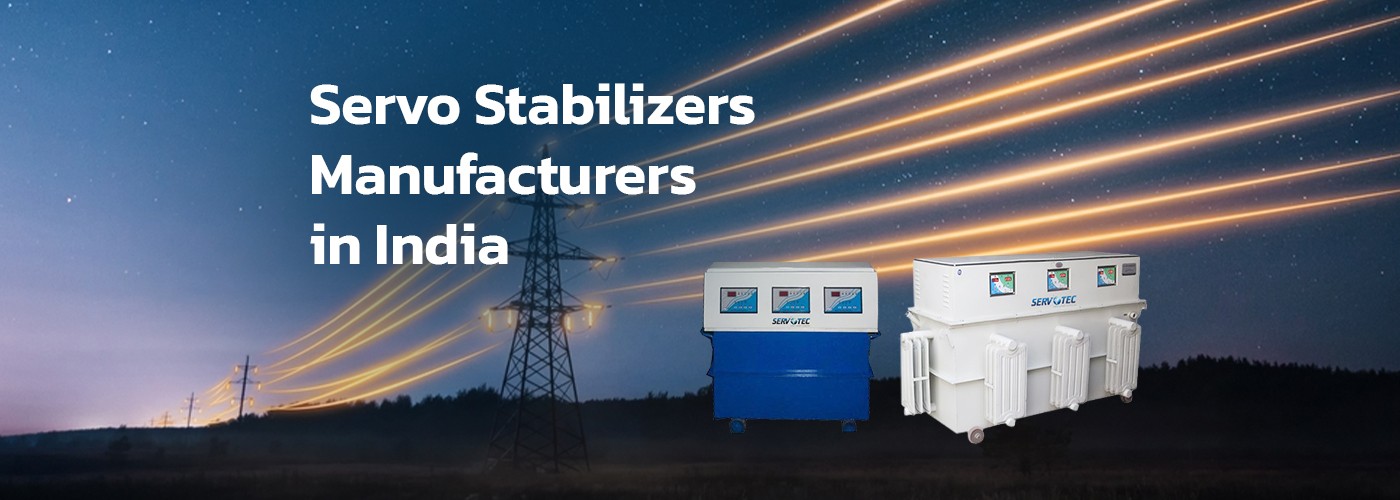
At the heart of every servo controlled voltage stabilizer is a servo motor — a precision-controlled motor that continuously adjusts the output voltage based on real-time input measurements. The entire mechanism operates through a closed-loop feedback system that is constantly monitoring the incoming supply.
Step-by-Step Operation
Here is how the process unfolds from input to output:
- The voltage sensing circuit continuously monitors the incoming AC supply.
- If a deviation is detected — either a surge or a sag — the control circuit activates the servo motor.
- The servo motor adjusts the position of a carbon brush on an auto-transformer (variac).
- This mechanical correction changes the transformer ratio and restores the output to a stable, preset voltage level.
- The correction happens in milliseconds, making the response virtually instantaneous from the machine’s perspective.
This real-time mechanical feedback loop is what sets the electronic servo voltage stabilizer apart from relay-type or static stabilizers. It does not rely on fixed tapping switches; instead, it provides a continuously variable correction that is far more accurate.
Types of Voltage Fluctuations a Servo Stabilizer Can Handle
Not all power problems are the same. A quality servo motor voltage stabilizer is engineered to handle a wide spectrum of power quality issues that plague Indian industries:
1. Voltage Surges and Spikes
Sudden increases in voltage — often caused by lightning strikes, utility switching, or heavy load switching — can destroy sensitive components in milliseconds. A servo stabilizer clamps these surges before they reach your equipment.
2. Voltage Sags and Brownouts
When voltage drops below the nominal level for an extended period, motors overheat, compressors stall, and digital controls malfunction. Servo stabilizers compensate for these dips by boosting the output voltage automatically.
3. Sustained Over-Voltage
Prolonged high voltage accelerates insulation breakdown and reduces the lifespan of motors, transformers, and electronic components. The servo mechanism trims excess voltage with precision.
4. Under-Voltage Conditions
In areas with weak grid supply, under-voltage is a chronic issue. The automatic servo voltage stabilizer boosts incoming voltage to the rated output, even when the grid supply falls significantly below normal — in many cases, handling input ranges as wide as 170V to 470V.
Which Industries Benefit Most from Servo Voltage Stabilizers?
The application range of a servo stabilizer is remarkably wide. Any industry that depends on precision machinery or sensitive electronics stands to gain significantly:
- Textile and garment manufacturing units where spindle motors demand stable voltage
- CNC machining centers and tool rooms where precision is non-negotiable
- Printing and packaging industries that use high-speed automated lines
- Hospitals and diagnostic centers protecting life-critical medical equipment
- IT parks and data centers maintaining uptime and server health
- Cold storage and refrigeration plants where compressor motors need consistent power
- Plastic injection molding and rubber processing units
- Pharmaceutical manufacturing with stringent equipment reliability requirements
Whether you need a 3 phase servo controlled voltage stabilizer for heavy industrial loads or a single-phase unit for office setups, there is a servo solution matched to your requirement.
| Feature | Servo Stabilizer | Relay Type Stabilizer |
Static Stabilizer |
|---|---|---|---|
| Voltage Correction | Continuous / Stepless | Step-by-step | Electronic switching |
| Response Speed | Very Fast (milliseconds) |
Moderate | Fast |
| Accuracy | +/- 1% | +/- 5-10% | +/- 2-3% |
| Input Voltage Range | 170V – 470V (wide) | Limited range | Moderate range |
| Suitable Load | All load types | Light to medium | Electronic loads |
| Efficiency | 98%+ | 90-95% | 95-97% |
| Cost | Moderate to high | Low | High |
| Lifespan | 15-25 years | 5-10 years | 10-15 years |
| Maintenance | Minimal (brush check) | Regular relay checks | Low |
Key Features to Look for When Choosing a Servo Stabilizer
Not all stabilizers are built the same. When evaluating products from different servo controlled voltage stabilizer suppliers, here are the critical specifications you must compare:
Wide Input Voltage Range
The broader the input range, the more useful the stabilizer is in areas with severe grid fluctuations. A good unit handles input ranging from 170V to 470V for three-phase systems.
Output Voltage Accuracy
Look for stabilizers that maintain output accuracy within +/- 1%. This is especially critical for CNC machines, medical equipment, and laboratory instruments.
Capacity and Load Rating
Servo stabilizers are available from as small as 1 KVA all the way up to 2000 KVA and beyond. A 15KVA servo controlled voltage stabilizer is a popular choice for medium-scale industrial and commercial setups. Always calculate your connected load before selecting capacity.
Protection Features
The best servo stabilizers include built-in protections such as:
- Over-voltage and under-voltage trip
- Short-circuit protection
- Overload protection
- Input and output fuses
- Time-delay relay to prevent rapid reconnection
Cooling Mechanism
Air-cooled units are suitable for most applications, while oil-cooled servo stabilizers are preferred for higher capacities and outdoor or harsh environments.
How to Choose the Right Servo Voltage Stabilizer Supplier in India
Choosing the right product is only half the battle. The supplier you work with determines after-sales support, warranty terms, and the overall reliability of the equipment. Here is what separates great servo voltage stabilizer suppliers in India from the rest:
- Proven track record with verifiable installations across industries
- In-house manufacturing with proper quality testing before dispatch
- ISI mark certification and compliance with IS 9815 standards
- Availability of spare parts and on-site service support
- Transparent technical specifications without hidden compromises
- Customization options for non-standard voltage requirements
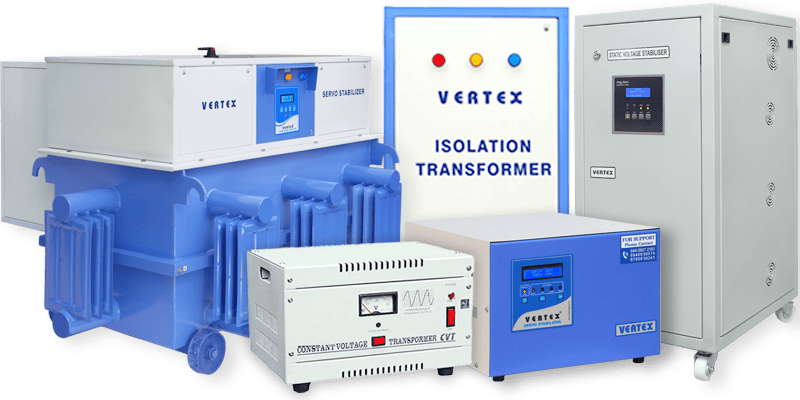
One name that consistently appears among the most trusted automatic servo voltage stabilizer suppliers in India is Vertex Power. With deep expertise in power conditioning equipment and a product range that covers single-phase and three-phase servo stabilizers from 1 KVA to 2000 KVA, they are a supplier that industries across India rely on.
Installation, Maintenance, and Long-Term Care of Servo Stabilizers
A servo stabilizer is a robust piece of equipment, but like any electromechanical system, it requires periodic attention to deliver its best performance over the long term.
Installation Best Practices
- Always install the stabilizer on a firm, level surface with adequate ventilation clearance.
- Ensure the input and output wiring is of proper gauge to handle the rated current.
- Use a proper earthing connection to protect against leakage faults.
- Allow a few minutes of no-load startup before connecting critical equipment.
Routine Maintenance Tips
- Inspect carbon brushes every 6 to 12 months and replace them when worn beyond the minimum length.
- Clean the interior of the stabilizer cabinet to remove dust accumulation from ventilation slots.
- Test bypass switch functionality periodically.
- Check terminal connections for tightening and signs of overheating.
With proper care, a quality electronic servo voltage stabilizer can deliver reliable performance for 15 to 25 years, making it an outstanding long-term investment for any facility.
Conclusion
Voltage fluctuations are an unavoidable reality across India’s power grid, particularly for industries operating in Tier-2 cities, industrial zones, and semi-urban areas. Investing in a servo voltage stabilizer is not just about protecting your equipment — it is about protecting your productivity, your profitability, and your operational continuity.
From single-phase systems for small setups to heavy-duty 3 phase servo controlled voltage stabilizer solutions for large manufacturing plants, today’s servo stabilizer technology delivers precision, speed, and reliability that no other voltage conditioning technology can match.
When selecting from servo voltage stabilizer suppliers in India, prioritize quality certifications, technical support, and customization capability. Vertex Power remains a benchmark in this space, offering products and service that match the demands of modern Indian industries.
FAQ
1. What is the main function of a servo voltage stabilizer?
A servo voltage stabilizer continuously monitors incoming voltage and uses a servo motor-controlled auto-transformer to correct any deviations, delivering a stable and accurate output voltage to connected equipment.
2. How is a servo stabilizer different from a relay-type stabilizer?
A relay-type stabilizer corrects voltage in fixed steps using switching relays, which means the output is never perfectly accurate. A servo stabilizer provides stepless, continuous correction with accuracy typically within +/- 1%, making it far superior for sensitive loads.
3. Can a servo stabilizer handle both over-voltage and under-voltage?
Yes. A servo stabilizer is designed to handle a wide input voltage range — correcting both surges (over-voltage) and sags (under-voltage) within its specified range, typically 170V to 470V for three-phase systems.
4. What capacity servo stabilizer do I need for my industry?
The capacity depends on your total connected load in KVA. Add up the KVA rating of all connected equipment, add a 20-25% safety margin, and select the nearest standard capacity. A 15KVA servo controlled voltage stabilizer is commonly used for medium commercial and light industrial applications.
5. Is a servo stabilizer suitable for three-phase industrial loads?
Absolutely. A 3 phase servo controlled voltage stabilizer is specifically designed to handle three-phase industrial loads and can correct voltage imbalances across all three phases simultaneously.
6. How often do carbon brushes in a servo stabilizer need replacement?
Carbon brushes typically last 1 to 3 years depending on operating hours and load conditions. Regular inspection every 6 to 12 months is recommended, and replacement should happen before the brush wears below the manufacturer’s minimum length.
7. Can servo stabilizers be used outdoors?
Standard servo stabilizers are designed for indoor installation. For outdoor or harsh environments, oil-cooled and weather-proof enclosure variants are available from quality suppliers.
8. What protection features should a good servo stabilizer have?
A reliable automatic servo voltage stabilizer should include over-voltage and under-voltage protection, short-circuit protection, overload protection, and a time-delay relay to prevent equipment damage from rapid reconnection.
9. Why should I prefer a servo stabilizer over a static stabilizer?
While static stabilizers are faster electronically, they are more expensive and less effective with purely resistive or inductive loads like motors. Servo stabilizers are more cost-effective, handle a wider load variety, and deliver excellent accuracy for most industrial applications.
10. Where can I find reliable servo voltage stabilizer suppliers in India?
You can find trusted servo voltage stabilizer suppliers in India by looking for manufacturers with ISI certification, a verifiable track record, and strong after-sales support. Vertex Power is one such established name offering a comprehensive range of servo stabilizers for industrial, commercial, and institutional applications.