
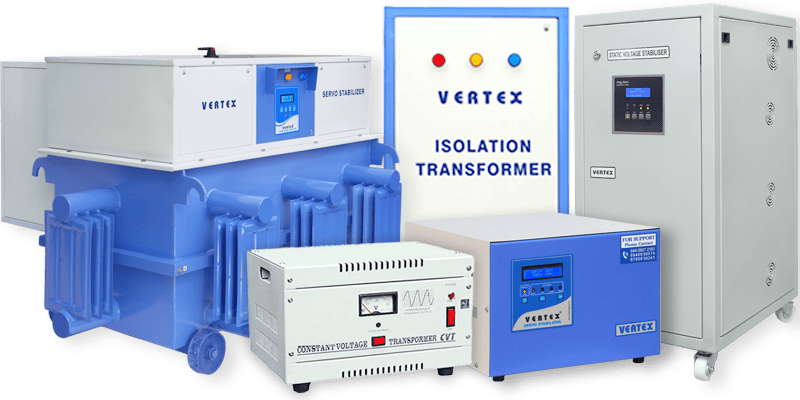


Introduction
Power quality is one of the most critical yet frequently overlooked factors that directly impacts the lifespan and performance of industrial machinery and electronic equipment. Voltage fluctuations, sags, and surges cause millions of rupees in equipment damage every year across Indian industries. The single most reliable and cost-effective solution to this problem is a servo voltage stabilizer, a precision device that automatically maintains a steady output voltage regardless of how erratically the supply fluctuates.
Whether you manage a textile mill, a hospital, a CNC workshop, a printing plant, or a large commercial complex, a servo-controlled voltage stabilizer protects every connected load from the silent but constant damage caused by voltage instability. Vertex Power, a leading servo stabilizer manufacturer based in India, offers a complete range of units from 10 KVA to 500 KVA built to industrial-grade standards and available at direct factory prices, shipped to your facility without middlemen.
What Is a Servo Voltage Stabilizer and How Does It Work?
A servo voltage stabilizer is an electromechanical device that uses a motorized variac (auto-transformer) controlled by a servo motor and an electronic control circuit to maintain a precise, steady output voltage. Unlike conventional relay-based stabilizers that switch between fixed voltage steps, the servo mechanism provides truly continuous, stepless voltage correction, delivering output accuracy within ±1% regardless of how wide the input fluctuation is.
Core Working Mechanism
The electronic sensing circuit constantly monitors the incoming supply voltage. The moment it detects a deviation, whether it is a dip, a surge, or a slow drift, it commands the servo motor to rotate the variac in the corrective direction. The variac adjusts the transformer tap in real time, raising or lowering the secondary voltage until the output returns to the set value. This entire correction cycle happens within one to two cycles of the supply frequency, making it practically instantaneous from the perspective of connected equipment.
Because the correction is mechanical and continuous, a servo-controlled voltage stabilizer handles wide input ranges, typically 260V to 470V for three-phase industrial models while always delivering a rock-solid 415V (or 220V for single-phase) at the output terminals.
Why Industrial Facilities Need an Automatic Servo Stabilizer
The Indian power grid, particularly in industrial zones, is subject to extreme fluctuations depending on the time of day, season, and local load conditions. An automatic servo stabilizer is not a luxury for these environments it is a fundamental requirement for protecting capital equipment and maintaining production continuity.
Equipment Protection
Motors, drives, CNC machines, medical imaging equipment, and data servers are all designed to operate within a narrow voltage window. Operating even 10% outside that window accelerates insulation degradation, increases winding temperature, and causes premature bearing failure. A quality industrial servo stabilizer eliminates these conditions, extending equipment life by years and drastically reducing unplanned downtime.
Energy Efficiency
When motors and drives operate at an incorrect voltage, they draw more current to compensate, resulting in higher energy losses and heat generation. By maintaining the correct voltage, the best servo stabilizer actually reduces your energy consumption. Studies consistently show 3% to 8% energy savings after installation in plants that previously had an unregulated supply.
Compliance and Safety
Many industrial certifications and equipment warranties explicitly require that equipment be operated within specified voltage limits. Installing an automatic servo stabilizer ensures your facility stays compliant and protects warranty coverage on expensive machinery.
Servo Voltage Stabilizer 10 KVA to 500 KVA Capacity Range & Application Guide
Selecting the right capacity is as important as selecting the right type. Undersizing leaves equipment unprotected; oversizing wastes capital and space. Vertex Power, your trusted servo stabilizer supplier, manufactures units across the full industrial spectrum from 10 KVA to 500 KVA, with both single-phase and three-phase configurations available.
| KVA Rating | Phase | Input Voltage Range | Output Voltage | Ideal Application |
|---|---|---|---|---|
| 10 KVA | Single / Three Phase | 300V – 470V | 415V ± 1% | Small Industries, Offices |
| 25 KVA | Three Phase | 300V – 470V | 415V ± 1% | Textile Machinery, Pumps |
| 50 KVA | Three Phase | 300V – 470V | 415V ± 1% | CNC Machines, Lifts |
| 100 KVA | Three Phase | 280V – 470V | 415V ± 1% | Hospitals, Data Centers |
| 200 KVA | Three Phase | 280V – 470V | 415V ± 1% | Manufacturing Plants |
| 300 KVA | Three Phase | 260V – 470V | 415V ± 1% | Steel & Metal Industries |
| 500 KVA | Three Phase | 260V – 470V | 415V ± 1% | Heavy Industrial Complexes |
All models listed above are manufactured and tested at the Vertex Power facility before dispatch. As a direct servo stabilizer manufacturer, the company offers these units without distributor markups, ensuring you receive the best available servo stabilizer price in the market along with full documentation, test certificates, and post-installation support.
Three-Phase Servo Voltage Stabilizer: Built for Heavy Industrial Demands
The servo voltage stabilizer 3-phase is the backbone of power protection for heavy industry. Three-phase industrial equipment, including large motors, compressors, injection molding machines, press machines, and rolling mills, is far more sensitive to phase-voltage imbalance than single-phase equipment. Even a small imbalance across phases causes disproportionate current imbalance, overheating, and mechanical stress.
The three-phase industrial servo stabilizer from Vertex Power uses three independent servo correction channels, one per phase, to regulate each phase individually. This ensures that even if only one phase dips or surges, correction happens precisely without disturbing the other phases. This architecture is critical in industries such as cold storage, chemicals, pharmaceuticals, and food processing, where unbalanced supply directly impacts product quality and equipment reliability.
Key Technical Features of the 3-Phase Range
The three-phase servo voltage stabilizer 3 phase units from Vertex Power incorporate oil-cooled or air-cooled configurations depending on capacity, motorized ball-bearing variac drives for low maintenance, digital microcontroller-based sensing circuits with adjustable set points, input and output MCB protection, overload and short-circuit protection, and LCD digital meters displaying both input and output voltages across all three phases simultaneously.
Why Buy Direct from a Servo Stabilizer Manufacturer at Factory Price?
Purchasing a servo voltage stabilizer through multiple distribution layers adds 15% to 30% to the end price without adding any value to the product itself. Vertex Power, as a direct manufacturer and servo stabilizer supplier, passes all those savings directly to you, the end buyer.
Advantages of Buying Factory-Direct
When you work with servo stabilizer dealers who are also the manufacturer, you gain access to custom specifications tailored to your exact load requirements, shorter lead times because there is no intermediary handling the order, direct technical support from the engineers who designed and built the unit, and complete traceability of components and test results. For large orders above 100 KVA, factory visits for factory acceptance testing (FAT) can be arranged, something only direct manufacturers can facilitate.
The servo stabilizer price at the factory level is also transparent. You receive a detailed bill of materials and specification sheet with every quotation, so you know exactly what you are paying for; there are no hidden margins or unnecessary accessories bundled into the price.
How to Select the Best Servo Stabilizer for Your Application
Choosing the best servo stabilizer for your facility involves evaluating five key parameters: total connected load in KVA or KW (with a 20% safety margin added), supply voltage range in your area (request local utility data or use a data logger), phase configuration (single or three phase), correction speed requirement (critical for sensitive electronics versus general motors), and ambient conditions such as temperature, humidity, and altitude.
Cooling Type: Oil-Cooled vs Air-Cooled
For capacities up to 50 KVA, air-cooled servo-controlled voltage stabilizer units are generally preferred due to lower weight, easier maintenance, and no risk of oil leakage. For capacities of 100 KVA and above, especially in outdoor or non-air-conditioned environments, oil-cooled units provide superior thermal performance, lower losses, and a longer service life. Vertex Power offers both configurations across the full 10 KVA to 500 KVA range.
Conclusion
Voltage instability is a problem that does not announce itself it silently degrades equipment, inflates energy bills, and shortens the productive life of every motor, drive, and electronic system in your facility. A properly sized servo voltage stabilizer is the most effective and economical solution available, and when purchased directly from a trusted servo stabilizer manufacturer like Vertex Power, it is also one of the best-value investments you can make in plant infrastructure.
With a full range from 10 KVA to 500 KVA, both single-phase and servo voltage stabilizer 3 phase models, oil-cooled and air-cooled options, and factory-direct pricing, Vertex Power is the one-stop source for all your power protection needs. Contact the team today for a free load survey, technical consultation, and the most competitive servo stabilizer price available in India.
FAQ
1. What is the difference between a servo voltage stabilizer and a relay-type stabilizer?
A relay-type stabilizer corrects voltage in discrete steps using electromagnetic relays, which means the output is never perfectly constant it oscillates between voltage bands. A servo voltage stabilizer uses a motorized variac for continuous, stepless correction, achieving output accuracy within ±1%, which is far superior for sensitive industrial and electronic loads.
2. What input voltage range does the servo stabilizer handle?
Most industrial servo stabilizer units from Vertex Power handle an input range of 260V to 470V (three-phase) and 170V to 270V (single phase), delivering a steady, regulated output throughout that entire range. Wider input range models are available on request for areas with severe supply problems.
3. Is a three-phase servo voltage stabilizer suitable for unbalanced loads?
Yes. The three-phase servo voltage stabilizer 3 phase design from Vertex Power uses independent per-phase correction, which means it handles both balanced and unbalanced loads effectively. Each phase is regulated independently, preventing imbalance from propagating through your distribution network.
4. How long does installation take for a 100 KVA to 500 KVA unit?
A standard installation by a qualified electrical contractor typically takes four to eight hours for units up to 200 KVA, and one to two days for 300 KVA to 500 KVA units, depending on site conditions and the complexity of the existing distribution panel. Vertex Power provides complete wiring diagrams and commissioning guidance.
5. What maintenance does an automatic servo stabilizer require?
An automatic servo stabilizer requires periodic cleaning of the variac carbon brush contact, inspection of the servo motor drive belt or coupling, verification of input/output voltage calibration, and, for oil-cooled units, an annual check of the oil level and dielectric strength. Vertex Power provides detailed maintenance schedules with every unit delivered.
6. Can I get a servo stabilizer manufactured to a custom specification?
Yes. As a direct servo stabilizer manufacturer, Vertex Power can produce units to custom input voltage ranges, output voltages other than standard 415V/220V, special enclosure ratings (IP54, IP55 for outdoor use), and communication interfaces such as RS485 or BMS integration. Custom orders typically ship within three to four weeks.
7. What is the typical efficiency of an industrial servo stabilizer?
High-quality industrial servo stabilizer units operate at 97% to 98.5% efficiency across the load range. This means energy losses are minimal, typically less than the savings achieved through improved equipment efficiency at the correct operating voltage.
8. Do servo stabilizers protect against power surges and spikes?
A servo-controlled voltage stabilizer provides excellent protection against slow voltage fluctuations and sustained overvoltages. For fast transient spikes (lightning, switching transients), an additional surge protection device (SPD) is recommended. Vertex Power can supply SPD panels as optional accessories.
9. What certifications do Vertex Power servo stabilizers carry?
Vertex Power servo voltage stabilizer units are manufactured in compliance with IS 9815 (the relevant Indian Standard for voltage stabilizers) and are tested per IEC 60076 for transformer components. Units above 100 KVA are dispatched with individual test certificates covering voltage regulation, efficiency, temperature rise, and insulation resistance.
10. How do I get the best servo stabilizer price from Vertex Power?
Contact Vertex Power directly at vertexpower.co.in with your load details, supply voltage range, phase configuration, and installation location. The technical team will send a detailed quotation with the most competitive servo stabilizer price. Bulk orders for multiple units attract additional factory discounts.