

In heavy industries, power quality is directly tied to your bottom line. Industrial plants run on massive three-phase electrical systems that feed delicate CNC machinery, automated production lines, heavy foundries, and medical imaging devices. A simple 5% drop or spike in line voltage can degrade microprocessors, cause insulation breakdown in motors, or trigger immediate system shutdowns.
An industrial-grade three-phase servo voltage stabilizer is your line of defense against these operational disruptions. Ranging from 3 kVA to 2000 kVA, these specialized systems provide continuous, distortion-free voltage correction to ensure your plant operates without expensive maintenance interruptions.
This guide breaks down the core technology, engineering parameters, and sizing protocols you must consider before deploying high-capacity three-phase systems.
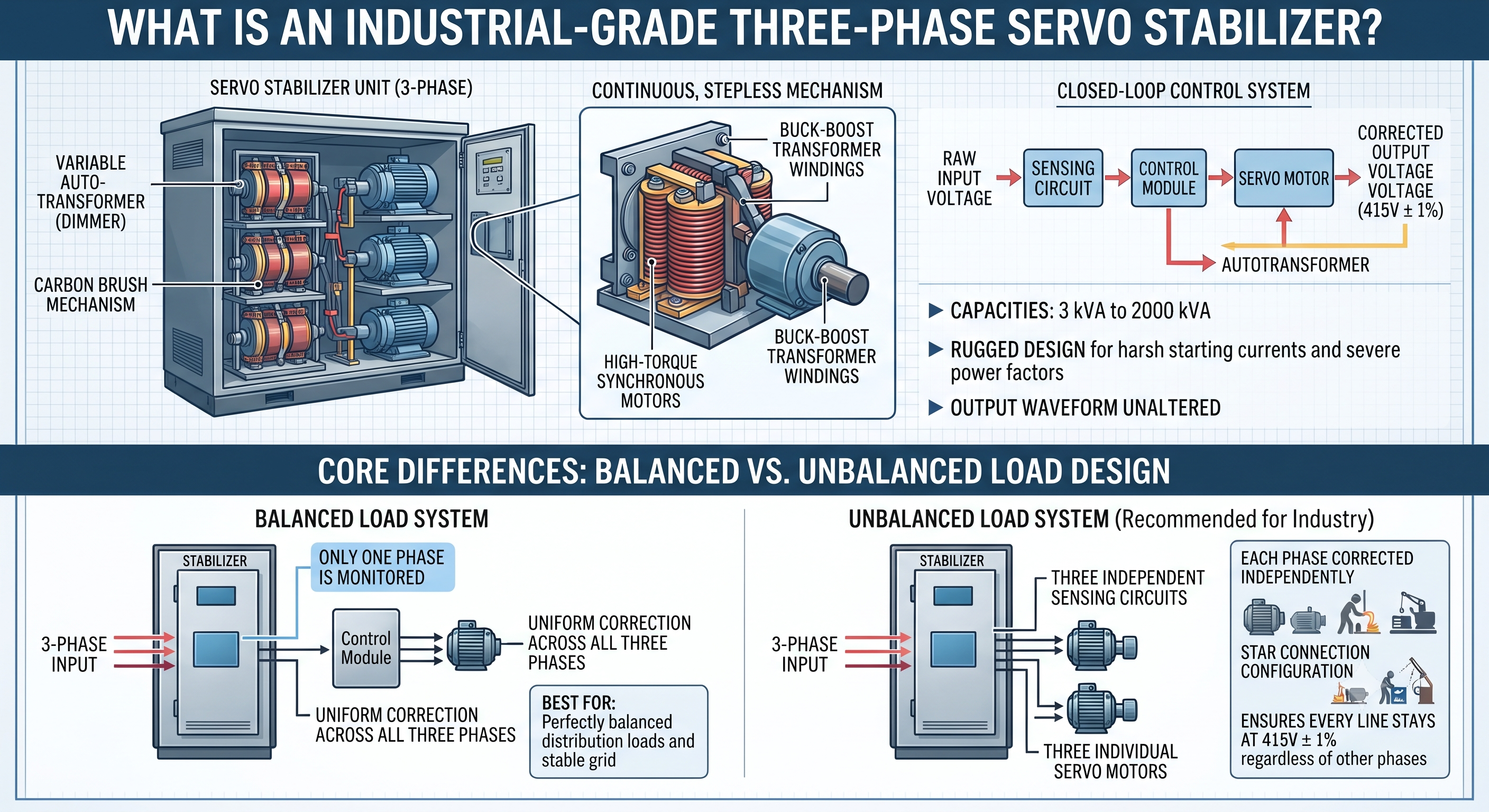
Unlike residential click-and-switch relay stabilizers, an industrial servo-controlled voltage stabilizer uses a continuous, stepless mechanism. It continuously tracks the incoming raw voltage via a closed-loop control system. When fluctuations occur, the control module activates a high-torque AC synchronous motor. This motor repositions a carbon brush along a variable autotransformer (dimmer) to adjust the buck-boost transformer windings, correcting the output voltage back to its exact nominal value.
For capacities between 3 kVA and 2000 kVA, these setups are engineered specifically to absorb harsh starting currents and handle severe power factors without altering the output waveform.
Core Differences: Balanced vs. Unbalanced Load Design
When ordering a three-phase system, you must specify the architecture based on your plant’s internal wiring and power grid profile:
- Balanced Load Systems: In this configuration, only one single phase is actively monitored for incoming voltage errors. The corrective mechanism changes the voltage output uniformly across all three phases based on that single reference point. This system works well if your plant features perfectly balanced distribution loads and stable grid phase vectors.
- Unbalanced Load Systems (Recommended for Industry): In modern manufacturing, different machines turn on and off independently, creating uneven phase loads. In an unbalanced configuration, each of the three phases is corrected completely independently. It features three separate sensing circuits and three individual servo motors operating in a star connection configuration, ensuring every single line stays at 415V ± 1% regardless of what the other phases are doing.
Technical Specifications Matrix: 3 kVA to 2000 kVA
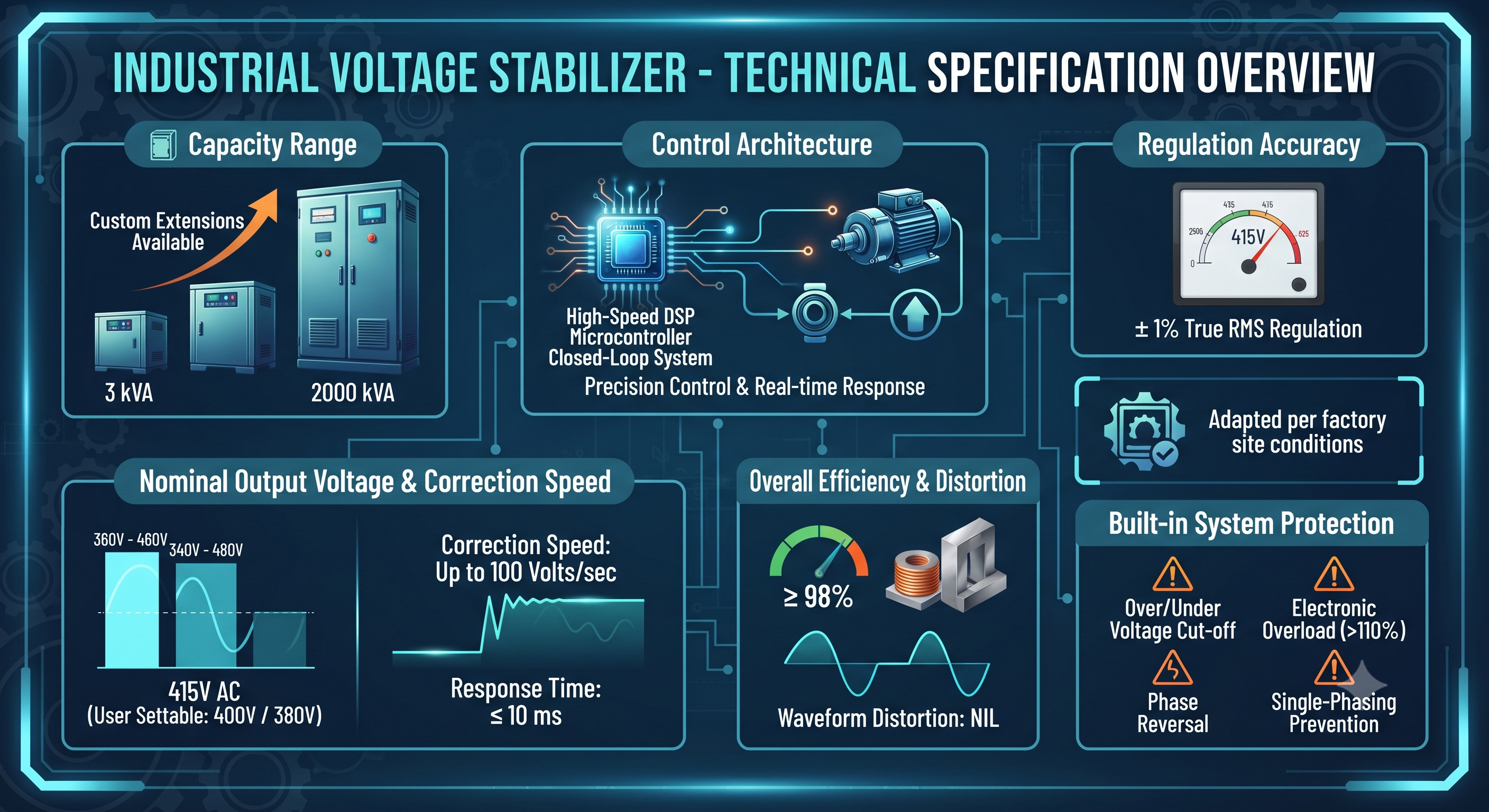
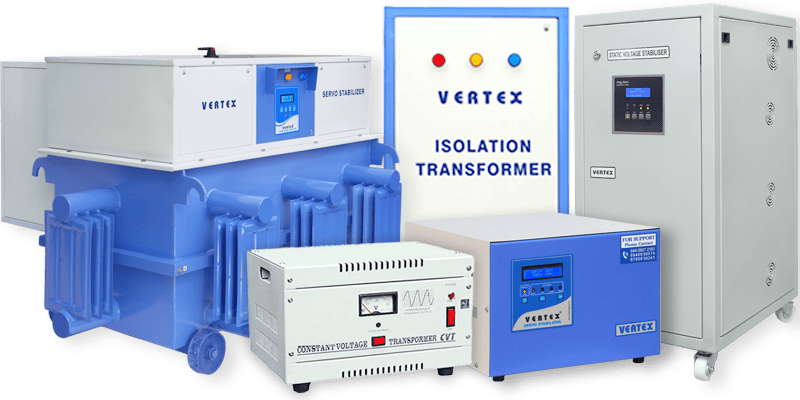
High-performance stabilizers, like the industrial configurations engineered by Vertex Power Solutions, align with the following premium engineering standards:
|
Technical Parameter |
Industrial Benchmark Specification |
|
Capacity Range |
3 kVA to 2000 kVA (Custom extensions above 2000 kVA available) |
|
Control Architecture |
High-Speed DSP Microcontroller Closed-Loop System |
|
Voltage Regulation Accuracy |
± 1% True RMS Regulation |
|
Input Voltage Windows |
360V – 460V | 340V – 480V | 300V – 480V (Customized per factory site) |
|
Nominal Output Voltage |
415 V AC (User Settable to 400 V or 380 V) |
|
Correction Speed |
Up to 100 Volts per second |
|
System Response Time |
≤ 10 milliseconds |
|
Overall Efficiency |
≥ 98% using high-grade CRGO laminations and electrolytic copper |
|
Waveform Distortion |
NIL (Output waveform matches pure input characteristics) |
|
Built-in System Protection |
Over/Under Voltage Cut-off, Electronic Overload (>110%), Phase Reversal, Single-Phasing Prevention |
Cooling Topology: Air-Cooled vs. Oil-Cooled
The cooling choice varies across the 3 kVA to 2000 kVA layout, deeply impacting the lifespan of your component coils:
Air-Cooled Servo Stabilizers (Typically 3 kVA to 100 kVA)
- Design: Uses natural convection or high-RPM exhaust fans to move ambient air across exposed coils.
- Best Fit: Ideal for indoor server rooms, corporate print machinery, standalone CNC controllers, and clean clinical imaging spaces.
- Pros: Compact footprint, lightweight, and requires simple dust cleaning maintenance intervals.
Oil-Cooled Servo Stabilizers (Typically 75 kVA to 2000 kVA)
- Design: The complete transformer assembly and regulatory components are submerged inside a rugged, sealed tank filled with high-dielectric transformer oil.
- Best Fit: Essential for large textile spinning mills, chemical foundries, heavy automobile press lines, or entire factory mainline installations.
- Pros: Superior thermal dissipation for continuous 24/7 heavy-duty operation. The sealed environment completely prevents the ingress of iron filings, carbon dust, conductive lint, and moisture from settling on active electrical elements.
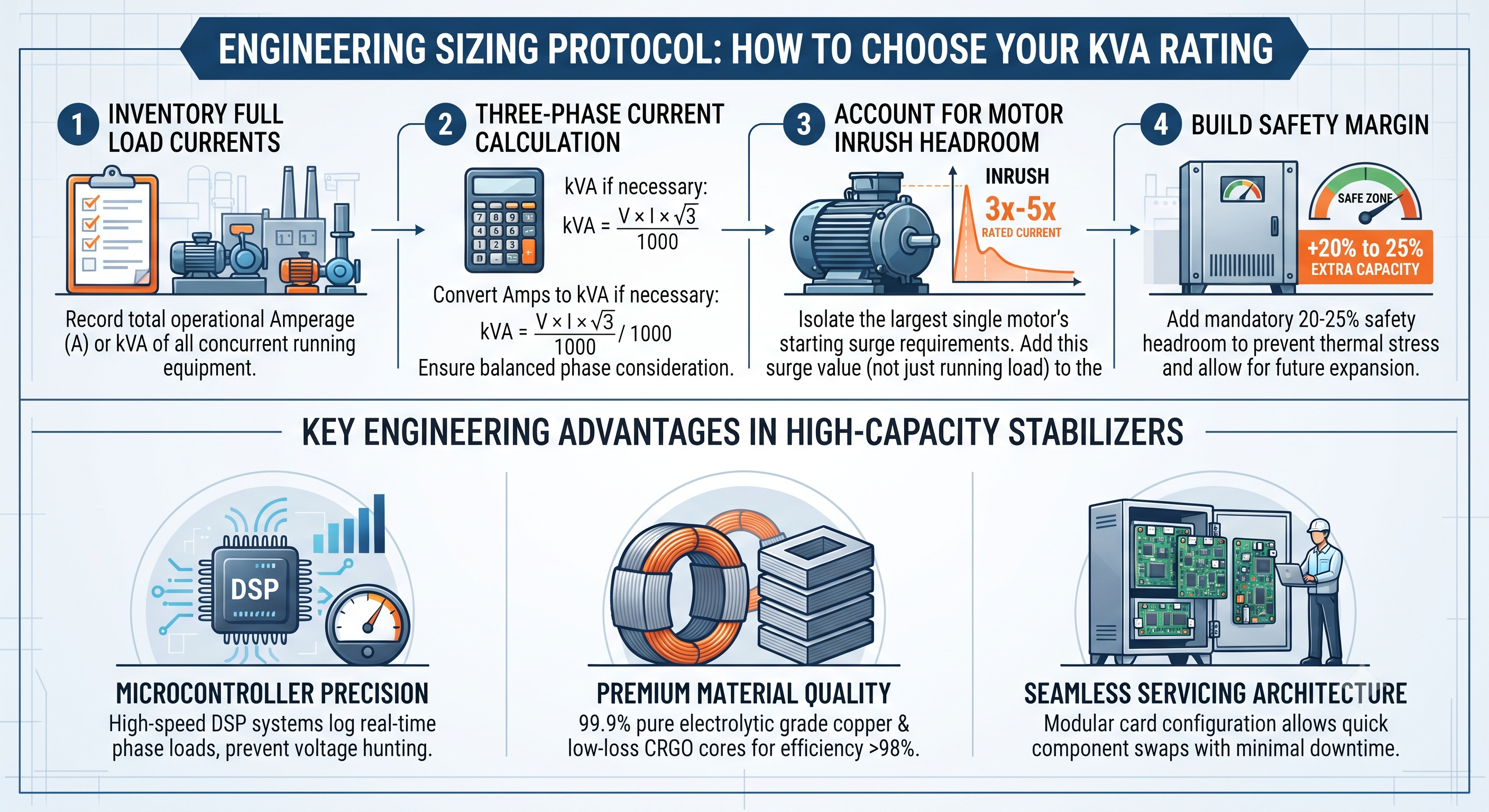
Never buy a stabilizer matching your running load exactly. Inductive loads like heavy electric motors, pumps, and compressors draw massive starting inrush currents (often 3x to 5x their rated current). To accurately size your three-phase stabilizer, apply this professional electrical step-by-step sizing model:
- Inventory Full Load Currents: Record the total operational Amperage or kVA of all machinery designed to run concurrently.
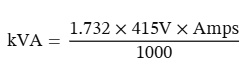
- Perform the Three-Phase Current Calculation: If your device ratings are explicitly stated in Amps, convert to kVA using the formula:
- Account for Motor Inrush Headroom: Isolate the single largest motor in your array. Add its specific starting surge requirements to the running total.
- Build Safety Margin: Factor in a mandatory 20% to 25% safety headroom margin. This prevents the stabilizer from running under high thermal stress and accommodates future plant expansion.
The Vertex Advantage in High-Capacity Engineering
Deploying an industrial voltage protection solution requires partnering with an experienced manufacturer. Vertex Power Solutions brings over 25 years of specialized field expertise to every three-phase configuration we build.
- Microcontroller Precision: All our units use high-speed DSP Microcontroller systems that log real-time phase loads and prevent voltage overshooting or hunt cycles.
- Premium Material Quality: We use 99.9% pure electrolytic grade copper wires combined with low-loss Cold-Rolled Grain-Oriented (CRGO) lamination cores, sustaining a true operational efficiency above 98%.
- Seamless Servicing Architecture: Designed for active factory lifespans, our stabilizers feature plug-and-play modular card configurations. If adjustments are needed, components can be swapped with minimal downtime without dismantling massive wire groupings.
Conclusion: Safeguard Your Industrial Bottom Line
In a competitive manufacturing landscape, operational efficiency is everything. Leaving your multi-million rupee CNC lines, heavy foundries, or automated textile looms unprotected against grid voltage anomalies is an expensive gamble. A minor electrical surge can wipe out productivity, compromise component tolerances, or cause catastrophic hardware failure.
Investing in a high-performance three-phase servo stabilizer from 3 kVA to 2000 kVA is not merely an equipment purchase—it is an insurance policy for your entire plant. Vertex Power Solutions combines over 25 years of engineering experience with a guaranteed >98% operational efficiency profile to deliver custom power conditioning systems that stand up to the most demanding industrial environments.
Review Technical Specifications: Browse our detailed Three-Phase Oil-Cooled Systems Catalog.
Industrial Servo Stabilizer Buying Guide: Frequently Asked Questions
How do I calculate the KVA rating for a 3-phase servo stabilizer?
To calculate the required kVA rating, multiply your total full load current (in Amperes) by the nominal phase voltage (415V) and 1.732, then divide by 1000. Finally, add a 20% to 25% safety headroom margin to safely handle initial motor starting inrush currents.
What is the difference between air-cooled and oil-cooled servo stabilizers?
Air-cooled servo stabilizers use cooling fans and are ideal for indoor, clean environments up to 100 kVA. Oil-cooled servo stabilizers submerge components in transformer oil for superior heat dissipation, making them essential for heavy-duty applications (up to 2000 kVA) in dusty, high-heat factories.
Why do three-phase servo stabilizers require an unbalanced load design?
An unbalanced load design uses three independent sensing circuits and separate motors to correct each phase individually. This is critical in factories where different machines run independently, ensuring all lines maintain a stable 415V output even if input phase voltage fluctuates unevenly.
Does a servo voltage stabilizer save electricity?
Yes, high-quality servo stabilizers save electricity by maintaining an optimal voltage window, which prevents industrial motors from overheating and drawing excess current. Vertex servo stabilizers utilize low-loss CRGO cores to achieve a certified energy efficiency rating of over 98%.
Can a 3-phase servo stabilizer work if the neutral wire is missing?
In unbalanced type three-phase stabilizers, a solid neutral connection is vital. Because each phase stabilizes independently between its respective line and neutral wire, an unstable or missing neutral can shift phase-to-neutral voltages and trigger trip safeties. If your factory grid completely lacks a neutral line, an Isolation Transformer must be introduced ahead of the stabilizer to recreate a stable star point.
What standard maintenance do these systems require?
Air-cooled models need periodic dust removal from vents and inspection of carbon brush wear. Oil-cooled models require simple yearly testing of the transformer oil’s dielectric strength (breakdown voltage value) to ensure moisture or contamination has not entered the tank shell.