

Industrial diesel generator (DG) sets are the ultimate line of defense when the main power grid fails. Manufacturing plants, modern multi-specialty hospitals, engineering foundries, and corporate data centers invest heavily in high-capacity generators to ensure operations continue running smoothly during unexpected blackouts.
However, switching your entire facility’s load onto a standby generator introduces a completely new set of power quality threats. Many facility managers mistakenly assume that because a generator features a built-in Automatic Voltage Regulator (AVR), the output electricity is perfectly safe for high-end machinery.
The reality? Standard generator power loops contain hidden, erratic voltage fluctuations that can quietly destroy your most expensive machinery. Here is a deep breakdown of why generator power behaves this way, the exact mechanical secrets behind how a servo system fixes it, and how a dedicated down-line stabilizer solves the problem permanently.
Why Industrial Generators Face Severe Power Risks?
While generators provide exceptional mechanical emergency energy, their electrical output undergoes severe strain during standard operational cycles. Unlike a massive utility grid, a generator is an isolated system that is highly vulnerable to internal load adjustments.
1. The Slow Response Time of Built-in AVRs
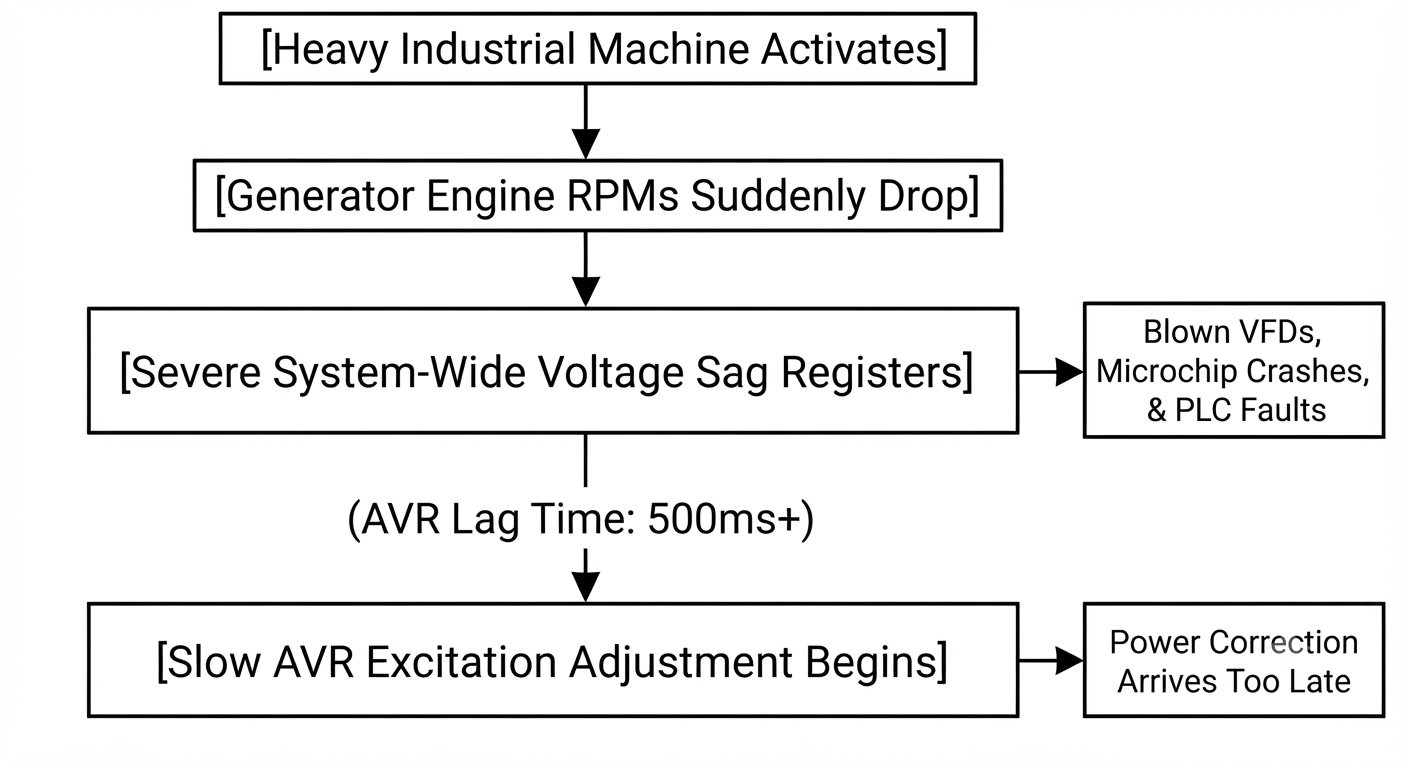
Every industrial generator includes an Automatic Voltage Regulator (AVR) designed to maintain a consistent output. However, an AVR corrects voltage by adjusting the generator’s internal magnetic field excitation. This loop features a slow response lag time—often taking anywhere from 500 milliseconds to multiple seconds to stabilize the line. During this window, your sensitive downstream equipment is completely exposed to extreme power surges or deep voltage drops.
2. Step-Load Sags and Engine Hunting
When heavy equipment (such as a large water pump, compressor, or CNC spindle motor) kicks in inside a generator loop, it demands a massive, sudden burst of starting current. This sudden load acts as a physical brake on the generator’s engine, causing its RPMs to drop instantly.
As the engine struggles to recover its operating speed—a phenomenon known as engine hunting—the voltage sags dramatically. Conversely, when that same heavy machine turns off, the engine overspeeds momentarily, sending a high-voltage surge running through the circuit that can easily fry microchips and VFD panels.
3. Waveform Distortion and Electrical Noise
Built-in AVRs can only regulate voltage; they have absolutely no control over electrical frequency or waveform purity. When the engine hunts under fluctuating loads, the frequency drifts away from its standard 50 Hz profile. This variation causes synchronized electric motors to run erratically and introduces severe harmonic distortion across your entire power distribution network, leading to unexplained data corruption and PLC logic errors.
The Definitive Solution: Dedicated Down-Line Servo Stabilizers
To successfully isolate your valuable machinery from erratic generator behaviour, installing a centralized Microcontroller-Based Servo Voltage Stabilizer immediately down-line from the generator’s main distribution breaker is the ultimate solution.
Instead of relying on the slow mechanical updates of the generator engine, a premium servo stabilizer acts as a high-speed electrical shield that stabilizes power and delivers steady voltage to your sensitive devices.
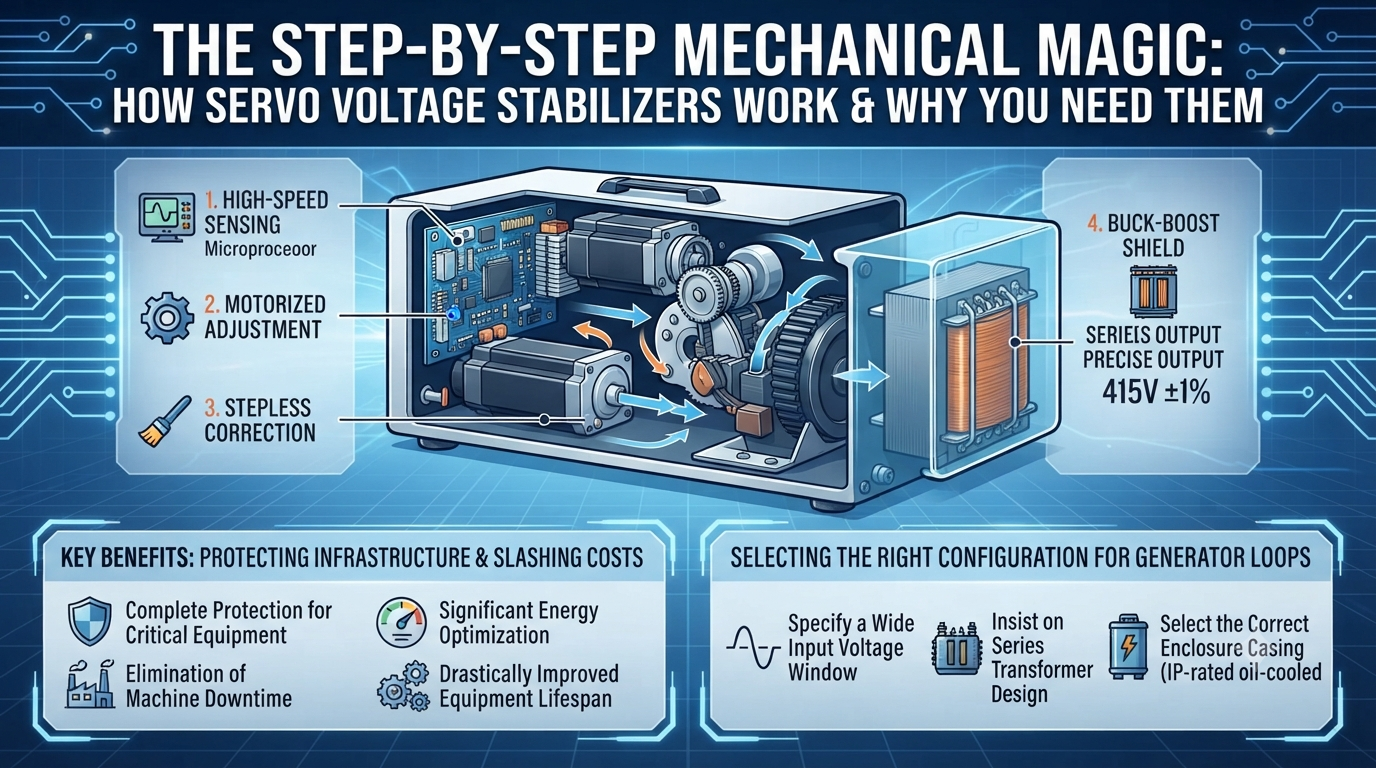
The Step-by-Step Mechanical Magic: How It Works
Unlike standard electronic or relay-type stabilizers that use rough step-switching, a servo voltage stabilizer utilizes a precise, motor-controlled system to track and smooth out incoming fluctuations:
- High-Speed Sensing: The microcontroller-based motherboard continuously monitors true RMS input and output voltages. If the incoming voltage from the generator drops or surges, the board registers the error instantly.
- Motorized Adjustment: The motherboard sends an immediate signal to a high-torque, precision servo motor connected via a heavy-duty gear mechanism.
- Stepless Correction: The servo motor smoothly glides a durable carbon brush across a variable autotransformer (variac). If the voltage is low, it moves forward to boost the line; if it is high, it moves in reverse to buck the voltage.
- The Buck-Boost Shield: This corrected voltage is fed into a heavy-duty series transformer (also called a buck-boost transformer). The series transformer actively adds or removes the voltage difference, delivering a highly accurate, continuous output of 415V (3-phase) or 230V (1-phase) with a tight regulation accuracy of ±1%.
Key Benefits: Protecting Infrastructure and Slashing Overhead Costs
By adding this precise down-line layer, you fundamentally alter the economics of your emergency power operations:
- Complete Protection for Critical Equipment: It shields your machinery from sudden overvoltage, undervoltage, short-circuits, and phase failure risks, preventing expensive component burnouts.
- Elimination of Machine Downtime: In high-precision environments like CNC shops or medical imaging labs, a momentary voltage sag triggers an emergency system trip. A servo stabilizer absorbs these sags, keeping your lines completely live.
- Significant Energy Optimization: Maintaining proper, flat voltage levels reduces internal electrical friction. Motors run significantly cooler, minimizing energy losses and stopping inductive components from drawing excess current.
- Drastically Improved Equipment Lifespan: By removing continuous electrical spikes and thermal shocks, a servo stabilizer extends the operational running life of your downstream automation arrays, compressors, and motor insulation layers.
Choosing the Right Configuration for Generator Loops
When deploying a stabilizer to interface with a diesel or gas generator, it is vital to select technical specifications that handle wide operational swings:
- Specify a Wide Input Voltage Window: Because generators create much wider voltage swings than standard utility lines, you must select a stabilizer with an expanded input window (such as 300V to 480V or 340V to 480V for 3-phase setups). This prevents the stabilizer from constantly triggering its internal safety cut-offs during minor engine drops.
- Insist on Series Transformer Design: Ensure the manufacturer utilizes a true series buck-boost transformer architecture rather than cheap double-winding autotransformers. Autotransformers degrade quickly under high generator strains, whereas series transformers offer massive long-term reliability.
- Select the Correct Enclosure Casing: If the stabilizer is being installed next to a generator in an open shed, garage, or outdoor area exposed to heat, exhaust soot, and dust, an oil-cooled stabilizer with a 100% sealed tank design is highly recommended. Air-cooled units are best restricted to clean, climate-controlled indoor closets.
The Vertex Advantage: Secure Your Backup Power Infrastructure
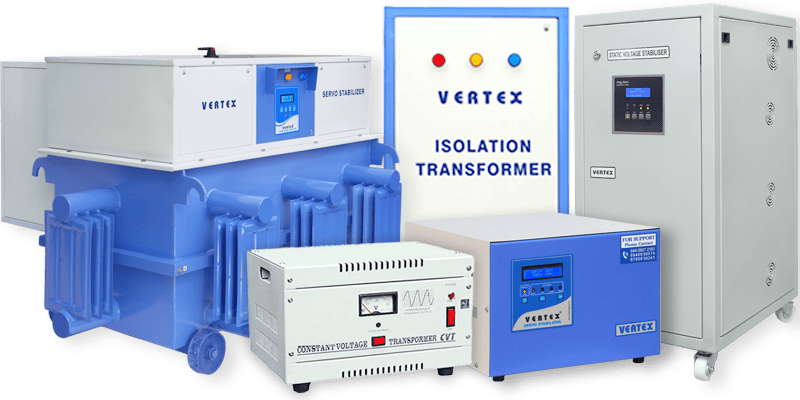
Integrating industrial generator power conditioning requires sophisticated engineering. Vertex Power Solutions designs high-capacity Three-Phase Servo Voltage Stabilizers built explicitly to manage the demanding electrical environments of generator loops.
Backed by a team of engineers with over 25 years of specialized manufacturing experience and 1,0,000 successful field installations across India, Vertex stabilizers utilize high-speed DSP microcontrollers to eliminate voltage hunting and overshooting. Running at a certified efficiency rating of >98%, our systems protect your equipment warranties while ensuring your emergency backup power stays fully optimized.
FAQ – Servo Voltage Stabilizers for Generators
1. Can I connect a servo voltage stabilizer to a diesel generator?
Yes, you can connect a servo voltage stabilizer directly downstream from a diesel generator. However, the stabilizer must be specifically configured with a broad input voltage window and compatible frequency tolerances to cleanly handle the sharp voltage swings caused by generator step-loading.
Does a diesel generator need a voltage stabilizer if it already has an AVR?
Yes, because built-in generator AVRs are designed for slow mechanical alternator excitation adjustment, not rapid chip safety. While a standard AVR takes several hundred milliseconds to correct voltage drops, a downstream Vertex Servo Stabilizer bridges this gap instantly, shielding sensitive CNCs and medical machinery from terminal voltage sags.
Can a voltage stabilizer correct generator frequency variations or drifts?
No, a conventional voltage stabilizer cannot correct frequency changes. Electrical frequency is entirely dependent on the physical rotational speed (RPM) of the generator’s engine. While a servo stabilizer completely fixes voltage drops, spikes, and surges, frequency variations must be addressed using a high-quality electronic engine governor on your DG set.
Why do lights flicker or machines trip when switching power to a generator?
When heavy inductive facility loads (like large compressors or central HVAC lines) kick in on a generator grid, they draw a massive burst of starting current. This acts as a physical brake on the engine, causing a momentary drop in engine RPMs (engine hunting) and severe system-wide voltage sags, which cause machinery controls to reset.
How do I size a servo voltage stabilizer for an industrial generator loop?
To safely handle dynamic load fluctuations, your down-line servo stabilizer should be sized with a minimum 20% to 30% safety headroom margin over your peak operational current draw. Never choose a stabilizer that matches your running current or breaker limit exactly, as it will experience extreme thermal stress during sudden step-load spikes.