


Introduction:
A step down transformer addresses this challenge directly. It converts a higher incoming voltage to a lower, usable output voltage through electromagnetic induction, with no moving parts, minimal losses, and exceptional reliability over decades of service. But the right choice goes beyond just picking a kVA rating. When you combine a step down transformer with the voltage regulation technology used by servo stabilizer manufacturers, you get a power conditioning system that not only steps down voltage but actively corrects fluctuations and maintains precise output under all load conditions.
Understanding Step Down Transformers: The Engineering Foundation
A step down transformer operates on Faraday’s law of electromagnetic induction. The primary winding, connected to the higher supply voltage, carries an alternating current that creates a time-varying magnetic flux in the laminated core. This flux links to the secondary winding, inducing a voltage proportional to the turns ratio. If the secondary has fewer turns than the primary, the output voltage is proportionately lower; this is the step-down action.
The key parameters that define a step down transformer’s suitability for any application are the turns ratio (which determines the voltage conversion), the kVA rating (which defines the power handling capacity), the regulation percentage (which indicates how much the output voltage drops from no-load to full-load), and the efficiency rating (which affects operating costs over the transformer’s life).
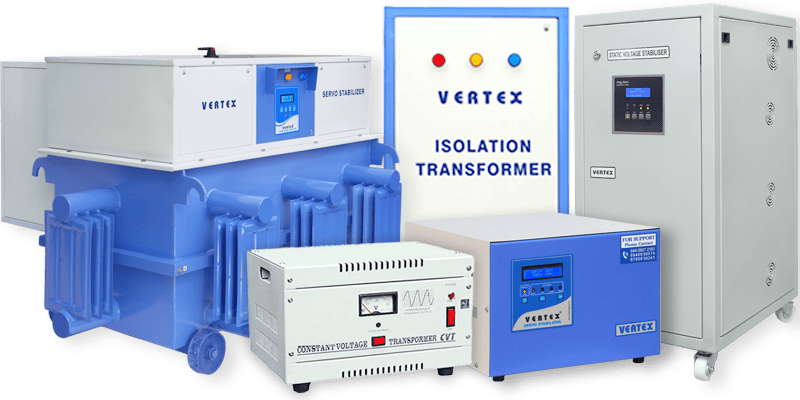
Modern servo voltage stabilizer manufacturer firms integrate step down transformers with closed-loop servo motor control systems. In these configurations, the transformer’s secondary voltage is continuously monitored by a control circuit, and a servo motor adjusts a variable autotransformer tap in real time to compensate for input voltage variations. This combination delivers both voltage conversion and tight regulation typically within ±1% of the set output regardless of input swings of ±30% or more.
Types of Step Down Transformers and When to Use Each
2.1 Single-Phase Step Down Transformer
Single-phase step down transformers are the workhorses of light commercial and residential power distribution. They convert 240V or 230V single-phase supply to 110V, 48V, 24V, or other lower voltages required by specific equipment. Laboratories, small offices, and repair workshops commonly use these units. When combined with servo control, as offered by servo voltage stabilizer manufacturers in India specialists, they ensure that sensitive instruments receive stable, noise-free power even when the mains supply fluctuates during peak demand periods.
2.2 Three-Phase Step Down Transformer
For industrial loads motors, compressors, VFDs, welding machines, and production machinery three-phase step down transformers are essential. They convert 11kV, 6.6kV, or 415V three-phase supply to the working voltage required on the factory floor. Delta-wye configurations provide the added benefit of isolating zero-sequence harmonics, and wye-delta units are preferred for motor drive applications where harmonic filtering is critical. Leading industrial servo voltage stabilizer manufacturers offer three-phase units with integrated step down functionality to serve heavy industrial environments with a single, compact solution.
2.3 Oil Cooled Step Down Transformer
When load currents are very high or ambient temperatures are extreme, air cooling becomes insufficient. Oil cooled step down transformers immerse the core and windings in transformer oil, which absorbs heat and circulates it to a radiator or cooling fins. This design allows much higher power densities in a smaller physical footprint compared to dry-type units. Companies specialising as servo oil cooled stabilizers manufacturers build integrated oil-cooled servo stabilizer and step down transformer systems for heavy-duty substations, paper mills, steel plants, and utility distribution networks.
2.4 Air Cooled Step Down Transformer
Air cooled (dry-type) step down transformers use Class F or Class H insulation materials and rely on natural or forced air convection for heat dissipation. They are preferred for indoor installations in commercial buildings, hospitals, and data centers where oil poses a fire risk. Modern air cooled servo stabilizer manufacturers produce compact, IP-rated units that combine air cooled step down transformers with servo voltage regulation in a single cabinet, suitable for sensitive IT and medical infrastructure.
2.5 Servo Controlled Step Down Transformer
The most advanced configuration for mission-critical power applications is the servo controlled step down transformer, a system where a step down transformer is integrated with a servo motor-driven variac and a microprocessor-based control circuit. Unlike relay-switched stabilizers that correct voltage in discrete steps, servo controlled units correct voltage smoothly and continuously. Servo controlled voltage stabilizer manufacturers design these systems with response times of 15–25 milliseconds per volt, making them ideal for CNC machines, printing presses, packaging lines, and laboratory equipment where any voltage step would cause a process error.
Step Down Transformer Types at a Glance
The following table compares the most common step down transformer configurations across key technical and application parameters to help you identify the right fit for your installation:
| Transformer Type | Voltage Step-Down |
Load Type | Cooling Method | Best Application |
|---|---|---|---|---|
| Single-Phase Step Down | 240V → 110V / 24V | Light to medium | Air cooled | Offices, labs, homes |
| Three-Phase Step Down | 415V → 200V / 110V | Heavy industrial | Air / Oil cooled | Factories, plants |
| Auto Transformer | Variable ratio | Medium | Air cooled | Motor starters, AVR |
| Servo Stabilizer + Step Down | Wide input range | Sensitive equipment | Air / Oil cooled | Hospitals, IT, telecom |
| Oil Cooled Step Down | HV to LV industrial | Very heavy loads | Oil (ONAN/ONAF) | Substations, utilities |
| K-Factor Step Down | Custom ratio | Non-linear loads | Air / Enclosure | Data centers, VFDs |
How Servo Voltage Stabilization Enhances Step Down Transformer Performance
A standard step down transformer is a passive device that converts voltage at a fixed ratio and cannot compensate for input fluctuations. If the mains supply drops by 10%, the output drops by 10% as well. For applications where output voltage must remain within tight tolerances, this limitation is unacceptable.
This is precisely where the integration of servo voltage stabilization creates a step change in performance. A servo stabilizer continuously samples the output voltage and compares it to the set point. If the output deviates, the servo motor instantly adjusts the variac position, correcting the output within fractions of a second. When this servo control mechanism is paired with a step down stage, the combination provides both accurate voltage conversion and dynamic regulation, a complete power quality solution.
Firms registered as automatic servo voltage stabilizer manufacturers have refined this integration to the point where the complete system step down transformer, variac, servo motor, control electronics, and protection relays is engineered as a unified product with matched impedances, optimised dynamic response, and comprehensive protection features including over-voltage cut-off, under-voltage cut-off, and short circuit protection.
The control electronics in modern servo stabilizers have also evolved significantly. Servo stabilizer control card manufacturers now produce microprocessor and DSP-based control cards that offer remote monitoring via RS-485, Modbus RTU communication, LCD display with voltage and current readouts, data logging for power quality analysis, and programmable set points capabilities that were previously available only in expensive industrial UPS systems.
Key Applications Across Industries
5.1 Healthcare and Diagnostic Centers
Hospitals run MRI machines, CT scanners, digital X-ray systems, and ICU monitoring equipment all of which demand precise, stable voltage. A step down transformer with integrated servo voltage control from a qualified servo voltage stabilizer manufacturer in India provides the dual function of voltage conversion and tight regulation, ensuring diagnostic accuracy and patient safety are never compromised by power supply variations.
5.2 Information Technology and Telecom
Server rooms, network operations centers, and telecom switching equipment operate on specific DC bus voltages derived from rectified AC. Input voltage variations stress the rectifier circuits and shorten the life of power supply modules. Step down transformers with servo control deliver stable AC input to rectifiers, extending server power supply life significantly and reducing total cost of ownership for IT infrastructure.
5.3 Industrial Manufacturing
CNC machining centers, injection molding machines, and robotic assembly lines all require stable power to maintain dimensional accuracy and cycle repeatability. Industrial servo voltage stabilizer manufacturers design heavy-duty step down stabilizer systems with custom kVA ratings, motor-rated overcurrent protection, and oil-cooled designs for high-ambient shop-floor environments.
5.4 Textile and Process Industries
Textile mills running high-speed looms and dyeing machines, and process plants operating large pumps and compressors, need step down transformers capable of handling high starting currents and continuous heavy loads. Oil cooled configurations from oil cooled servo voltage stabilizer manufacturers handle these demanding duty cycles with thermal margins that ensure reliable continuous operation without derating.
5.5 Educational and Research Institutions
Laboratories with analytical instruments, spectrometers, electron microscopes, precision balances, and chromatography systems require clean, stable power that protects calibration accuracy. A compact, air cooled step down servo stabilizer from specialist air cooled servo stabilizer manufacturers is the standard power conditioning choice for such environments.
How to Select the Right Step Down Transformer: A Practical Framework
Choosing the wrong step down transformer is an expensive mistake. Here is a systematic approach used by experienced power engineers and recommended by reputable servo stabilizer manufacturers across India:
Step 1 Define the Load: Catalogue every connected load with its rated voltage, current, power factor, and starting characteristics. Identify sensitive loads (medical, IT, instrumentation) that require tighter voltage tolerance and loads with high starting currents (motors, compressors) that require the transformer to handle inrush without excessive voltage dip.
Step 2 Determine Input Voltage Range: Record the actual measured input voltage over a representative operating period, noting minimum, maximum, and typical values. This determines both the primary voltage rating and the regulation range required from any servo control stage.
Step 3 Calculate kVA: Sum the connected load in kVA (accounting for power factor), then apply a minimum 25% growth margin. Select the next standard kVA rating above this figure from your manufacturer’s catalog.
Step 4 Choose Cooling Method: Select air cooled for indoor, clean environments below 200 kVA. Select oil cooled for outdoor installations, high ambient temperatures, or loads above 200 kVA where thermal management is critical. Consult servo oil cooled stabilizers manufacturers for customized solutions above 500 kVA.
Step 5 Specify Regulation Requirement: If input voltage varies by more than ±5%, integrate servo voltage control. For input swings of ±20% or more, a full servo controlled step down unit from servo controlled voltage stabilizer manufacturers is essential.
Step 6 Verify Certifications: Insist on BIS certification, ISO 9001 quality management, and test reports covering efficiency, regulation, temperature rise, and insulation resistance. Reputable servo voltage stabilizer manufacturer partners will provide full factory acceptance test documentation.
Conclusion
A step down transformer is far more than a simple voltage converter. In the context of modern power quality requirements, it is the foundation of a complete energy management strategy protecting equipment, improving efficiency, and ensuring operational continuity. The best step down transformer for your application is not necessarily the cheapest or the largest; it is the one precisely matched to your load characteristics, input supply conditions, and regulatory environment.
When you add the dynamic voltage correction capability of servo technology to a well-engineered step down transformer, you create a power conditioning system that adapts in real time to the realities of grid instability. Whether you need a compact single-phase unit for a diagnostic lab or a large oil-cooled industrial system for a manufacturing plant, partnering with experienced servo stabilizer manufacturers and industrial servo voltage stabilizer manufacturers ensures that the solution is engineered to deliver decades of dependable service.
Investing in quality power conditioning is ultimately an investment in uptime, equipment longevity, and operational efficiency returns that far exceed the initial capital cost over the life of your installation.
FAQ
1. What is a step down transformer and how is it different from a step up transformer?
A step down transformer has more turns in its primary winding than in its secondary, which results in an output voltage that is lower than the input voltage. A step up transformer does the opposite: it increases voltage. Step down transformers are used when equipment operates at a lower voltage than what the supply grid provides, which is the most common scenario in industrial and commercial power distribution.
2. Can a step down transformer also regulate voltage?
A standard step down transformer cannot regulate voltage; it converts at a fixed ratio and the output varies proportionally with the input. However, when integrated with a servo voltage stabilizer circuit, as manufactured by specialist automatic servo voltage stabilizer manufacturers, the combined system both steps down and actively regulates the output, maintaining it within ±1% of the set voltage despite input swings of ±25% or more.
3. What is the difference between oil cooled and air cooled step down transformers?
Oil cooled transformers use transformer oil as a coolant, allowing higher power densities and better thermal performance in hot or high-load environments. Air cooled (dry-type) transformers use air convection and high-grade insulation, making them safer for indoor installations where oil presents a fire or environmental risk. Oil cooled servo voltage stabilizer manufacturers and air cooled servo stabilizer manufacturers each offer integrated step down stabilizer systems optimized for these respective environments.
4. How do I calculate the kVA rating I need for a step down transformer?
Total all connected load current in amperes, multiply by the supply voltage and by the square root of 3 for three-phase systems to get the total VA. Convert to kVA by dividing by 1000, then add a 25 to 30 percent safety margin for future load growth and inrush current tolerance. Your servo voltage stabilizer manufacturer in India should provide free load assessment assistance as part of their pre-sales support.
5. What does a servo stabilizer control card do?
A servo stabilizer control card is the brain of the servo voltage stabilization system. It continuously samples the output voltage through a sensing circuit, compares it to the programmed set point, and drives the servo motor in the correct direction and at the correct speed to restore the output to the target value. Advanced control cards from servo stabilizer control card manufacturers incorporate microprocessors or DSPs, LCD displays, communication ports, and programmable protection thresholds.
6. Are step down transformers suitable for sensitive medical equipment?
Yes, but they should be combined with servo voltage control and, ideally, isolation. Medical facilities require output voltage held within very tight tolerances to ensure the accuracy and safety of diagnostic and life-support equipment. A servo controlled step down transformer system from a qualified servo voltage stabilizer manufacturer in India meets the voltage stability requirements for medical environments and can be configured to comply with relevant electrical safety standards.
7. What are the signs that my step down transformer is undersized?
Signs of an undersized transformer include excessive operating temperature (hot to the touch or activating thermal protection), significant output voltage droop under full load, buzzing or humming louder than normal, and frequent over-temperature trips. If you observe these symptoms, consult servo stabilizer manufacturers to conduct a load audit and recommend an appropriately sized replacement or additional capacity.
8. How long does a quality step down transformer typically last?
A well-engineered step down transformer from a reputable manufacturer, operating within its rated load and in a clean environment, has a typical design life of 25 to 30 years. The primary aging mechanisms are thermal degradation of winding insulation and moisture ingress. Proper installation, periodic maintenance, and protection against overloading can extend operational life well beyond the design target.
9. What industries benefit most from oil cooled servo stabilizer step down systems?
Steel plants, paper mills, textile factories, cement plants, and utility substations benefit most from oil cooled configurations due to their very heavy continuous loads, high ambient temperatures, and outdoor or semi-outdoor installations. Servo oil cooled stabilizers manufacturers design these systems to handle continuous duty cycles at full rated load with forced oil cooling and alarm systems for oil level and temperature monitoring.
10. How do I choose between a servo controlled stabilizer and a relay-type stabilizer with a step down transformer?
Relay-type stabilizers correct voltage in discrete steps (typically 10 to 20 steps of 2 to 5% each) with a momentary output interruption at each step. This is unsuitable for sensitive equipment. Servo controlled systems correct voltage continuously and smoothly with no output interruption, and maintain tighter regulation accuracy. For any application involving computers, medical devices, laboratory instruments, or precision machines, servo controlled step down systems from servo controlled voltage stabilizer manufacturers are the only appropriate choice.
