

Introduction
Elevators are the lifeline of multi-storey buildings, hospitals, hotels, commercial towers, and residential complexes depend on them every single day. Yet behind the smooth ride lies a critical vulnerability: unstable electrical voltage. Power fluctuations, voltage surges, and phase imbalances can silently erode your elevator’s motor, controller board, and safety systems. This is precisely where a lift stabilizer becomes not just useful, but absolutely essential.
A lift stabilizer is a dedicated voltage regulation device engineered to keep the power supply to your elevator consistently within the manufacturer’s specified range. Whether you operate a residential elevator or a heavy-duty commercial one, pairing it with a high-quality servo stabilizer for lift or a 3 phase stabilizer for lift dramatically extends equipment lifespan, reduces downtime, and safeguards passenger safety.
Understanding Voltage Fluctuations and Their Impact on Elevator Systems
Why Voltage Instability Is a Serious Elevator Hazard
Elevator motors are precision electromechanical systems. They require a steady, clean power supply to operate correctly. When the incoming voltage deviates even by 10% above or below the rated value the consequences can range from annoying operational glitches to catastrophic motor failure.
Common causes of voltage fluctuation include overloaded distribution networks, industrial machinery sharing the same circuit, lightning strikes, utility grid switching, and poor power factor at the building level. In regions with developing infrastructure, these fluctuations are a daily reality.
A 3 phase voltage stabilizer for lift addresses this problem at the source by continuously monitoring incoming voltage across all three phases and instantly correcting any deviation before it reaches the elevator’s sensitive components.
What Happens Without a Stabilizer?
- Motor windings overheat due to over-voltage, reducing insulation life
- Under-voltage causes excessive current draw, tripping breakers and damaging contactors
- Phase imbalance leads to vibration, noise, and uneven mechanical wear
- Frequent voltage spikes corrupt PLC and microprocessor-based elevator controllers
- Emergency brake systems may respond erratically under power instability
Types of Lift Stabilizers: Choosing the Right Voltage Solution
Servo Stabilizer for Lift
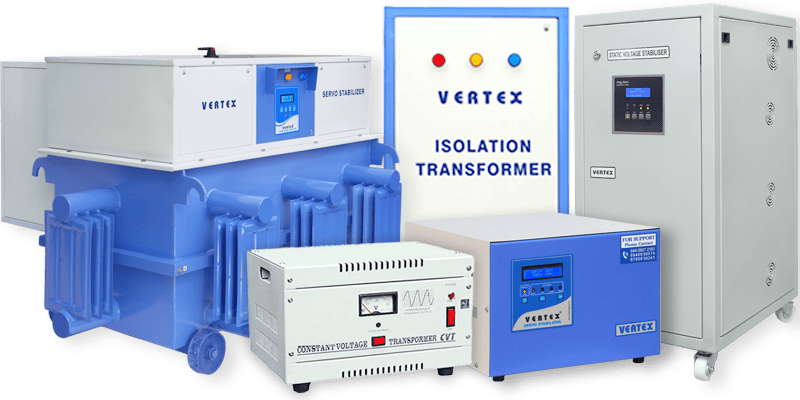
A servo stabilizer for lift is one of the most precise and widely recommended voltage regulation solutions for elevator applications. It operates using a servo motor that continuously adjusts a variable auto-transformer (variac) to maintain constant output voltage regardless of input fluctuations.
The key advantage of a servo stabilizer is its ability to correct wide voltage variations typically ±20% to ±35% of nominal voltage while delivering output accuracy within ±1%. This level of precision is critical for modern elevators fitted with variable frequency drives (VFDs) and sophisticated microprocessor controls.
Vertex Power’s range of servo stabilizer for lift products is engineered for continuous duty cycles, high efficiency ratings above 98%, and is available in capacities from 5 KVA to 2000 KVA, covering everything from small residential lifts to heavy industrial freight elevators.
3 Phase Stabilizer for Lift
Commercial and industrial elevators universally use three-phase motors for their superior torque-to-size ratio and smooth operation. Protecting this power supply requires a purpose-built 3 phase stabilizer for lift.
A 3 phase stabilizer for lift simultaneously regulates voltage across all three phases, corrects phase imbalance, and filters harmonic disturbances. This prevents the single-phasing phenomenon where one phase drops out which is among the most common causes of three-phase motor burnout.
3 Phase Voltage Stabilizer for Lift
The 3 phase voltage stabilizer for lift combines the functions of a voltage regulator and a power conditioner. Advanced models include built-in over-voltage and under-voltage protection relays, phase sequence protection, bypass switches for maintenance, and digital display panels showing real-time voltage, current, and frequency readings.
For high-rise buildings where the elevator operates dozens of times per hour, investing in a high-capacity 3 phase voltage stabilizer for lift from a reliable manufacturer is a non-negotiable safety requirement.
Lift Stabilizer Comparison Table
The table below provides a quick reference to help you identify the most suitable stabilizer type for your elevator application:
| Type | Voltage Range | Best For | Key Benefit |
|---|---|---|---|
| Servo Stabilizer for Lift | 160V – 270V | High-rise buildings | Precise auto-correction |
| 3 Phase Stabilizer for Lift | 300V – 470V (3Ø) | Commercial elevators | Balanced 3-phase supply |
| 3 Phase Voltage Stabilizer for Lift | ±20% correction | Industrial elevators | Wide fluctuation control |
| Static Voltage Stabilizer | 180V – 260V | Residential lifts | Low maintenance |
| Digital Servo Stabilizer | 150V – 280V | Smart buildings | LCD monitoring + protection |
Key Features to Look for in a High-Quality Lift Stabilizer
Essential Technical Specifications
Not all stabilizers are created equal. When specifying a unit for elevator protection, there are several non-negotiable technical parameters to evaluate:
- Correction Speed: A servo stabilizer should correct voltage at a rate of 15V per second minimum; faster response times (30–50V/sec) are preferable for buildings with severe fluctuations.
- Input Voltage Range: Look for a unit that handles at least ±20% variation from nominal, e.g., 160V–270V for a 230V system.
- Output Accuracy: ±1% output regulation ensures your elevator motor always sees the correct voltage.
- Efficiency Rating: A quality stabilizer should operate at above 98% efficiency to minimize energy losses.
- Protection Features: Over-voltage, under-voltage, phase loss, phase reversal, short-circuit, and overload protection are all essential.
- Cooling System: Air-cooled units for standard environments; oil-cooled for high-capacity or outdoor installations.
Benefits of Installing a Lift Stabilizer in Your Building
Operational and Financial Advantages
The return on investment from installing a quality lift stabilizer is compelling. Here is a breakdown of the core benefits building owners and facility managers experience:
Extended Motor Life: Elevator motors are expensive to replace often costing several lakh rupees for a high-capacity unit. A servo stabilizer for lift keeps voltage within design parameters at all times, preventing the thermal stress and insulation breakdown that prematurely ages motor windings. Studies in the power quality management sector consistently show that stable voltage can more than double motor operational life.
Reduced Maintenance Costs: Voltage instability accelerates wear on contactors, relays, capacitors, and circuit boards. By stabilizing supply with a 3 phase stabilizer for lift, building managers report significant reductions in unplanned maintenance calls and component replacements.
Enhanced Passenger Safety: Voltage dips during peak demand can cause elevator doors to malfunction, emergency lighting to fail, or safety brakes to engage unexpectedly. A stabilizer eliminates these risks, ensuring every journey is smooth and safe.
Regulatory Compliance: Building codes and elevator safety standards in India and globally increasingly require documented power quality measures. Installing a certified stabilizer helps facilities meet IS standards and insurance requirements.
Energy Savings: Running a motor on unstable voltage wastes energy. Optimised voltage regulation reduces reactive power consumption, improving the overall power factor of the installation and reducing electricity bills.
Installation, Sizing, and Maintenance Guidelines
How to Size Your Lift Stabilizer Correctly
Proper sizing is critical. An undersized stabilizer will be overloaded, shortening its life and failing to protect the motor during peak operation. The general sizing formula is:
Stabilizer KVA = Motor KW × 1.25 ÷ Power Factor
For example, a 15 KW, 0.85 power factor elevator motor requires a stabilizer rated at approximately 22 KVA. Always add a 25% safety margin to the calculated capacity.
Vertex Power’s engineering team provides free sizing consultations and can customize stabilizers to meet specific input voltage ranges, load profiles, and environmental conditions.
Maintenance Best Practices
A servo stabilizer for lift with mechanical servo motor components requires periodic servicing every six months. Key maintenance tasks include:
- Inspect and replace carbon brushes on the servo motor if worn below minimum length
- Clean dust and debris from ventilation slots and internal components
- Check tightness of all terminal connections and torque to specification
- Verify output voltage accuracy with a calibrated meter and compare against display readings
- Test all protective relays and ensure they trip at the set voltage thresholds
- Lubricate servo motor bearings per manufacturer’s schedule
Conclusion
Elevator safety is not just about mechanical components it begins with the quality of the power that drives every system. A reliable lift stabilizer is the single most cost-effective investment a building owner can make to protect their elevator infrastructure, reduce operational costs, and ensure passenger safety.
Whether you need a servo stabilizer for lift, a 3 phase stabilizer for lift, or a comprehensive 3 phase voltage stabilizer for lift, the right solution exists for every application and budget. The key is to choose a reputable, experienced manufacturer who understands the demanding requirements of elevator power systems.
Vertex Power has built its reputation on precision engineering, rigorous quality control, and after-sales support that keeps your critical systems running reliably. Explore the full range of elevator power protection solutions at and take the first step toward a safer, more efficient building.
FAQ
1.What is a lift stabilizer and why is it important?
A lift stabilizer is an electrical device that regulates voltage supplied to an elevator motor, protecting it from fluctuations. Without it, voltage surges or drops can damage motor windings, controllers, and safety circuits, leading to costly breakdowns.
2.What is the difference between a servo stabilizer and a static stabilizer for lifts?
A servo stabilizer for lift uses a motorized variac with a servo motor for precise, continuous voltage correction, making it ideal for fluctuating industrial environments. A static stabilizer uses solid-state components with no moving parts, offering faster response and lower maintenance.
3.Why is a 3 phase stabilizer for lift required instead of a single phase one?
Most elevator motors run on three-phase power to deliver smooth, high-torque operation. A 3 phase stabilizer for lift balances all three phases simultaneously, preventing phase imbalance that can overheat and damage the motor.
4.Can a lift stabilizer reduce electricity consumption?
Yes. By maintaining optimal voltage levels, a lift stabilizer ensures the motor operates at peak efficiency. Over-voltage and under-voltage conditions both cause excess energy consumption, so stable voltage directly reduces power bills.
5.What capacity of 3 phase voltage stabilizer for lift should I choose?
The capacity depends on the lift motor’s KVA rating. As a rule of thumb, choose a stabilizer with at least 1.25 times the motor’s rated KVA. Always consult a specialist Vertex Power experts can recommend the right sizing.
6.How does a servo stabilizer for lift handle sudden load changes?
It uses a closed-loop feedback circuit that constantly monitors output voltage. When a deviation is detected, the servo motor adjusts the variac position in milliseconds, ensuring the elevator receives steady power even during peak load transitions.
7.What protection features should a quality lift stabilizer include?
A reliable lift stabilizer should include over-voltage protection, under-voltage cutoff, time-delay relays on start-up, phase sequence protection, short-circuit protection, and an input/output voltage display for easy monitoring.
8.Is the installation of a 3 phase stabilizer for the lift complex?
Installation should always be done by a qualified electrician. The stabilizer is connected between the main supply and the elevator control panel. Proper earthing and correct phase connections are critical for safe, effective operation.
9.How often does a lift stabilizer need maintenance?
A servo stabilizer for lift with mechanical components should be serviced every six months this includes checking carbon brushes, servo motor alignment, and contact surfaces. Static and digital stabilizers require annual inspection of connections and protective components.
10.Where can I buy a reliable lift stabilizer in India?
Vertex Power is a trusted manufacturer offering high-quality lift stabilizer solutions across India, including servo stabilizers, 3 phase stabilizers, and customized units. Visit for product details and expert guidance.