
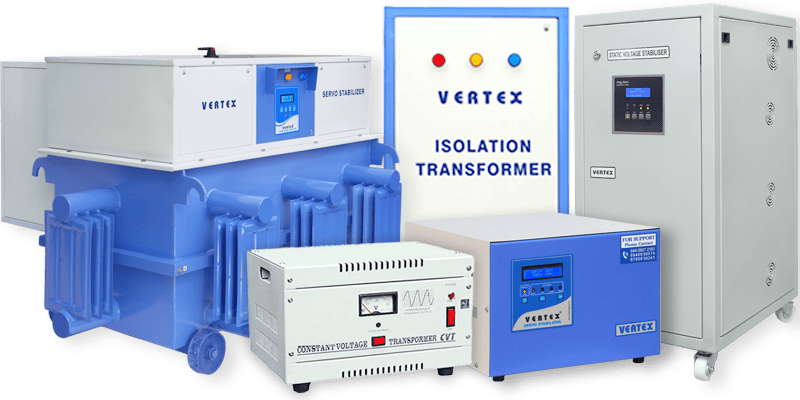


In modern multi-storey residential complexes, commercial IT parks, and high-intensity healthcare centers, elevators serve as the critical lifeline of vertical transportation. However, the complex heavy inductive loads drawn by passenger lifts make them exceptionally vulnerable to grid voltage fluctuations.
When erratic voltage hits a building, standard machinery might experience mild drops in efficiency. But an elevator system reacts immediately—safety brakes trip, expensive digital controllers burn out, and passengers end up trapped between floors.
To protect your building assets, reduce maintenance costs, and guarantee occupant peace of mind, traditional mainline stabilizers are rarely enough. You need a specialized Servo Voltage Stabilizer for Elevators and Lifts. This master guide breaks down the critical electrical engineering issues, the definitive technical solutions, and structural frameworks to consider for your facility.
Why Elevators Fail Under Grid Fluctuations?
Standard municipal power grids are prone to continuous voltage spikes, deep sags, and transient surges. While generic building appliances can tolerate minor dips, an elevator system reacts critically, leading to immediate mechanical and financial damage:
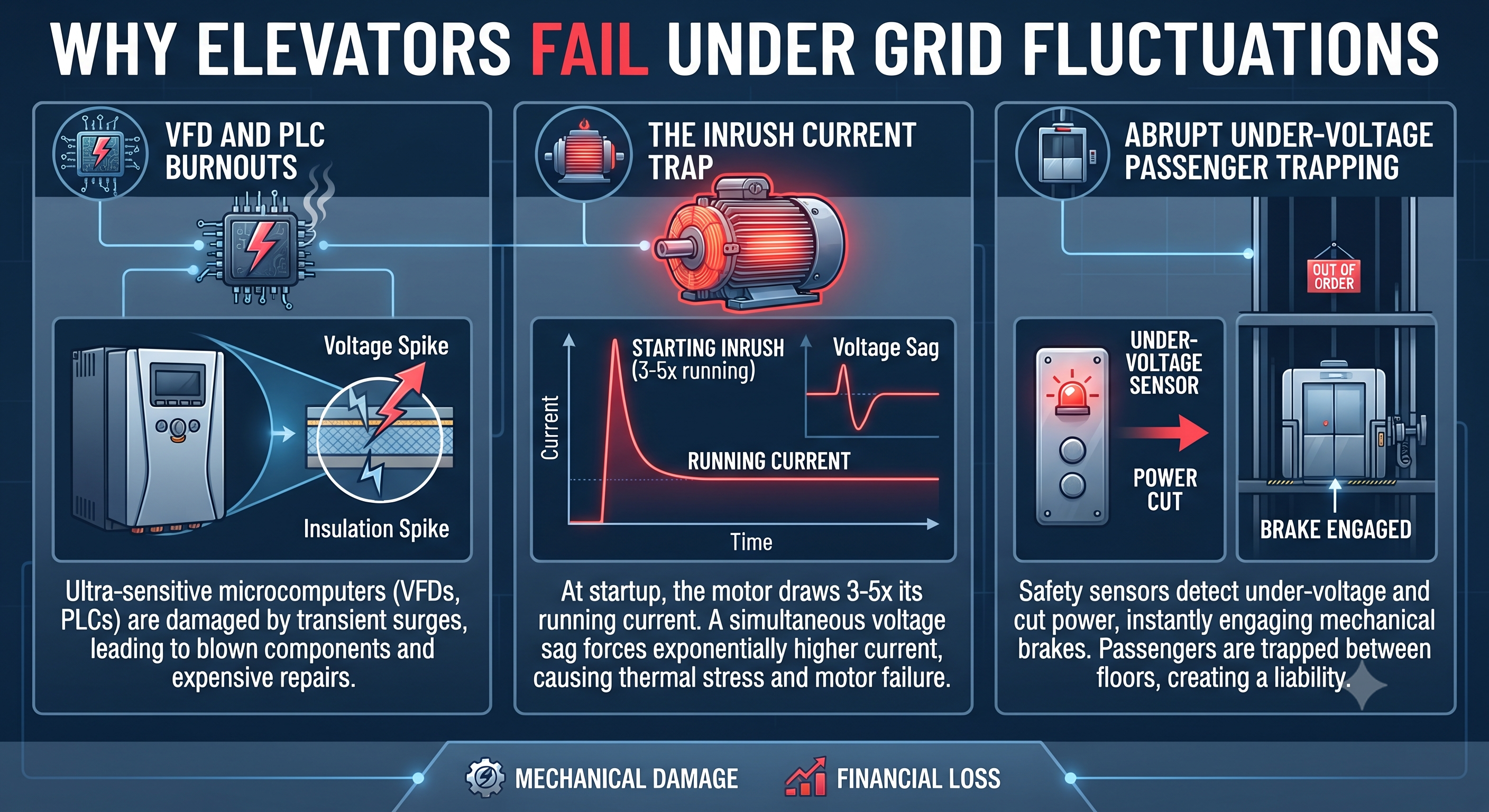
VFD and PLC Burnouts
Modern lifts utilize ultra-sensitive Variable Frequency Drives (VFDs), VVVF controllers, and Programmable Logic Controllers (PLCs) to manage acceleration, deceleration, and landing precision. These components are essentially specialized microcomputers. Even a brief voltage spike can puncture insulation layers, blow microprocessors, or fry internal capacitors—forcing building owners to face massive replacement expenses and prolonged equipment downtime.
The Inrush Current Trap
At the precise second a passenger cabin begins tracking upward from a complete stop, the induction motor draws a massive burst of starting inrush current (often 3 to 5 times its running current). If your building grid suffers from an uncorrected voltage sag during this peak moment, the motor draws exponentially higher current to compensate for the drop. This leads to intense thermal stress, blistering winding insulation, and premature motor failure.
Abrupt Under-Voltage Passenger Trapping
To prevent catastrophic structural failures, elevator manufacturers integrate rigid under-voltage safety sensors into their control loops. The instant the line voltage dips below a safe threshold, the lift controller cuts active power. This drops the mechanical safety brakes instantly, immediately stopping the lift. While this protects the electronics, it leaves passengers terrified and trapped between floors in a dark cabin shaft, creating an immediate liability issue for building management.
The Definitive Engineering Solution: Dedicated Lift Servo Stabilizers
Deploying a standard mainline building stabilizer to handle a complex elevator system rarely resolves the issue. To successfully handle rapid, cyclical motor dynamics, you need a specialized Microcontroller-Based Lift Servo Voltage Stabilizer.
This system acts as a high-speed electrical shield positioned directly between your incoming building grid and the elevator control room. It provides a permanent, bulletproof solution to your elevator power issues:
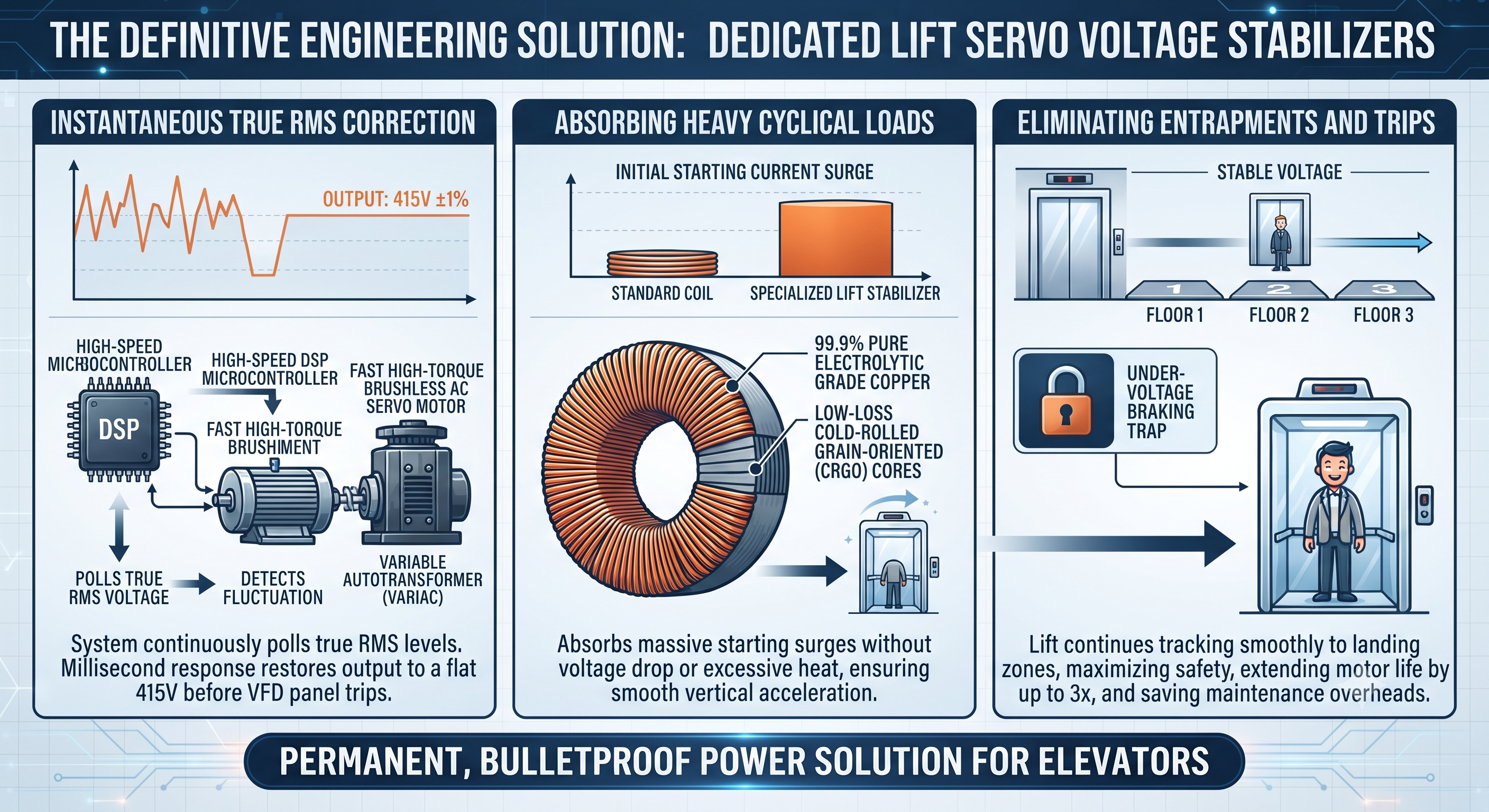
Instantaneous True RMS Correction
Premium lift stabilizers utilize high-speed Digital Signal Processor (DSP) microcontrollers coupled with a fast, high-torque brushless AC servo motor. The system continuously polls true RMS line voltage levels. The millisecond a grid fluctuation or voltage drop occurs, it mechanically adjusts a heavy-duty variable autotransformer (variac), restoring the output flow back to a flat 415V ±1% accuracy long before the dip can reach and trip your sensitive VFD panel.
Absorbing Heavy Cyclical Loads
Specialized lift stabilizers are wound exclusively with 99.9% pure electrolytic grade copper paired with low-loss Cold-Rolled Grain-Oriented (CRGO) lamination cores. This allows the stabilizer to easily absorb massive initial starting current surges without dropping output voltage or generating excessive heat, ensuring smooth vertical acceleration.
Eliminating Entrapments and Trips: By keeping your building’s lift voltages perfectly steady, you eliminate the underlying cause of under-voltage braking cycles. Lifts continue tracking smoothly to their designated landing zones, maximizing passenger safety, extending motor operational life by up to 3x, and saving significant maintenance overheads.
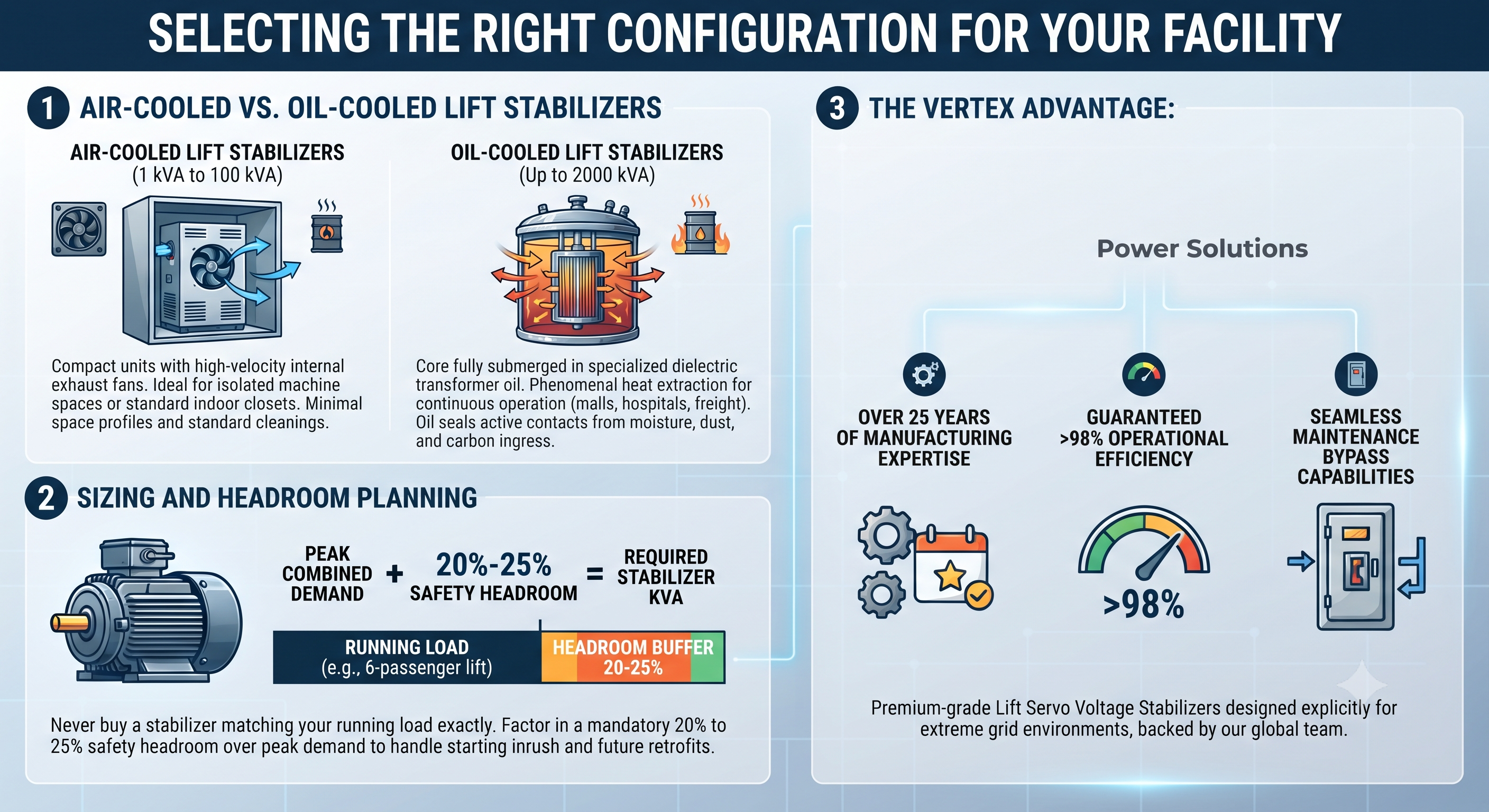
Selecting the Right Configuration for Your Facility
When choosing your stabilizer framework, selecting the proper structural cooling and sizing architecture determines your system’s long-term service frequencies and operational efficiency.
Air-Cooled vs. Oil-Cooled Lift Stabilizers
Air-Cooled Lift Stabilizers (Typically 1 kVA to 100 kVA)
Configured with high-velocity internal exhaust fans, these compact units are ideal for isolated elevator machine spaces or standard indoor control closets. They demand minimal space profiles and standard cleanings.
Oil-Cooled Lift Stabilizers (Up to 2000 kVA)
The stabilizer core stays fully submerged inside a heavy-gauge steel tank containing specialized dielectric transformer oil. This layout provides phenomenal heat extraction for lifts operating continuously, such as in busy commercial malls, multi-specialty hospitals, and industrial freight elevator towers. The oil capsule also perfectly seals the active contacts from moisture, dust, and carbon ingress.
Sizing and Headroom Planning
Never buy a stabilizer matching your running load exactly. To safely handle initial motor starting inrush currents and accommodate future building retrofits, always factor in a mandatory 20% to 25% safety headroom margin over your elevator’s peak combined kilowatt or current demand. For instance, a standard 6-passenger lift typically requires a 15 kVA to 20 kVA lift stabilizer, depending on the engine’s baseline horsepower (HP).
The Vertex Advantage: Secure Vertical Mobility
As pioneers in microcontroller-based power optimization, Vertex Power Solutions manufactures premium-grade Lift Servo Voltage Stabilizers designed explicitly for extreme grid environments.
Backed by a team of engineers with over 25 years of manufacturing expertise and over 1,00,000 successful installations across complex industries, our systems deliver guaranteed >98% operational efficiency and seamless maintenance bypass capabilities to keep your facility safe.
People Also Ask (Frequently Asked Questions)
Why does an elevator need a dedicated lift stabilizer instead of a standard mainline unit?
Elevators contain sensitive Variable Frequency Drives (VFDs) and microchips that fail during sudden voltage spikes. Lifts also draw high inrush currents during startup, which cause localized voltage drops. A dedicated servo voltage stabilizer designed for lifts handles these rapid, erratic current demands much better than a generic building-wide unit.
What capacity stabilizer is required for a standard 6-passenger lift?
Typically, a standard 6-passenger elevator requires a 15 kVA to 20 kVA lift stabilizer. However, the exact capacity rating depends directly on the horsepower (HP) rating of the lift motor, the drive design, whether the system incorporates an Automatic Rescue Device (ARD), and your specific input voltage windows.
How does a servo voltage stabilizer prevent passengers from getting trapped in a lift?
When grid voltage falls too low, an elevator’s safety system triggers an under-voltage brake trip, freezing the lift between floors. By maintaining a steady, regulated output flow of electricity, a servo voltage stabilizer prevents under-voltage braking cycles, ensuring the lift reaches the landing zone safely.
Is an air-cooled or oil-cooled stabilizer better for a rooftop elevator room?
If the elevator machine room is situated on a hot rooftop prone to high ambient temperatures and dust, an oil-cooled stabilizer is highly recommended for its superior thermal cooling and sealed design. For standard indoor installations with limited footprint limits, an air-cooled stabilizer is highly efficient and easier to install.