
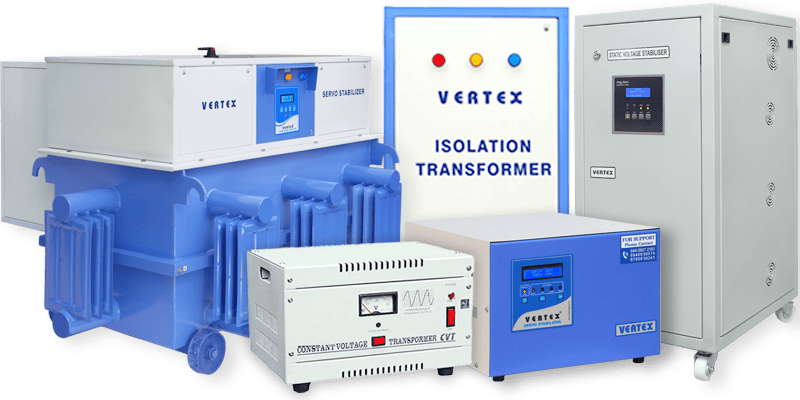



Investing in a luxury duplex home means managing a sophisticated, high-value electrical ecosystem. From centralized VRV/VRF air conditioning and smart home automation hubs to premium appliances, modern residences function like sensitive mini-grids.
Unfortunately, standard residential zones face continuous voltage drops, sudden surges, and dangerous phase unbalances. Patchwork retail stabilizers are no longer enough to protect these integrated systems.
This buying guide provides a clear, step-by-step guide to understanding residential power risks. You will learn how to accurately calculate your total household load and select the correct mainline servo voltage stabilizer to permanently secure your home investment.
Understanding the Problem—The Unique Vulnerabilities of Duplex Homes
Before looking at technical specifications, it is critical to understand the exact electrical engineering challenges that occur inside a modern duplex home. A luxury duplex is not just a larger house; it operates structurally as a complex, highly inductive mini-grid.
The Micro-Chip Vulnerability (VFD & Inverter Loads)
Modern luxury homes no longer run on simple resistive circuits (like traditional incandescent bulbs or basic coil heaters). High-end duplex homes utilize:
- Variable Refrigerant Volume (VRV/VRF) Air Conditioning: These systems use highly sophisticated, frequency-controlled inverter compressors.
- Smart Automation Hubs & IoT Panels: Centralized home servers, security arrays, and architectural lighting control blocks.
These systems rely on delicate microprocessors. When municipal voltage drops (a voltage sag), these electronic components face immense thermal stress. Conversely, when voltage surges occur, the fine circuit pathways on the control boards can instantly fuse and short-circuit, causing systemic equipment failure.
The Inductive Starting Current Phenomenon
Heavy household machinery—such as high-pressure hydro-pneumatic water pumps, large borehole submersibles, automated entrance gates, and modular kitchen appliances—rely on induction motors.
When an induction motor starts up from a complete standstill, it requires a massive, instantaneous rush of power known as starting inrush current. This draw is typically 3 to 5 times higher than its regular running current. If the incoming grid voltage is un-stabilized and low during this exact second, the motor draws even higher current to compensate, overheating the coils and rapidly degrading the insulation layers over time.
The Danger of Three-Phase Load Unbalance
Because of their high cumulative power demand, duplex houses are almost universally provisioned with a Three-Phase electrical connection from the local utility board. The household circuits are divided across three separate incoming lines (typically referred to as the R, Y, and B phases).
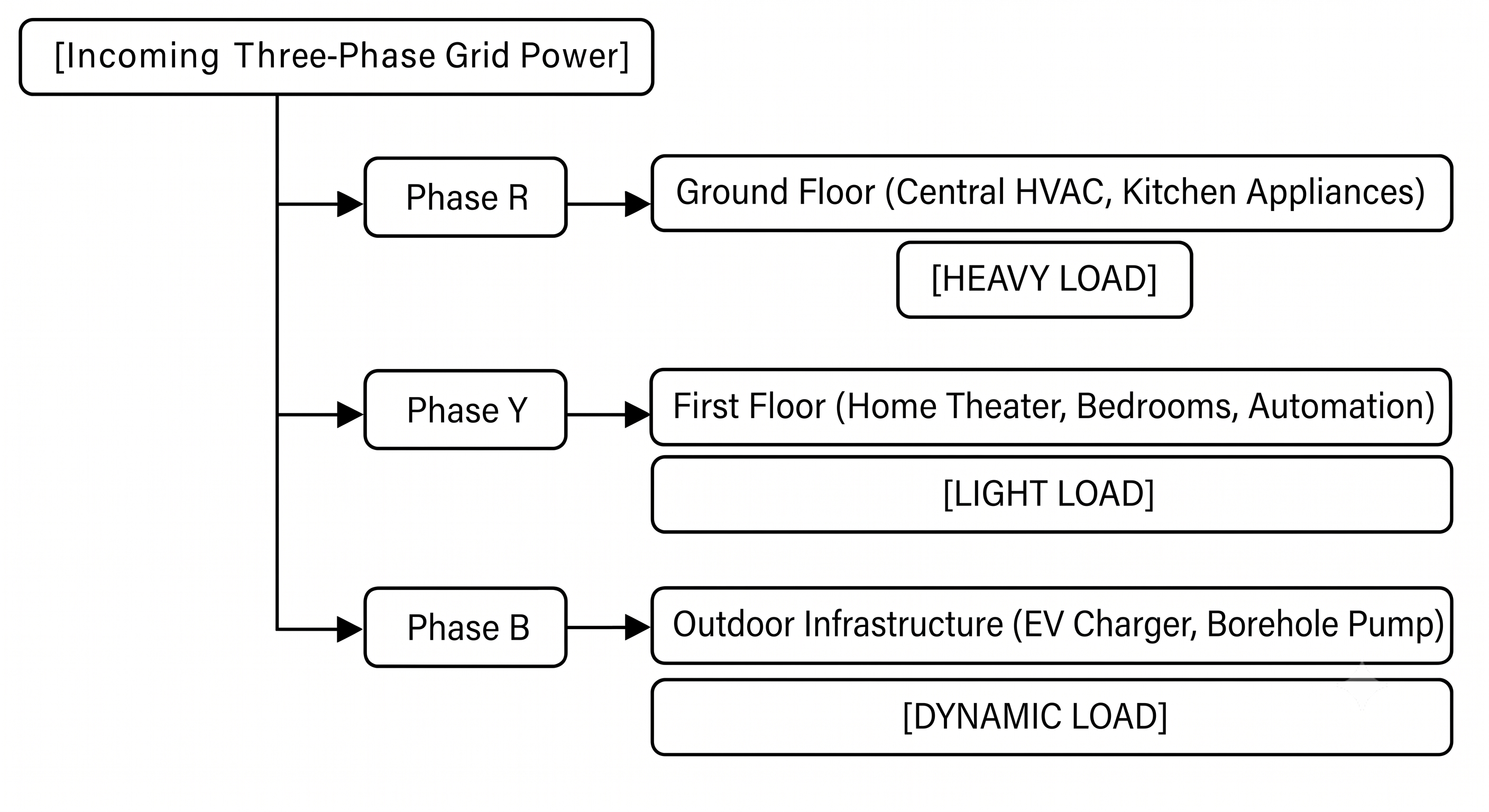
In a residential property, load distribution changes constantly. For example, if multiple heavy air conditioners are running on the ground floor (Phase R) while the first floor (Phase Y) is completely dark, a severe load unbalance occurs. This structural imbalance shifts the electrical neutral point, causing a dangerous over-voltage spike to flow down the underloaded phase, which can instantly ruin sensitive single-phase electronics.
The Solution Architecture—How a Mainline Servo Stabilizer Works
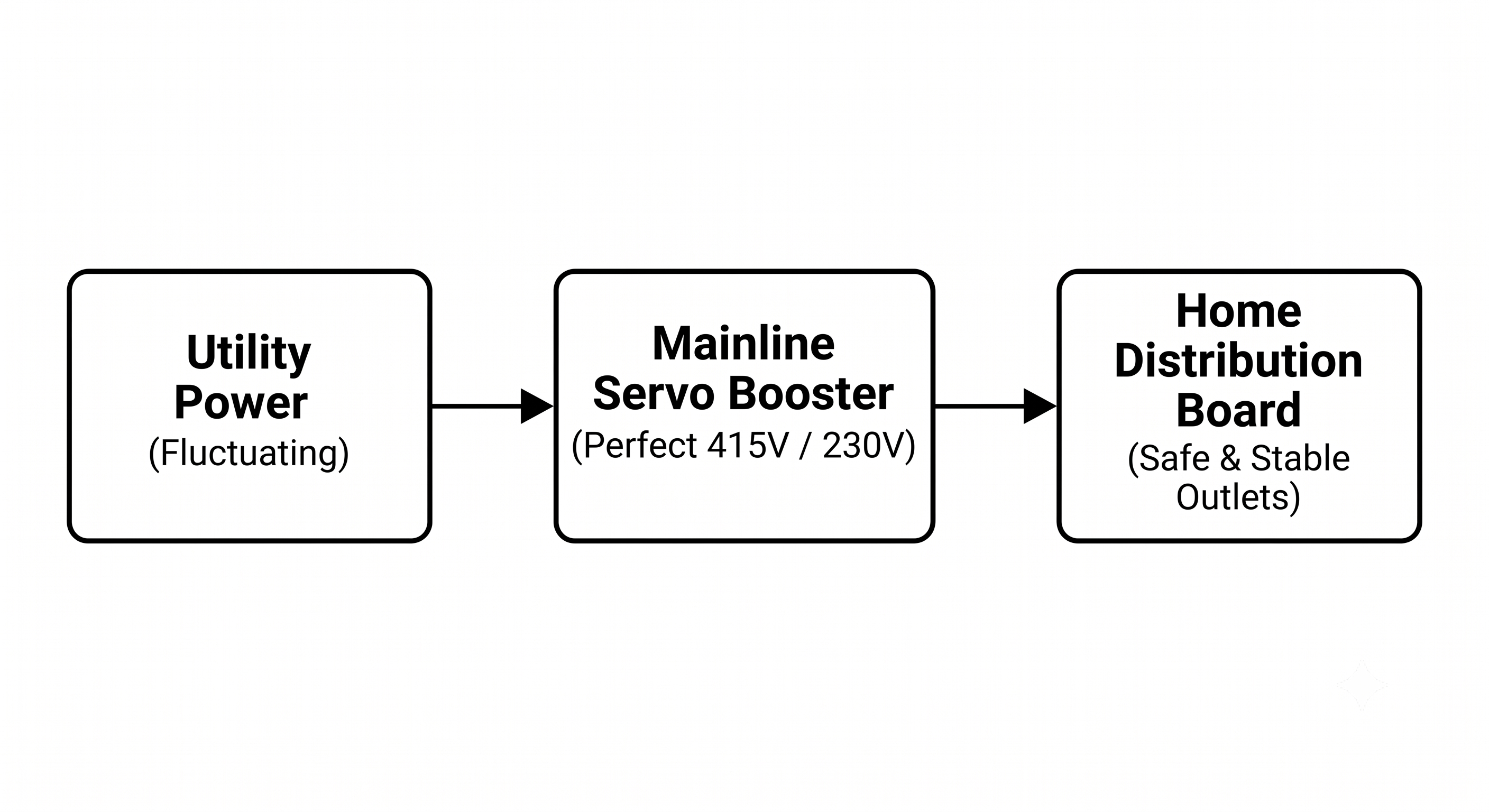
To eliminate these issues across the entire property, a centralized Mainline Servo Voltage Stabilizer is integrated directly after the utility billing meter and before the main indoor distribution board.
The Closed-Loop Correction Mechanism
Unlike basic retail stabilizers that click loudly and switch abruptly between preset transformer loops (causing electrical arcs and screen flickers), a servo stabilizer operates on a continuous, stepless correction method.
- Sensing: The internal microcontroller monitoring circuit continuously polls the incoming true RMS line voltage values at high frequencies.
- Commanding: If a voltage error is detected, the controller sends an immediate directional command to a high-torque, brushless AC servo motor.
- Correcting: The motor physically rotates a carbon brush smoothly along a precision-wound variable autotransformer (variac). This adjustment changes the voltage on the buck-boost transformer, delivering a perfectly steady output back to the home.
Independent Phase Control (The Balanced Output Rule)
For a duplex home, a three-phase stabilizer must utilize a fully unbalanced load design. This means the stabilizer houses three separate sensing microcontrollers and three independent servo motor drives configured in a star structure. Each phase is corrected independently of the other two, ensuring that heavy usage on one floor never triggers a dangerous voltage fluctuation or shift on another.
Step-by-Step Selection & Sizing Methodology
Follow this step-by-step engineering approach to calculate the exact stabilizer capacity your duplex home requires.
Complete a Total Load Inventory
Walk through the property and document every high-capacity appliance. Note down their consumption values in kilowatts (kW), horsepower (HP), or Amperage (A).
- Group A (Heavy Inductive Loads): Centralized VRV/VRF AC units, swimming pool pumps, borehole submersibles, elevators, and large refrigerators.
- Group B (Resistive/Heating Loads): Bathroom geysers, modular microwave ovens, washing machine heaters, and electric irons.
- Group C (Sensitive Electronic Loads): Automation server racks, home theater amplifiers, computers, and security systems.
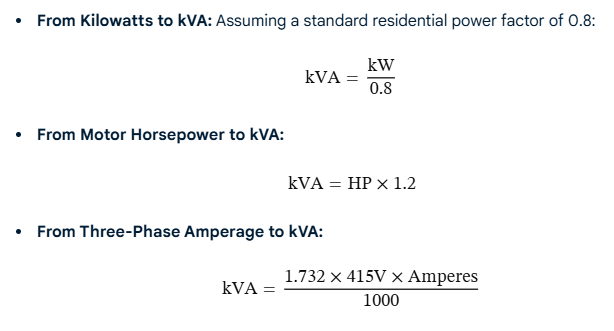
Convert Your Electrical Units to kVA
Stabilizers are explicitly rated in kVA (Kilo-Volt-Amperes). If your appliances list their consumption metrics in different units, use these standard conversions:
Apply the Mandatory Headroom Factor
Never size a mainline stabilizer to match your calculated running load exactly. To safely absorb the initial inrush currents from induction motors and protect the system from running under continuous thermal stress, you must apply a minimum safety headroom margin of 20% to 25%.
Standard Guide Reference: A typical 3 to 4-bedroom premium duplex home utilizing central inverter climate control generally requires a capacity between 20 kVA and 30 kVA Three-Phase.
Structural Engineering Choices—Air-Cooled vs. Oil-Cooled
When finalizing your purchase specification, you must select the structural enclosure design based on where the unit will be physically installed:
Architectural Metric | Air-Cooled Servo Stabilizers | Oil-Cooled Servo Stabilizers |
Cooling Method | High-velocity internal exhaust fans | Complete submersion in dielectric transformer oil |
Best Physical Location | Indoor garages, utility rooms, under-stair closets | Outdoor parking sheds, open terraces, generator rooms |
Environmental Shielding | Vulnerable to heavy external dust accumulation | 100% Sealed Tank Construction; immune to dust and moisture |
Footprint & Weight | Highly compact, lightweight, easy to wall-mount or slide | Larger footprint, significantly heavier due to oil mass |
Ideal Application Range | Residential setups up to 30 kVA with indoor space | Properties requiring >30 kVA or situated in harsh climates |
Essential Safety Checklist for Home Installations
When evaluating technical spec sheets, ensure the manufacturer includes these mandatory protection systems to safeguard your family and property:
- High/Low Voltage Cut-off with Graded Delay: The stabilizer should seamlessly smooth out standard fluctuations. However, if the main utility grid experiences an extreme, catastrophic fault, the stabilizer must instantly cut off output power to protect your home. A graded time delay prevents unnecessary trips during minor, momentary dips.
- Phase Reversal Prevention: If utility technicians accidentally reverse the grid lines during external line maintenance, a three-phase motor can run backward, ruining your water pumps. The stabilizer must detect this and isolate the line immediately.
- True CRGO & Copper Construction: Insist on 99.9% pure electrolytic grade copper windings paired with low-loss Cold-Rolled Grain-Oriented (CRGO) silicon steel lamination cores. Cheap aluminum or commercial steel alternatives run incredibly hot, waste substantial electricity, and significantly inflate your monthly utility bills.
Final Summary: Smart Engineering for Lasting Comfort
Securing a luxury duplex home requires moving away from patchwork, localized power solutions. Relying on small, noisy retail stabilizers scattered across your rooms leaves your most expensive assets—like centralized automation servers and inverter compressors—vulnerable to the devastating effects of phase unbalance and sudden voltage surges.
As we have explored in this handbook, a centralized, microcontroller-based mainline servo voltage stabilizer is the only definitive way to establish an unbroken, flat 415V/230V electrical shield across your entire property. It optimizes your energy intake, protects your warranty investments, and guarantees that your home functions smoothly through any grid fluctuation.
FAQ – Servo Stabilizer Buying Guide for Duplex Homes
1. How does a servo stabilizer differ from a cheap retail relay stabilizer?
A relay stabilizer switches abruptly between fixed transformer coils using mechanical switches, which causes a brief output voltage jump and makes household lights flicker. A servo stabilizer uses a continuous, motor-driven mechanism that glides smoothly across the windings, providing constant, precise voltage regulation without any electrical breaks or flickers.
2. Is it safe to install an oil-cooled stabilizer inside a residential house?
No, oil-cooled units should ideally be installed in well-ventilated, semi-outdoor areas like a garage, parking shed, or covered terrace. For interior installations—like utility closets or under staircases—a compact, silent air-cooled servo stabilizer is the correct and safe choice.
3. Will a mainline servo stabilizer increase my monthly electricity bill?
A premium stabilizer will actually help optimize your energy costs. Vertex servo stabilizers are highly efficient (>98%), meaning they waste negligible power. By keeping your home’s voltage at an optimal level, they prevent appliances and AC motors from overheating and drawing excess current, which lowers overall power wastage.