


In the entertainment business, the show must go on—no matter what happens to the municipal power grid. For commercial cinemas, high-end multiplexes, and live performance auditoriums, power continuity directly affects revenue and brand reputation.
A sudden voltage dip or a total blackout doesn’t just cause a minor dark screen. It triggers immediate demands for ticket refunds, sudden data corruption across centralized media servers, and severe thermal shock to expensive xenon or laser projector lamps. Furthermore, sudden darkness inside a crowded room presents an immediate public safety and security risk.
To achieve zero operational downtime, modern theaters require a multi-layered, fast-acting industrial power backup framework. This guide details how to build a resilient energy infrastructure to keep your screens illuminated and audio systems booming through any grid failure.
The Anatomy of a Theater’s Power Load Profile
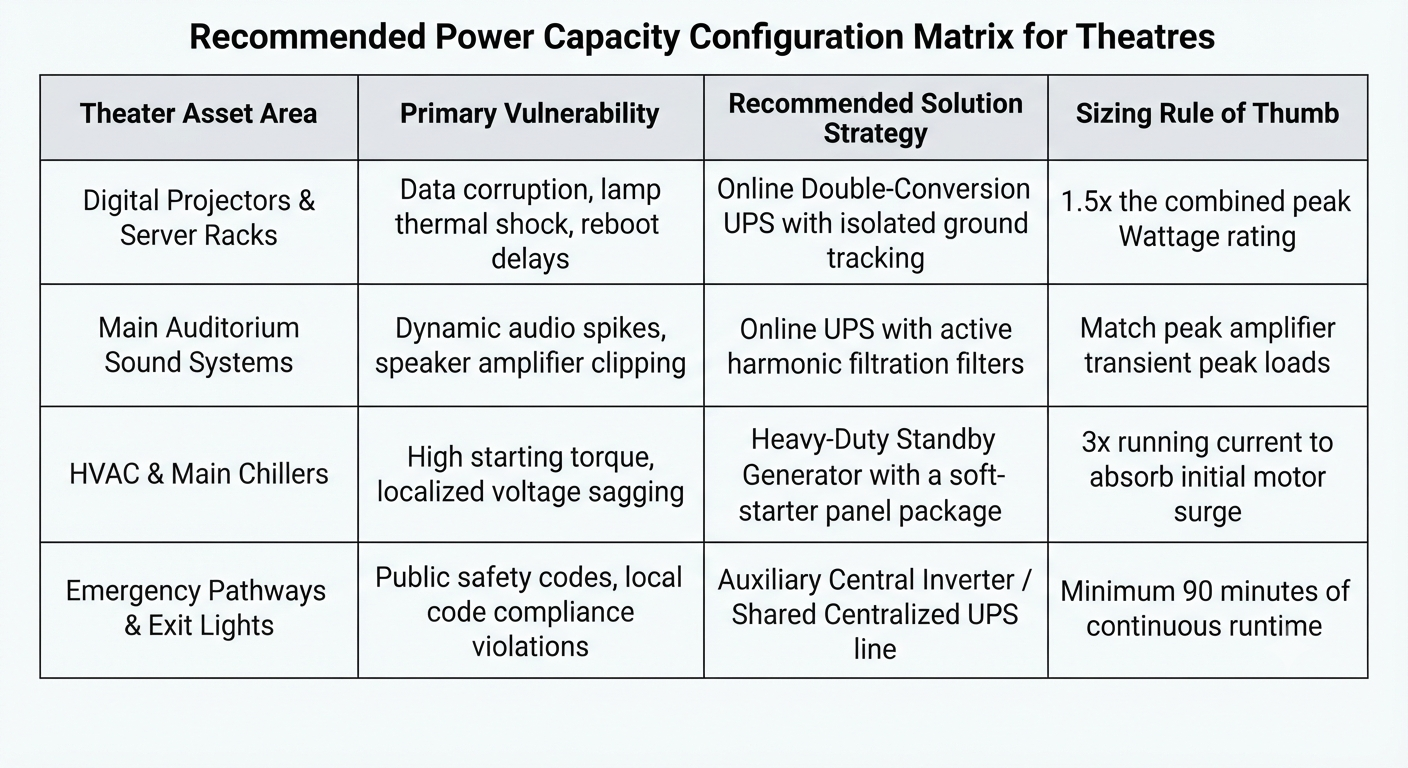
A theater complex does not use standard commercial power loops. The electrical architecture is divided into distinct zones, each demanding a specific type of protection:
- The Projection Booth (Ultra-Sensitive Load): Digital cinema projectors (Barco, Christie, Sony), media blocks, Dolby Atmos audio processors, and local server racks cannot tolerate even a millisecond of power interruption. A microscopic power break triggers a full hardware reboot cycle, keeping the screen dark for up to 15 minutes.
- Auditorium Lighting & HVAC (Heavy Inductive Load): Central air conditioning chillers, air handling units (AHUs), and house step lights require massive initial startup current.
- Concessions & Ticketing (Commercial Load): Point-of-Sale (POS) systems, automated ticketing kiosks, popping machines, and cold storage lines must stay online to protect high-margin auxiliary revenues.
The Twin Pillars of Theater Power Continuity
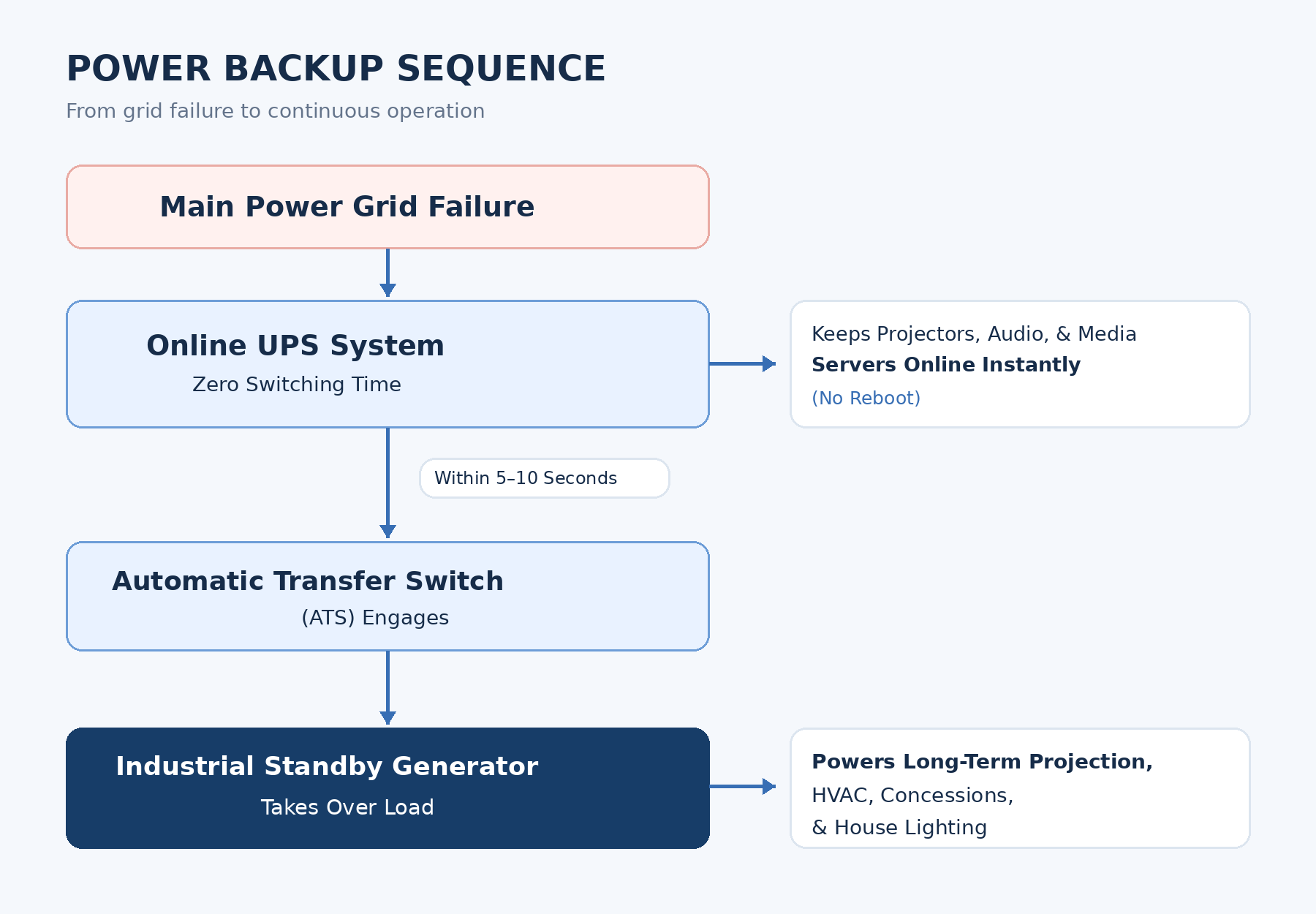
An unbroken theater operations strategy relies on a symbiotic relationship between two critical pieces of hardware: an Online Uninterruptible Power Supply (UPS) and an Industrial Standby Generator.
Pillar 1: Online Double-Conversion UPS (The Instant Shield)
A standard offline or line-interactive UPS is completely inadequate for a commercial projection booth. You must deploy an Online Double-Conversion UPS system.
- Zero Transfer Time (0ms): Online UPS systems continuously rectify incoming AC power to DC power, then invert it back to a clean, stable AC sine wave. Because the internal battery bank is always connected to the inverter line, when the main grid fails, there is zero milliseconds of switching delay. Your digital projectors and sound engines do not experience a flicker.
- Safe Lamp Cooling Shutdown: High-lumen cinema projector lamps generate intense heat and require dedicated internal exhaust cooling fans to run for several minutes after the lamp is turned off. If power cuts out abruptly without fan runtime, the trapped heat can shatter a multi-thousand-rupee bulb element. An online UPS provides critical battery buffering to perform a safe automated shutdown sequence if needed.
Pillar 2: Industrial Standby Generator with ATS (The Long-Term Muscle)
While the UPS keeps sensitive systems alive for 15 to 30 minutes, an industrial-grade standby generator is required to sustain long-term operations.
- Automatic Transfer Switch (ATS) Integration: An ATS continuously monitors the health of the incoming grid. The moment a phase drop or black-out occurs, the ATS automatically signals the diesel or gas generator to crank up.
- Seamless Handshake: Within 5 to 10 seconds, the generator achieves standard operating RPMs and frequency stabilizers. The ATS then seamlessly switches the primary load over to generator power, protecting the UPS batteries from deep discharging.
Why Vertex Engineering Safeguards the Cinematic Experience?
Deploying an enterprise power backup blueprint across multiple auditorium paths requires a deep understanding of load variations. Vertex Power Solutions designs custom-engineered backup hardware matching the complex specifications of the entertainment industry.
- DSP-Controlled True Sine Wave Output: Vertex Online UPS modules utilize advanced Digital Signal Processor (DSP) microcontrollers. This yields a pure, undistorted sine wave output that eliminates electromagnetic hum and audio buzz across sensitive surround-sound processors.
- Massive Surge Handling Capability: Our backup systems feature durable, heavy-duty IGBT power configurations designed to withstand sudden dynamic load spikes when audio tracks transition from silence to intense, bass-heavy sequences.
- Integrated Static Bypass Switches: In the rare event of a severe internal module fault, our backup systems feature an automatic, uninterrupted static bypass line. This keeps the show running on raw grid power while isolating the internal circuitry for servicing.
FAQ – Power Backup Solutions for Theaters
Why can’t a cinema run its projection equipment directly on an automatic standby generator?
Generators require 5 to 10 seconds to start up and stabilize their electrical output following a power cut. During this short window, digital media servers will crash and projector bulbs will lose arc ignition, forcing a prolonged, 15-minute cool-down and reboot sequence.
What is the purpose of an online double-conversion UPS in a theater?
An online double-conversion UPS provides zero-millisecond power transfer time, ensuring sensitive projection systems and sound processors never turn off during a grid failure. It also filters incoming voltage surges, sags, and harmonic distortions to expand equipment lifespans.
How long should a theater UPS battery backup system last?
An industrial theater UPS battery bank is typically sized to provide 15 to 30 minutes of backup runtime. This window is not designed to run the movie indefinitely, but to keep systems alive until the standby generator starts up or to execute a safe, controlled equipment shutdown.
How do you protect theater projector lamps from breaking during power cuts?
When power fails, projector cooling fans must continue running to dissipate extreme bulb heat. An online UPS ensures that internal exhaust fans remain fully powered, executing a standard cooling run cycle that prevents expensive lamp explosions or warping.