


Introduction
A CNC machine that stops mid-cut. A motor that runs hot by noon. A drive that trips every time the unit next door starts its compressor. Most Indian factory owners have seen at least one of these, and the cause is often the same: the voltage reaching the machine is not the voltage it was built for.
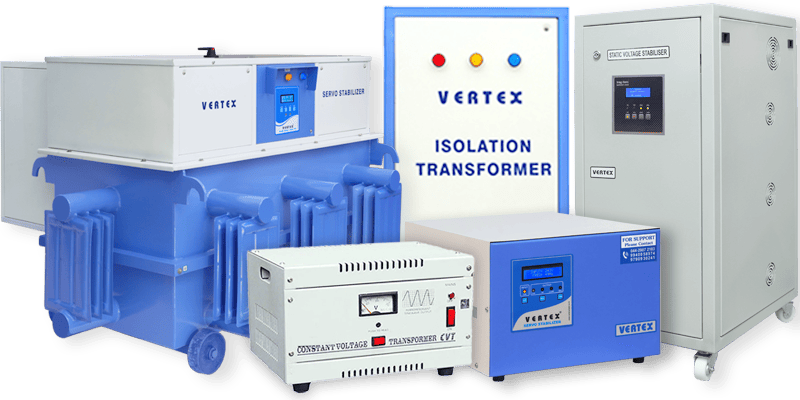
At Vertex Power Solution, a servo voltage stabilizer manufacturer working with Indian workshops and factories, we see this pattern all the time. The damage is rarely dramatic. It is slow, expensive, and easy to blame on something else.
This guide explains what unstable voltage does to your equipment, how to spot it, and how to size and budget for protection. You will also find a simple sizing calculator and current price ranges.
What Is Voltage Fluctuation, and Why Is It Common in India?
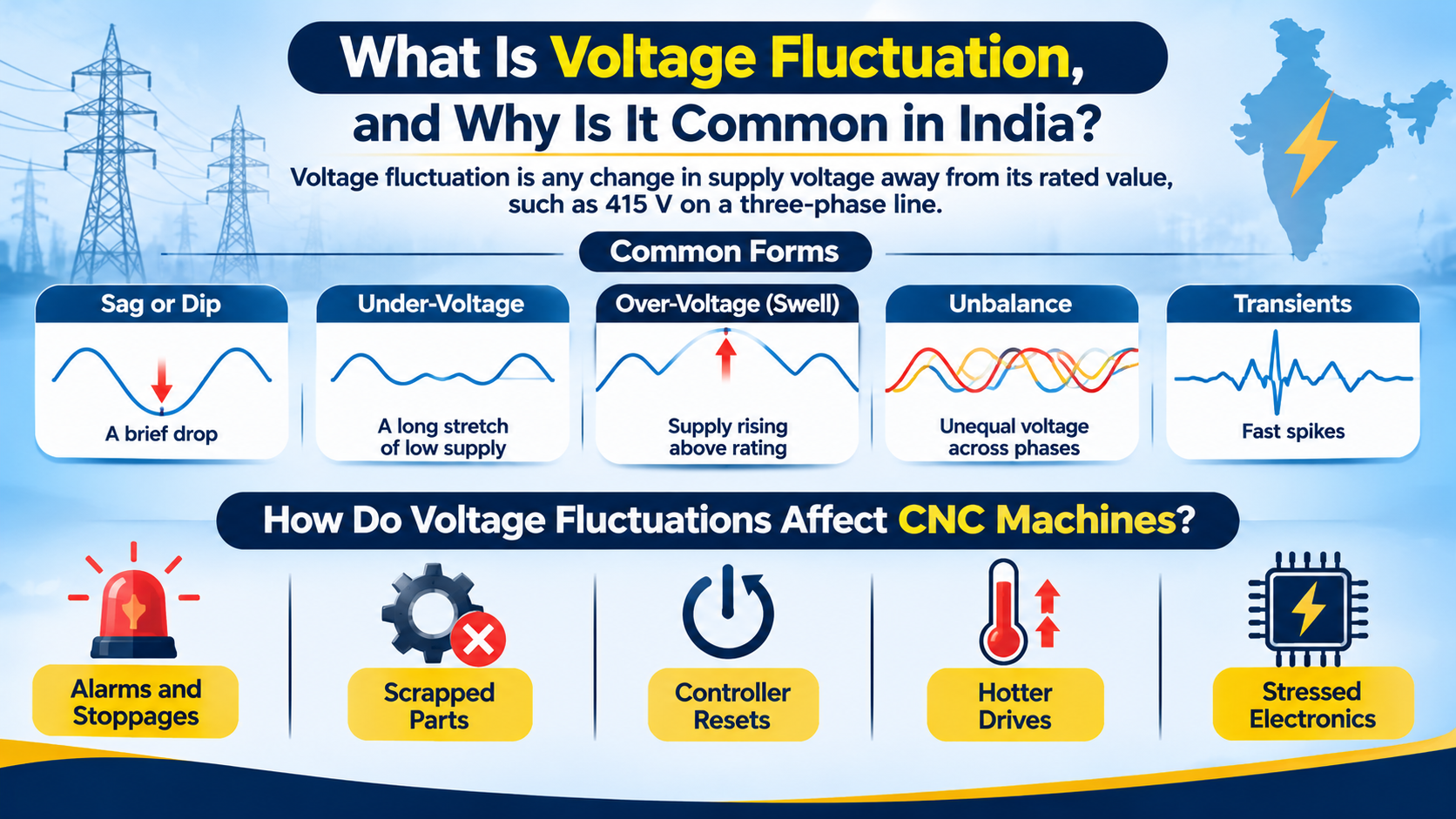
Voltage fluctuation is any change in supply voltage away from its rated value, such as 415 V on a three-phase line. It can be a short dip, a long under-voltage, a swell, or a mismatch between phases.
The usual forms look like this:
- Sag or dip: a brief drop, often when a large load starts nearby.
- Under-voltage: a long stretch of low supply, common at peak hours and at the far end of long feeders.
- Over-voltage (swell): supply rising above rating, often at night when demand is low.
- Unbalance: the three phases do not carry equal voltage.
- Transients: very fast spikes caused by switching or lightning.
Under the CEA safety regulations, supply companies must keep low-voltage supply within ±6% of the declared voltage. Utility training material, however, has noted that real feeders often swing 10% or more. Your machines may see more than the rulebook promises.
How Do Voltage Fluctuations Affect CNC Machines?
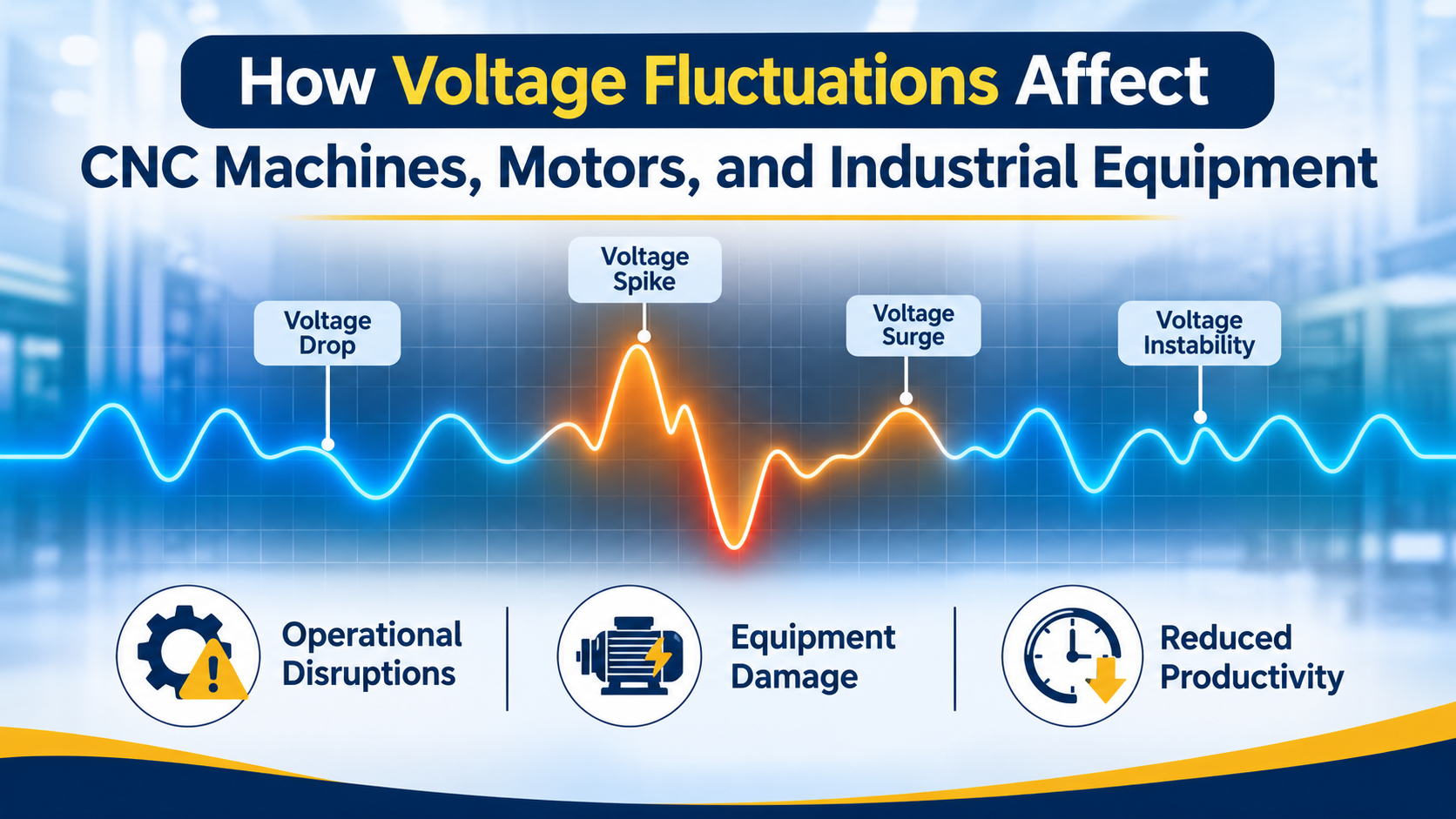
CNC machines are sensitive because their drives, controllers, and power supplies expect steady voltage. Dips and swells can trigger alarms, stop a program mid-cut, or slowly age the electronics.
- Alarms and stoppages: servo and spindle drives watch their internal DC supply. A dip can trip an under-voltage fault and halt the machine.
- Scrapped parts: a stop mid-cut can leave a half-machined component. On an expensive job, one stop can cost more than a stabilizer.
- Controller resets: short sags can reboot controllers and PLCs, forcing a restart and re-check.
- Hotter drives: at low voltage, drives and spindle motors draw more current for the same work.
- Stressed electronics: repeated swells and spikes age capacitors and power supplies.
Picture a job shop running a machining centre at the end of a long feeder. Every evening, voltage sags as nearby units switch on. The machine throws a drive alarm twice a week, and each restart means re-homing and re-checking the part. A few hours vanish every week, and nobody writes it down.
How Do Voltage Fluctuations Affect Electric Motors?
Motors react to voltage with heat. When voltage falls, current rises to deliver the same power, and extra current means extra heat inside the windings. Over time, that heat breaks down insulation.
Here is what the motor research and standards say:
Condition | What happens | Result |
Low voltage (about 10% below rating) | Full-load current rises by roughly 10%, and efficiency drops by about 2% | More heat, shorter insulation life |
High voltage | Magnetic core works harder and magnetising current climbs | Overheating, extra noise |
1% voltage unbalance | Current unbalance of 6–10% in a fully loaded motor | One winding runs hotter than the others |
5% voltage unbalance | NEMA guidance suggests derating to about 75% of rated power | The motor can safely deliver only about three-quarters of its rating |
Motor standards allow operation within about ±10% of rated voltage. But “operates” is not the same as “lasts for years.” A motor can run inside that band and still age faster than it should.
Unbalance deserves special attention. It is easy to miss, because each phase may look acceptable on its own while the gap between them quietly overheats the motor.
What Other Industrial Equipment Suffers From Unstable Voltage?
Almost anything with a motor, drive, or circuit board is affected. The common casualties in Indian plants include:
- Compressors and pumps: repeated overload trips and hot windings.
- Variable frequency drives: under-voltage and over-voltage faults, especially at shift start.
- PLCs and control panels: random resets and communication errors.
- Injection moulding and packaging machines: heater and drive faults that spoil a batch.
- Chillers and air conditioners: compressor stress and nuisance trips.
- Lighting and LED drivers: flicker and early failure.
How Can You Tell Voltage Is Hurting Your Plant?
Look for patterns, not single events. Problems that cluster around certain hours usually point to supply voltage rather than faulty machines.
- Motors feel hot to the touch or smell of varnish.
- Breakers and overload relays trip without an obvious reason.
- CNC or drive alarms appear at the same time each day.
- Lights dim when a large machine starts.
- Control boards and capacitors fail more often than they should.
What Is the 7-Day Voltage Log, and Why Should You Do It First?
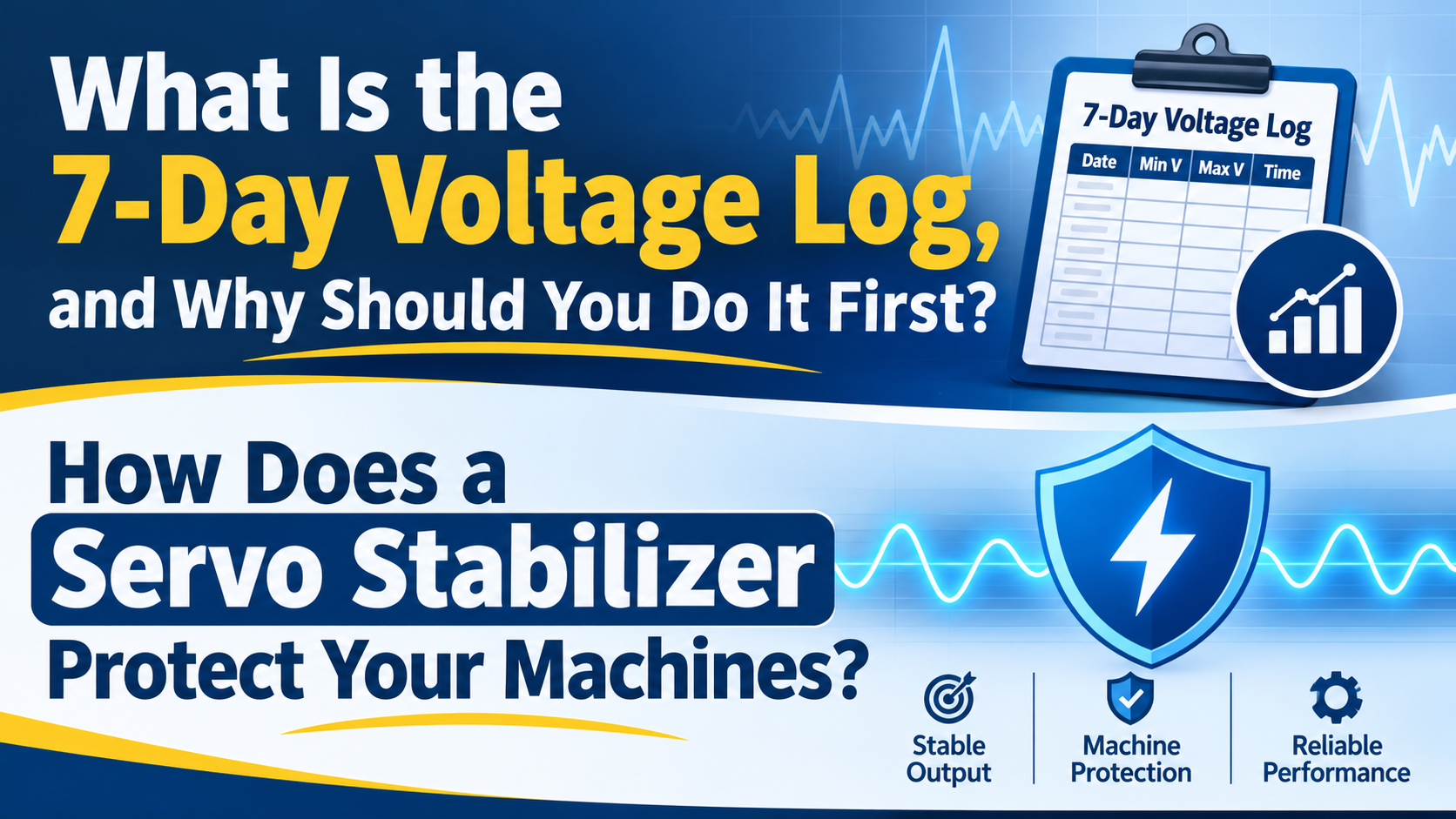
The 7-day voltage log is a week of voltage readings taken at your machine terminals while the plant is working. It shows the real problem, so you buy a stabilizer that fits it instead of guessing.
Most buyers skip this and size from the nameplate alone. That is where mistakes begin. Here is the simple method:
- Use a power analyser or logging meter, and record all three phases at the machine, not just in the meter room.
- Log for seven full days, including night shifts and weekends.
- Note the lowest and highest voltage, and the time each occurs.
- Calculate unbalance: the biggest gap between any phase and the average, divided by the average, times 100.
- Compare your lowest and highest readings with the stabilizer’s input correction range.
If your log shows phases drifting apart, ask for a three-phase unit with independent per-phase correction. A balanced-type unit corrects all three phases together and cannot fix the gap between them.
How Does a Servo Stabilizer Protect Your Machines?
A servo stabilizer is an automatic voltage regulator that uses a small servo motor to adjust a transformer, holding the output steady even when the input swings. Indian product listings commonly quote output accuracy of about ±1%.
A control circuit compares the output voltage with a set value. When they differ, the servo motor moves a brush along the transformer winding until the output is back on target.
One honest limit: servo units correct smoothly, at rates listed that commonly quote between roughly 20 and 50 volts per second. They are not built to stop microsecond spikes. Pair the stabilizer with surge protection if lightning or heavy switching is a concern.