

Why does the manufacturer matter more than the brochure?
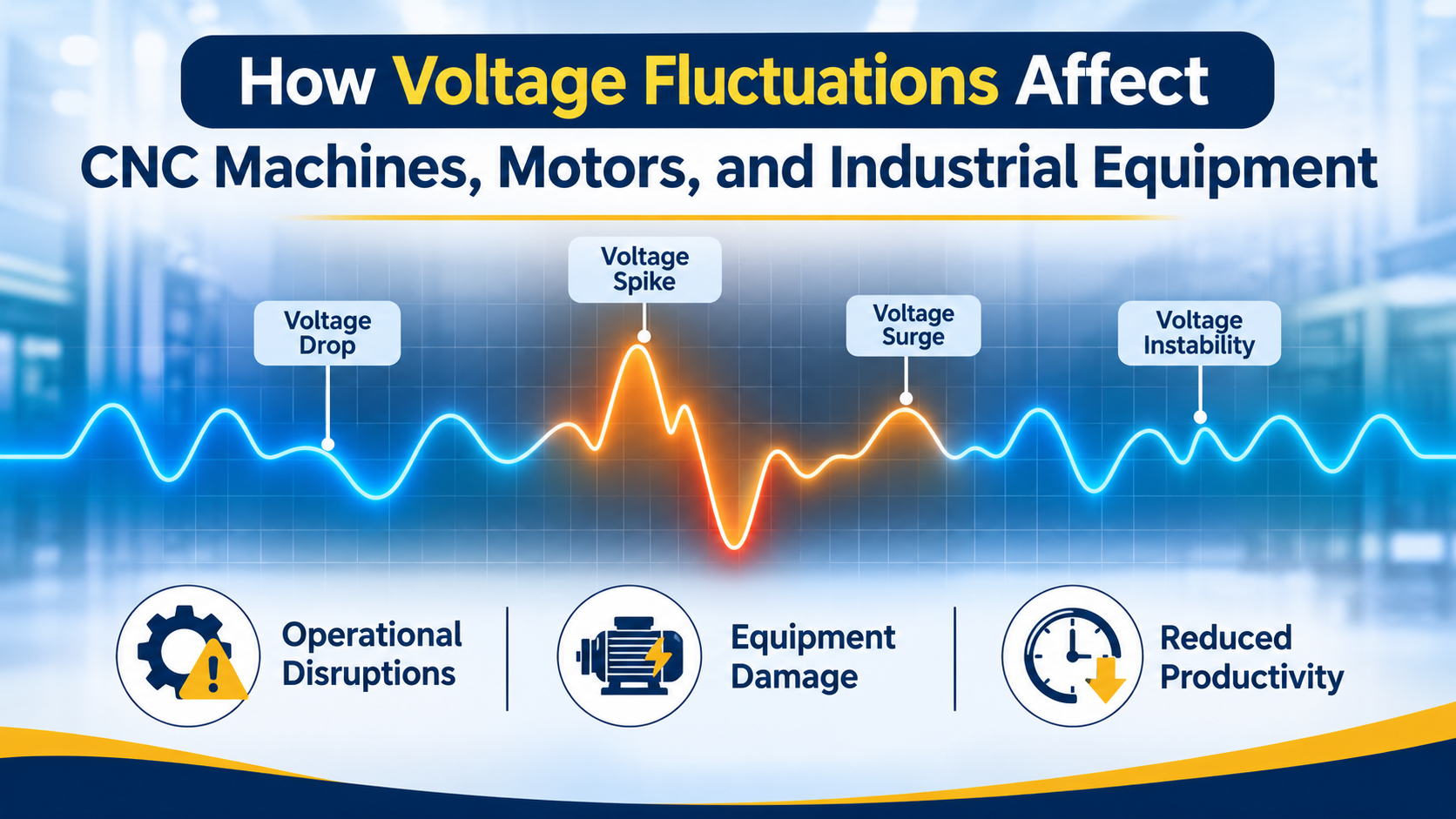
Picture a plastic moulding unit where voltage sags every afternoon, just when neighbouring factories fire up their furnaces. Machines trip. A heater band burns out. The production manager blames the machine, but the real culprit is the supply.
A servo stabilizer solves this, but only if it is sized and built properly. Two units with the same kVA label can behave very differently under load. So who builds it, and how they test it, matters as much as the rating on the nameplate.
This guide gives you a practical way to compare manufacturers, realistic price ranges, and a sizing calculator you can finish in five minutes.
What does a servo voltage stabilizer do?
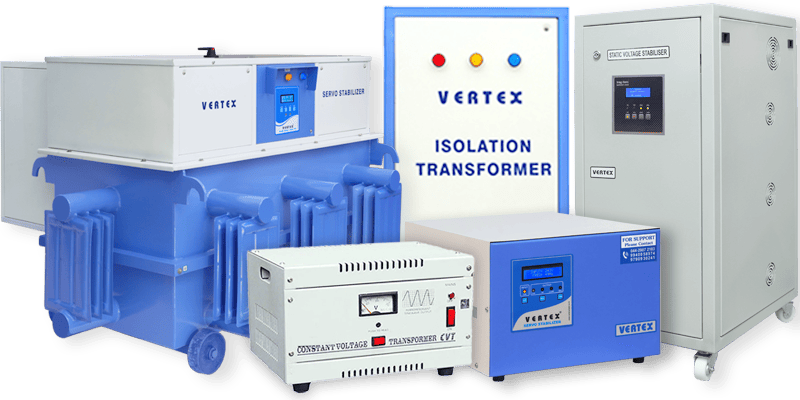
A servo voltage stabilizer is an electrical device that automatically keeps output voltage steady when the incoming supply rises or falls. A servo motor moves a brush along an autotransformer winding, adding or removing voltage as needed.
In a factory, that means CNC machines, compressors, textile machinery, and cold storage see steady voltage instead of the raw grid. Three-phase units do this across all three phases, and good designs correct each phase on its own. That matters when your load is unbalanced.
How do you choose a servo stabilizer manufacturer in India?
Shortlist manufacturers who can show test reports, declare copper windings, give a written warranty, and keep service engineers near your plant. Then compare quotes on identical specifications, never on headline price alone.
A good servo voltage stabilizer manufacturer will answer every point below without hesitation:
- Maker or middleman? Many online sellers are traders. Ask for the factory address and a video of your unit being tested.
- Winding material. Get it in writing. Copper is the usual benchmark.
- Input voltage window. Three-phase listings show windows such as 340–470 V or 360–460 V (line-to-line). Match the window to your worst-case readings, not the average.
- Output accuracy. Many manufacturers quote ±1%. Ask for a test at your actual load.
- Correction speed. Ask how many volts per second the unit corrects. Slow correction lets sensitive electronics feel the dip.
- Protections. Look for high- and low-voltage cut-off, overload and short-circuit protection, single-phasing protection, and a bypass switch.
- Warranty and service. Marketplace listings often show one to two years. Ask who visits, from which city, and how fast.
- Paperwork. Request a test certificate, GST invoice, and a datasheet stating cooling type and ambient temperature limit.
Air-cooled or oil-cooled: which one suits your plant?
Air-cooled stabilizers shed heat with air and fans, so they are compact and need less upkeep. Oil-cooled units keep the transformer immersed in oil and are usually preferred for heavy, continuous loads.
Feature | Air-cooled | Oil-cooled |
Cooling method | Natural or fan-forced air | Transformer immersed in oil |
Typical use | Small to mid-size loads, clean ventilated rooms | Heavy continuous loads, higher kVA |
Upkeep | No oil to check | Oil level and quality need periodic checks |
Footprint | Compact | Larger |
Cost | Generally lower | Generally higher (radiator, oil) |
How much does a servo stabilizer cost in India?
The servo voltage stabilizer price depends mostly on kVA rating, cooling type, winding material, and input range. A 3-phase voltage stabilizer 15kva unit sat anywhere from ₹33,000 to ₹85,000 in the listings sampled, and a few custom builds crossed ₹1.3 lakh. For the 40 kVA 3-phase servo stabilizer price, most listings fell between ₹40,000 and ₹1,00,000.
Air-cooled servo voltage stabilizer price usually runs lower than oil-cooled, since there is no radiator or oil to supply. Air-cooled three-phase listings in the 15–40 kVA range averaged around ₹47,000.
Product | Typical listed range | Indicative average |
15 kVA, three-phase | ₹33,000–₹85,000 | ~₹55,000 |
40 kVA, three-phase | ₹40,000–₹1,00,000 | ~₹70,000 |
Air-cooled, three-phase, 15–40 kVA | ₹30,000–₹68,000 | ~₹47,000 |
servo stabilizer cost in India
What do most buyers skip? A 7-day voltage log
Record your incoming voltage for seven days before you request quotes. Your lowest and highest readings, not the average, decide the input range and capacity you need.
Ask your electrician to log each phase at the incomer. Note readings at shift change, the midday peak, and late evening, and write down when the lows and highs happen. Then:
- Note the minimum and maximum for each phase.
- Send the same spec sheet (kVA, input window, cooling type, protections, ambient temperature) to three manufacturers.
- Ask each one: does the rated kVA hold at my lowest voltage and my hottest day? Get the answer in writing.
This changes the conversation from “what do you have in stock?” to “prove it fits my site.” Honest manufacturers welcome that question. And because all three quotes use one spec sheet, you can finally compare them fairly.
What are the red flags when buying a servo stabilizer?
Walk away, or at least pause, if you see any of these:
- A price far below every other quote, with no explanation
- No factory address, only a phone number
- Refusal to share a test video or certificate
- A vague warranty that does not say what is covered
- No bypass switch or no high/low cut-off
- Pressure to decide before you share your load and voltage data
How do you calculate the servo stabilizer capacity you need?
This calculator converts your connected load into the kVA rating to ask for, with a safety margin built in. It takes about five minutes and gives you a number you can put on your spec sheet.
The formula, in plain language:
Required kVA = (Total running load in kW ÷ Power factor) × (1 + Safety margin)
Then round up to the next available stabilizer size.
Input | What to enter | Where to find it |
Total running load (kW) | Sum of the machines that run at the same time | Machine nameplates |
Power factor | Usually 0.8–0.95 for industrial loads; 0.8 is a cautious guess if unknown | Electricity bill or power meter |
Safety margin | 25% (0.25) is a common rule of thumb | Raise it for frequent motor starts or planned expansion |
Lowest input voltage | Your worst reading from the 7-day log | Voltage log |
Worked example: a workshop runs a 25 kW load at a 0.85 power factor.
- 25 kW ÷ 0.85 = 29.41 kVA
- 29.41 × 1.25 (adding a 25% margin) = 36.76 kVA
- Round up to the next size: 40 kVA
So this workshop should ask for a 40 kVA three-phase unit, then confirm that the rating holds at its lowest recorded voltage.
Sample results:
Running load | Power factor | Margin | Calculated kVA | Ask for |
9 kW | 0.80 | 25% | 14.06 | 15 kVA |
18 kW | 0.85 | 25% | 26.47 | 30 kVA |
25 kW | 0.85 | 25% | 36.76 | 40 kVA |
40 kW | 0.90 | 25% | 55.56 | 60 kVA |
This is a first estimate. Motor-heavy loads draw extra current at start-up, so confirm the final size with your manufacturer.
Conclusion
Choosing a servo voltage stabilizer manufacturer is really a risk decision. Check that they build their own units, declare copper windings, test at your load, and stand behind the warranty. Log your voltage, size the unit with the calculator, and compare three quotes on one spec sheet.
FAQ
Who is the best servo stabilizer manufacturer in India?
There is no single best maker, only the best fit for your site. Choose a manufacturer that sizes the unit from your measured load and voltage data, declares copper windings, provides test reports, offers a clear warranty, and has service engineers within reach of your plant.
How do I calculate the kVA rating I need?
Divide your total load in kW by the power factor, then add a safety margin of about 25%. Round up to the next available size. For example, 25 kW at a 0.85 power factor needs roughly 36.8 kVA, so a 40 kVA unit fits. Motor-heavy loads may need extra headroom, so confirm with the manufacturer.
Is an air-cooled or oil-cooled servo stabilizer better for factories?
Neither wins everywhere. Air-cooled units are compact, simpler to maintain, and usually cheaper, which suits small to mid-size loads in clean, ventilated spaces. Oil-cooled units are generally chosen for heavy, continuous loads and higher capacities. Check your ambient temperature, duty cycle,e and available floor space before deciding.
How much does a 15 kVA three-phase servo stabilizer cost?
Marketplace listings reviewed in late 2025 and 2026 ranged from about ₹33,000 to ₹85,000, with an indicative average near ₹55,000. Branded and custom builds can cost more. Prices change with cooling type, winding material, and input range, so always request a written quotation with GST clearly stated.
What warranty should I expect on a servo stabilizer?
Listings on Indian marketplaces commonly show one to two years of warranty on servo stabilizers. What matters more is what the warranty covers and who services it. Ask whether the servo motor, controller,r and transformer are covered, and how quickly an engineer can reach your site.
Can a servo stabilizer handle unbalanced three-phase loads?
Yes, if it is designed for it. Many industrial models correct each phase independently, which keeps output steady even when phases carry different loads or arrive at different voltages. Not every unit does this, so ask the manufacturer to confirm per-phase correction and check it in the datasheet.