


Introduction
Choose a servo voltage stabilizer manufacturer by checking five things: compliance with IS 9815 and a type test report, the right kVA rating for your load, output accuracy of ±1%, a service network near your site, and verifiable references from similar industries. Compare on total ownership cost, not just price. A wrong pick shows up later as tripping machines, burnt motors, or a service call nobody answers. This guide helps you avoid that.
Why does the manufacturer matter more than the brand name?
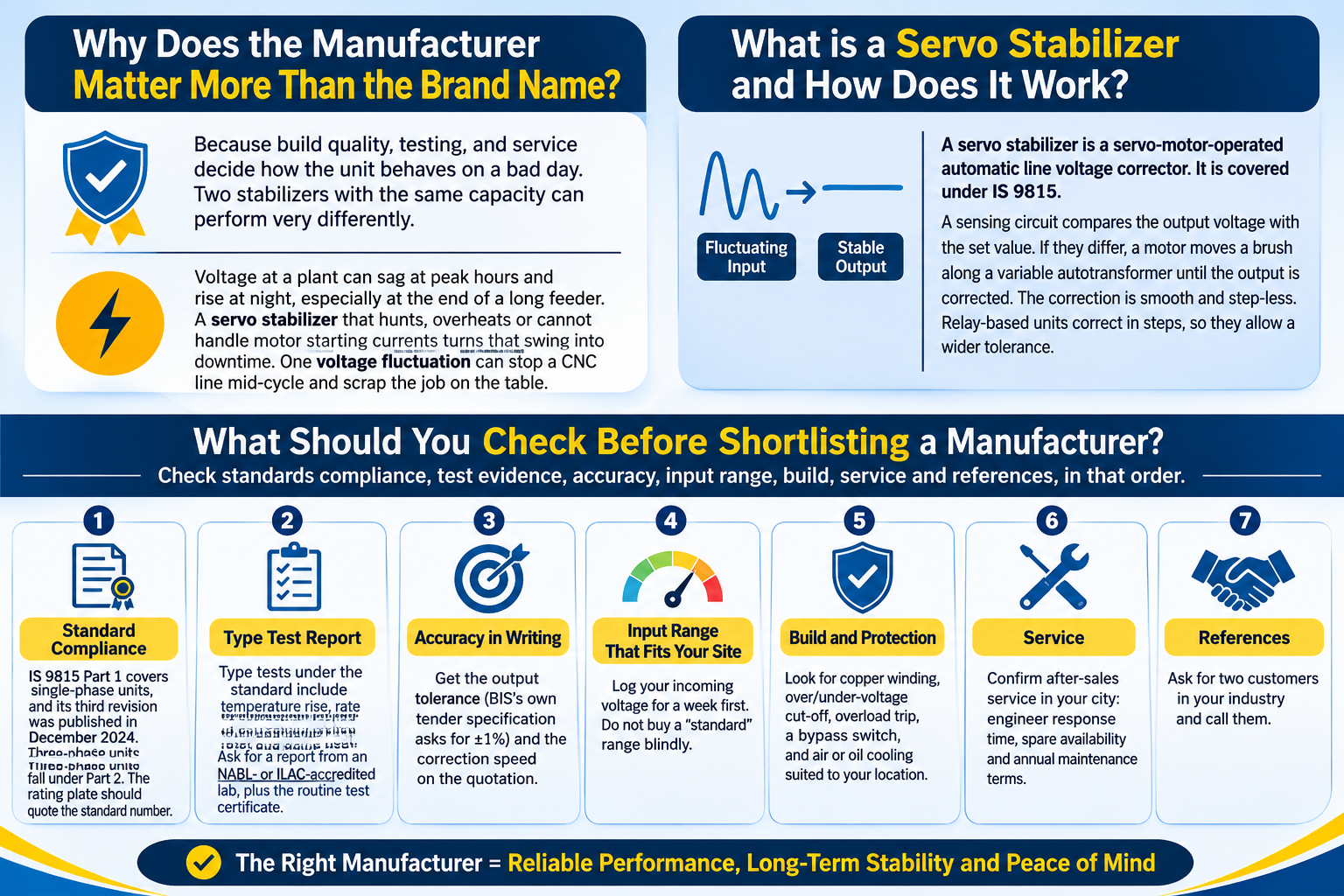
Because build quality, testing, and service decide how the unit behaves on a bad day. Two stabilizers with the same capacity can perform very differently.
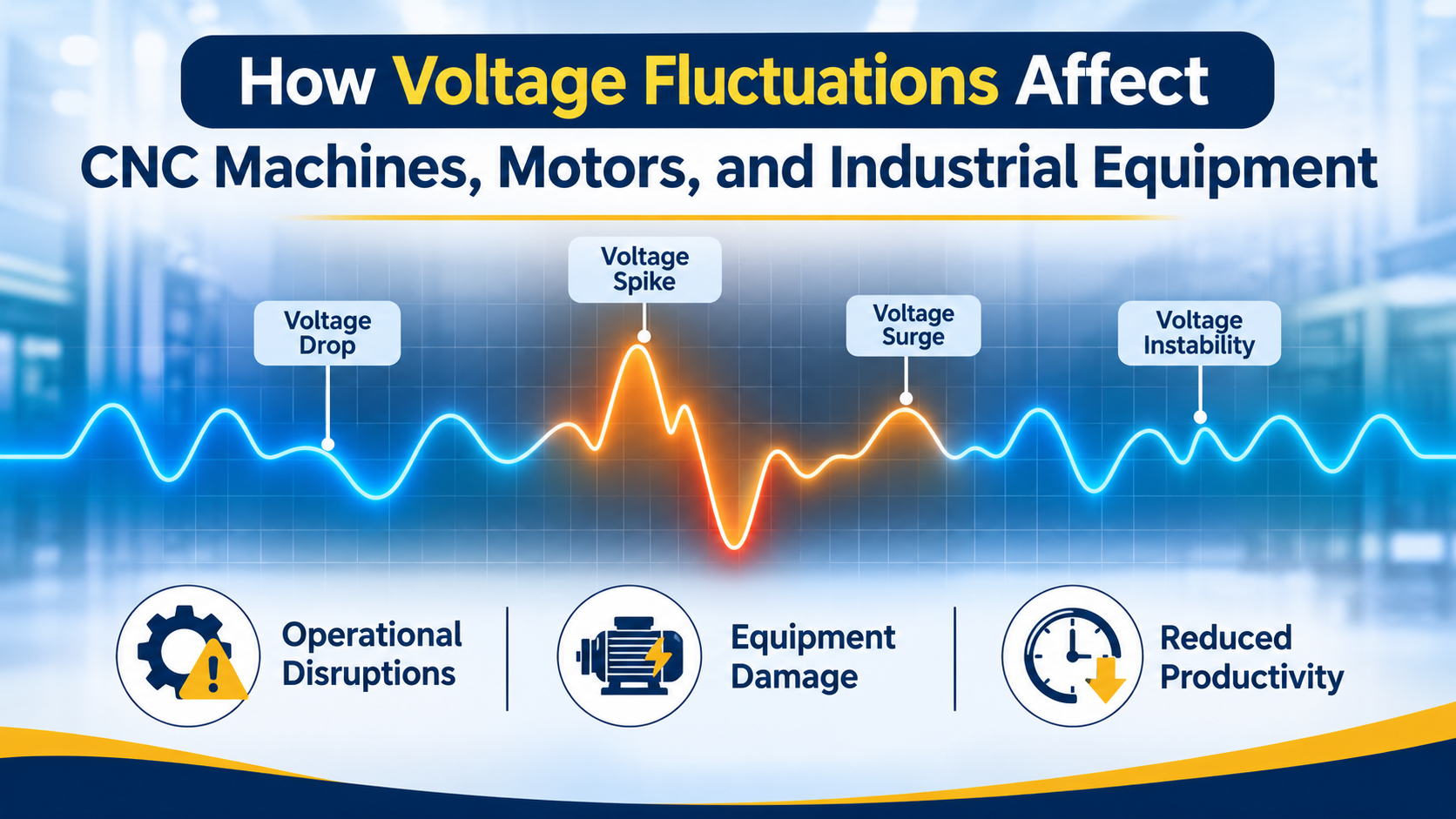
Voltage at a plant can sag at peak hours and rise at night when load drops, especially at the end of a long feeder. A servo stabilizer that hunts, overheats or cannot handle motor starting currents turns that swing into downtime. One voltage fluctuation can stop a CNC line mid-cycle and scrap the job on the table.
What is a servo stabilizer and how does it work?
A servo stabilizer is a servo-motor-operated automatic line voltage corrector. BIS covers it under IS 9815.
A sensing circuit compares the output voltage with the set value. If they differ, a motor moves a brush along a variable autotransformer until the output is corrected. The correction is smooth and step-less. Relay-based units correct in steps, so they allow a wider tolerance.
What should you check before shortlisting a manufacturer?
Check standards compliance, test evidence, accuracy, input range, build, service and references, in that order. Here is the sequence I recommend.
- Standard compliance. IS 9815 Part 1 covers single-phase units, and its third revision was published in December 2024. Three-phase units fall under Part 2. The rating plate should quote the standard number.
- Type test report. Type tests under the standard include temperature rise, rate of correction, locked rotor and damp heat. Ask for a report from an NABL- or ILAC-accredited lab, plus the routine test certificate for your unit’s serial number.
- Accuracy in writing. Get the output tolerance (BIS’s own tender specification asks for ±1%) and the correction speed on the quotation.
- Input range that fits your site. Log your incoming voltage for a week first. Do not buy a “standard” range blindly.
- Build and protection. Look for copper winding, over/under-voltage cut-off, overload trip, a bypass switch, and air or oil cooling suited to your location.
- Service. Confirm after-sales service in your city: engineer response time, spare availability and annual maintenance terms.
- References. Ask for two customers in your industry and call them.
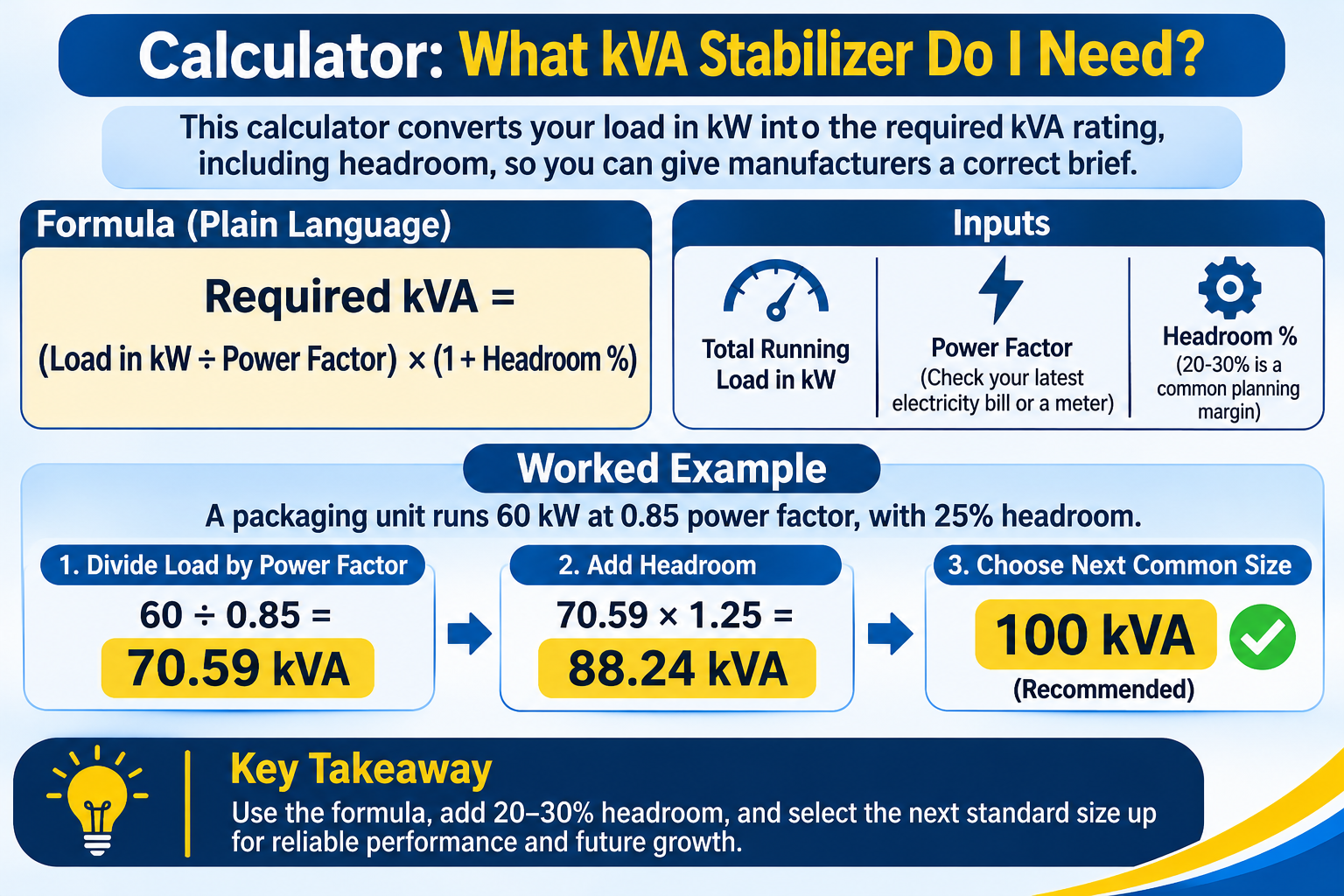
Calculator: What kVA stabilizer do I need?
This calculator converts your load in kW into the required kVA rating, including headroom, so you can give manufacturers a correct brief.
Formula (plain language):
Required kVA = (Load in kW ÷ Power factor) × (1 + Headroom %)
Inputs:
- Total running load in kW
- Power factor (check your latest electricity bill or a meter)
- Headroom % (20-30% is a common planning margin)
Worked example: A packaging unit runs 60 kW at 0.85 power factor, with 25% headroom.
- 60 ÷ 0.85 = 70.59 kVA
- 70.59 × 1.25 = 88.24 kVA
- Next common size up: 100 kVA
Sample scenarios:
Load (kW) | Power factor | Headroom | Required kVA | Pick |
20 | 0.90 | 20% | 26.67 | 30 kVA |
45 | 0.80 | 25% | 70.31 | 75 kVA |
60 | 0.85 | 25% | 88.24 | 100 kVA |
150 | 0.90 | 30% | 216.67 | 250 kVA |
For heavy motors, share the starting current with the manufacturer too. Standard sizes differ between makers.
Conclusion
The best servo voltage stabilizer manufacturer for you is the one that can prove its quality, size the unit to your real load, and show up when you call. Use the checklist, run the calculator, and score each quote. Do those three things and you will compare makers on evidence, not sales talk.