


Introduction
A servo voltage stabilizer protects factory machines by automatically correcting low, high, and fluctuating voltage to a steady output, usually 400 or 415 V in three-phase units. A motor-driven buck-boost mechanism corrects it smoothly. For Indian factories, it reduces breakdowns, motor overheating, and unplanned downtime. Nobody broke anything. The power simply wasn’t steady enough.
Why do factories in India need a servo voltage stabilizer?
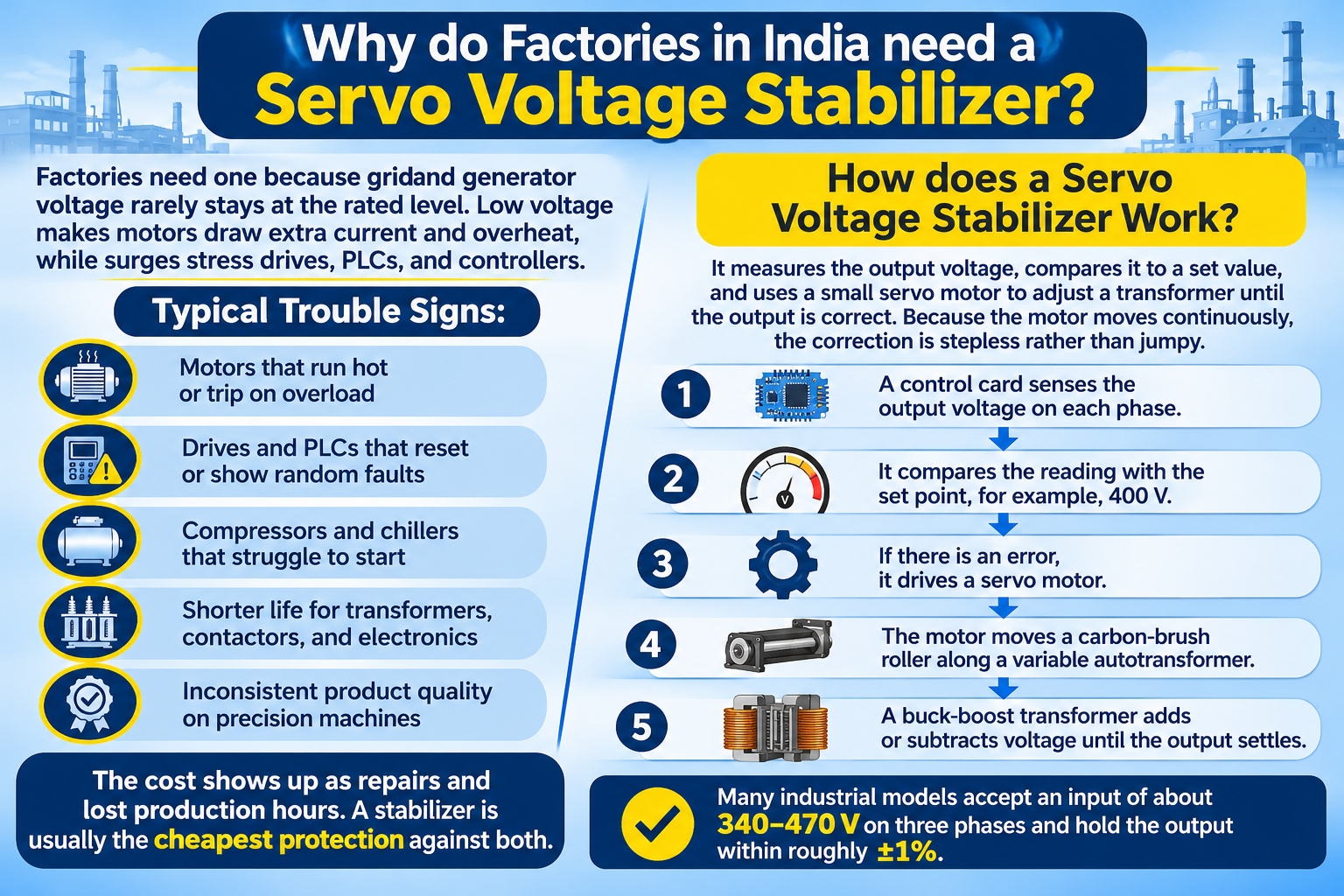
Factories need one because grid and generator voltage rarely stays at the rated level. Low voltage makes motors draw extra current and overheat, while surges stress drives, PLCs, and controllers.
Typical trouble signs include:
- Motors that run hot or trip on overload
- Drives and PLCs that reset or show random faults
- Compressors and chillers that struggle to start
- Shorter life for transformers, contactors, and electronics
- Inconsistent product quality on precision machines
The cost shows up as repairs and lost production hours. A stabilizer is usually the cheapest protection against both.
How does a servo voltage stabilizer work?
It measures the output voltage, compares it to a set value, and uses a small servo motor to adjust a transformer until the output is correct. Because the motor moves continuously, the correction is stepless rather than jumpy.
Here is the sequence:
- A control card senses the output voltage on each phase.
- It compares the reading with the set point, for example, 400 V.
- If there is an error, it drives a servo motor.
- The motor moves a carbon-brush roller along a variable autotransformer.
- A buck-boost transformer adds or subtracts voltage until the output settles.
Many industrial models accept an input of about 340–470 V on three phases and hold the output within roughly ±1%.
What is the average price of a 10 kVA 3-phase servo stabilizer in India?
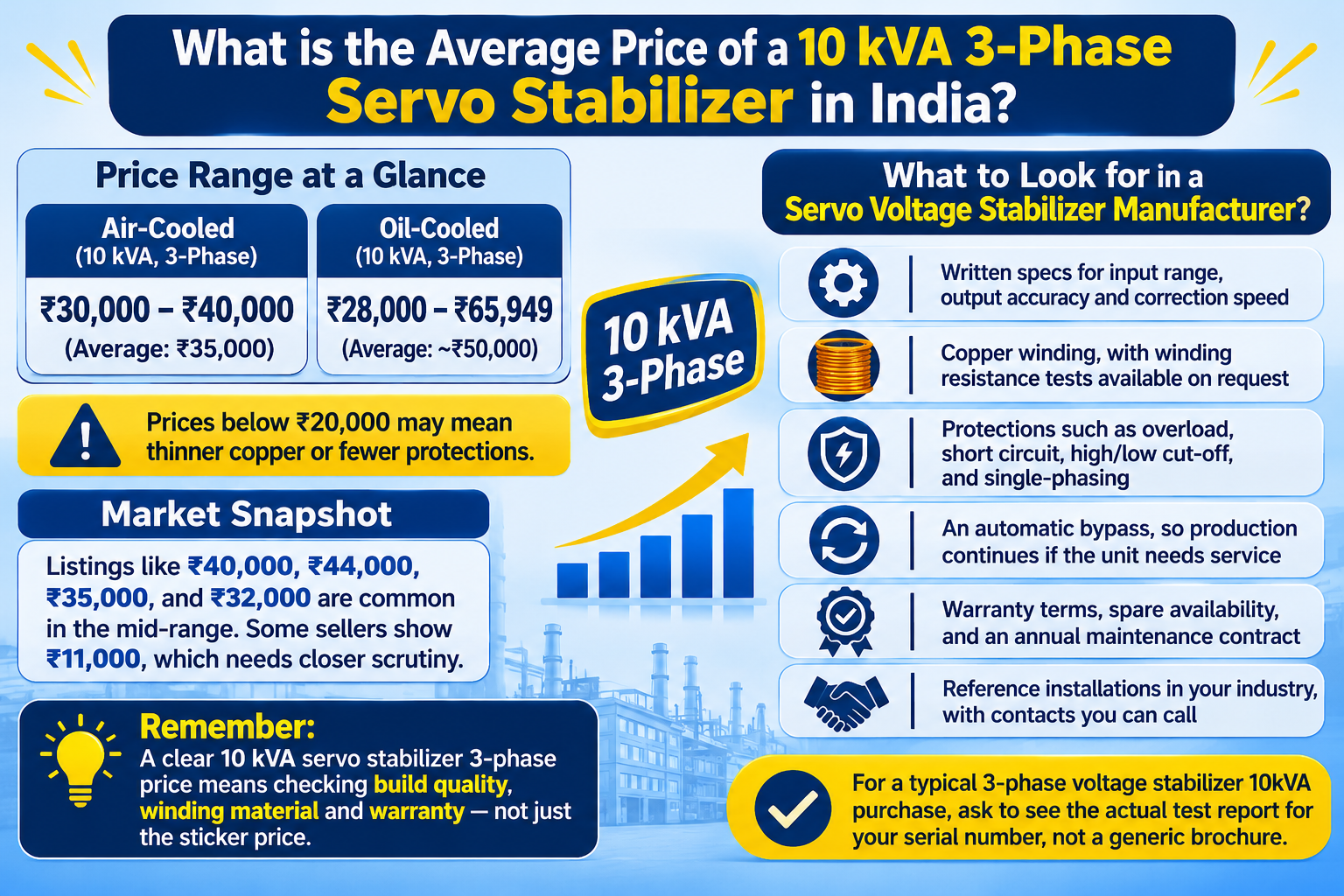
Most 10 kVA three-phase air-cooled servo units sell for about ₹30,000 to ₹40,000, with ₹35,000 a fair average. Oil-cooled 10 kVA models average about ₹50,000. Prices below ₹20,000 usually mean thinner copper or fewer protections.
Listings I reviewed spread widely. Examples include ₹40,000, ₹44,000, ₹35,000, and ₹32,000 at the middle of the market. At the bottom, some sellers show ₹11,000, which should make you ask what is inside.
A clear picture of the 10 kVA servo stabilizer 3-phase price needs more than the sticker figure. Check the winding material, the bypass switch, and the warranty before comparing.
For oil-cooled units, the oil-cooled servo voltage stabilizer price for 10 kVA ranged from ₹28,000 to ₹59,572–₹65,949 on the listings I found. Big brands sit at the top of that range.
These are marketplace figures, not quotes. They normally exclude GST, transport, and installation, so always get a written quotation.
What should you look for in a servo voltage stabilizer manufacturer?
Choose a servo voltage stabilizer manufacturer that shares test data, uses copper windings, offers service near your plant, and designs for your input range. A low price means little if the service engineer is three states away.
Use this checklist:
- Written specs for input range, output accuracy, and correction speed
- Copper winding, with winding resistance tests available on request
- Protections such as overload, short circuit, high/low cut-off, and single-phasing
- An automatic bypass, so production continues if the unit needs service
- Warranty terms, spare availability, and an annual maintenance contract
- Reference installations in your industry, with contacts you can call
For a typical 3-phase voltage stabilizer 10kVA purchase, ask to see the actual test report for your serial number, not a generic brochure.
Free tip: log your voltage for 7 days before you buy
Most buyers size a stabilizer from the nameplate and a guess. A better way is to record voltage on all three phases for a week.
Use a simple power-quality logger or the supplier’s demo meter. Note the lowest and highest readings, the time of day they happen, and how far the phases differ.
This tells you three things:
- The real input range you need, so you don’t pay for an unnecessarily wide one
- Whether a balanced or unbalanced design fits
- Whether the problem is the grid, your own wiring, or your generator
Calculator: how big a servo stabilizer does your factory need?
This calculator turns your connected load in kW into the kVA rating you should ask for. It uses the load’s power factor and adds a safety margin, then rounds up to the next standard size.
Formula, in plain language:
Required kVA = (Load in kW ÷ Power factor) × (1 + Safety margin)
Then choose the next standard rating your supplier offers.
Inputs you need:
- Total running load in kW (add up all machines on that stabilizer)
- Power factor (check the nameplate or energy meter; 0.8 is common for motor loads)
- Safety margin (25% as a general rule; 40% if heavy motors start often)
How do you maintain a servo stabilizer?
Do a basic check every month and a full service once a year. Most failures come from dust, worn carbon brushes, or low oil, not from the stabilizer’s design.
- Monthly: clean air filters and vents, listen for unusual motor noise, and check the display readings against a meter.
- Every six months: inspect brushes and rollers for wear, and tighten terminals.
- Yearly: test protections, check oil level and condition on oil-cooled units, and review earthing.