
Introduction

A reliable servo voltage stabilizer for heavy industrial machinery has copper windings, a correctly sized kVA rating with spare capacity, independent per-phase correction, accurate regulation, full protections, and proper cooling. It should also come from a proven servo voltage stabilizer manufacturer that offers testing, spares, and service support in India.

Voltage trouble rarely announces itself. A press motor runs a little hotter every afternoon. A CNC controller resets twice a week. A drive trips only when the neighbouring unit starts up. By the time the pattern is obvious, the damage has often been done: worn windings, scrapped parts and lost shifts. A stabilizer is the cheapest insurance against that, but only if it is built and sized properly.

What is a servo voltage stabilizer, and why do heavy machines need one?

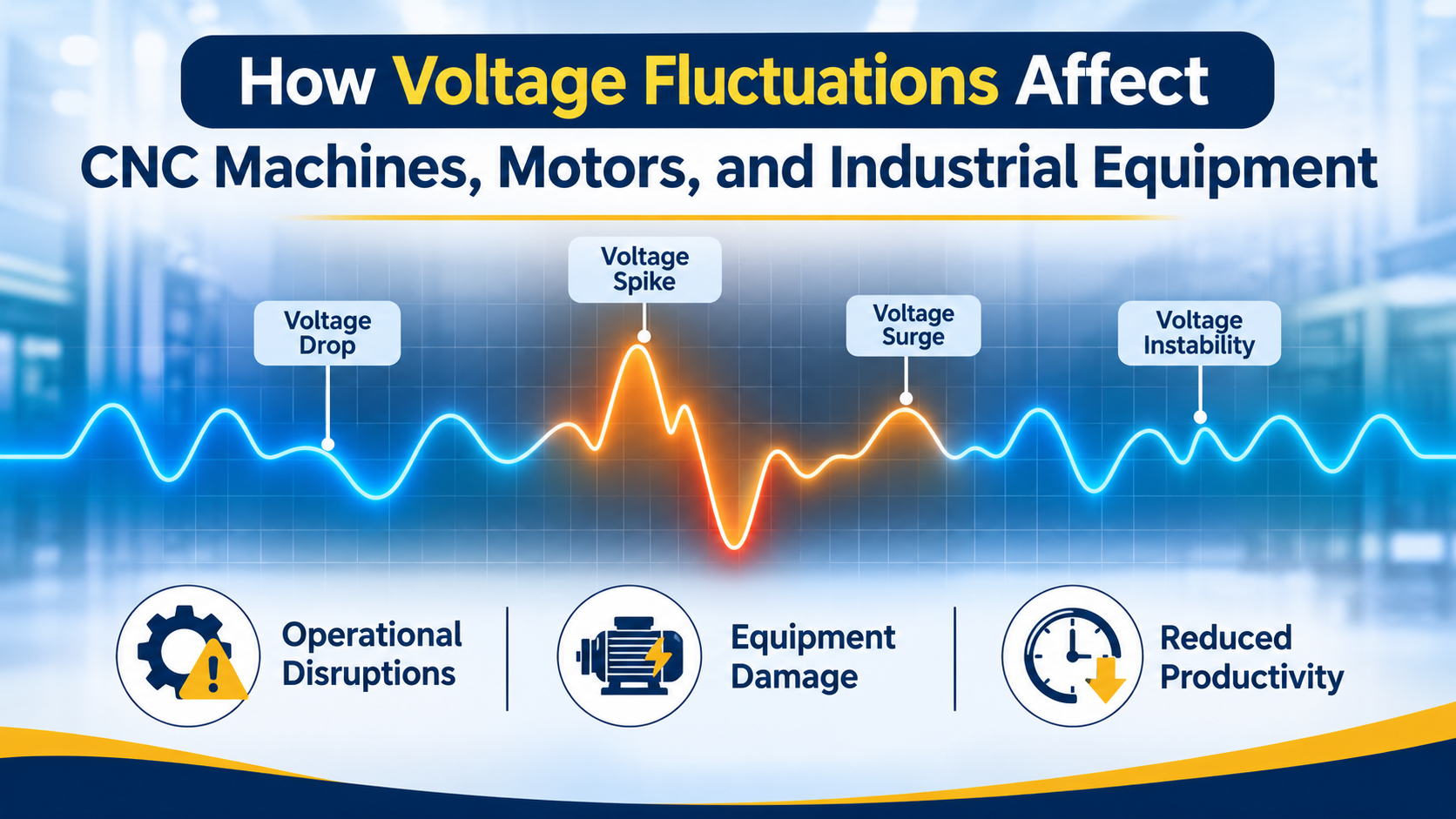
A servo voltage stabilizer is an electromechanical device that holds output voltage steady when the incoming supply rises or falls. Heavy machines need it because motors and drives are sensitive to low, high, and unbalanced voltage.

Inside, a control circuit compares output voltage with a set value. If it drifts, a servo motor moves a carbon brush along a copper-wound transformer. The output is corrected smoothly, without sudden jumps.

Here is why that matters on the shop floor:

  • Low voltage: motors draw extra current to deliver the same torque, so they run hotter.
  • High voltage: insulation, contactors, and electronics are stressed.
  • Unbalanced phases: one engineering reference estimates that a 5% voltage unbalance raises motor heating by roughly 25%.
  • Drive sensitivity: CNC controllers and VFDs often trip when supply sags or one phase dips.

Servo units are slower than static (thyristor) types because they move mechanical parts. In return, they handle large capacities and wide input swings with very smooth output, which is why heavy industry prefers them.

What makes a servo stabilizer reliable for heavy machinery?

Reliability comes from build quality, correct sizing, and after-sales support, not from a brand sticker. Check the winding material, correction method, input range, protections, and serviceability before you compare quotes.

Feature

What to look for

Why it matters

Winding

Copper-wound autotransformer

Runs cooler and holds its rating under continuous load

Phase correction

Independent per-phase control

Fixes unbalanced supply, common in factories

Output accuracy

Around ±1% is typical for good units

Keeps drives and PLCs within their tolerance

Input range

Wide enough to cover your lowest recorded voltage

A narrow range fails exactly when you need it

Protections

Overload, short circuit, high/low cut-off, phase failure

Stops a bad day from becoming a burnt motor

Bypass switch

Manual or automatic bypass

Lets you service the unit without stopping the plant

Serviceability

Accessible brushes, rollers and spares

Carbon brushes are wear parts

Two cautions. First, efficiency figures such as 98% appear on nearly every datasheet, so ask how and at what load they were measured. Second, a ±1% claim at no load means little. Ask for output readings at full load and at your lowest input voltage.

choose the right kVA rating

How do you choose the right kVA rating?

Size the stabilizer from the current your machines actually draw on the busiest phase, then add 20-30% spare capacity. Finally, check how your biggest motors start.

A 3-phase voltage stabilizer 15kva suits a small workshop whose running load is around 11-12 kVA. A fabrication line or a few CNC machines usually need 25-60 kVA. Guessing from machine nameplates alone often leads to oversizing or, worse, undersizing.

Three points are easy to miss:

  1. Use the busiest phase. Unbalanced loads overload one phase first, so size on the highest phase current, not the average.
  2. Plan for motor starting. Direct-on-line starting can pull 6-8 times the running current, while star-delta starting is roughly 2-3 times. A soft starter or star-delta panel eases the burden on the stabilizer.
  3. Allow for growth. If you plan to add a machine within two years, size for it now. Replacing a stabilizer is costlier than buying one step up.

The calculator below does the maths for you.

How much does a servo stabilizer cost in India?

In November 2026, a 15 kVA three-phase unit averaged about ₹59,000 and a 40 kVA unit about ₹78,000 across the Indian listings we reviewed. Exact quotes vary with copper weight, cooling type, and brand.

Capacity (three-phase)

Typical range seen

Sample average

10 kVA

₹35,000 to ₹59,600

about ₹45,000

15 kVA

₹33,000 to ₹85,000

about ₹59,000

40 kVA

₹40,000 to ₹1,29,700

about ₹78,000

Most 40 kVA listings cluster between ₹55,000 and ₹86,000. The 40 kVA 3-phase servo stabilizer price stretches higher for branded oil-cooled models, which were listed around ₹1.16-1.30 lakh.

Notice the price per kVA. It works out to about ₹3,900 per kVA at 15 kVA but about ₹1,950 at 40 kVA in this sample. Larger units cost more in total but less per unit of capacity.

Before you compare quotes:

  • Confirm whether 18% GST is included. Many listings show prices before tax.
  • Ask for the winding material and net weight. A suspiciously light unit often has thinner copper.
  • Compare warranty terms. Listings in our sample mostly offered one to two years.
  • Ask about freight, installation, and commissioning, which are often quoted separately.

Air-cooled or oil-cooled: which is better for industrial use?

Air-cooled units suit clean, ventilated rooms and small to mid-size loads. Oil-cooled units dissipate heat better, so they are the safer pick for hot, dusty, or continuous heavy-duty sites.


Air cooled

Oil cooled

Heat handling

Good in ventilated rooms

Better in hot or dusty plants

Upkeep

Keep vents and filters clean

Check oil level and condition

Weight and size

Lighter, easier to install

Heavier, needs a firm base

Cost

Lower

Higher

Air-cooled servo voltage stabilizer prices are usually lower. In our sample, 15 kVA three-phase air-cooled units were listed from about ₹36,900 to ₹67,800, averaging near ₹48,000. Oil-cooled units of the same size ran from ₹38,000 to ₹85,000, averaging near ₹66,000.

A practical rule: if the panel room reaches high temperatures in summer, or fine dust (textile lint, cement, metal) is part of daily life, lean towards oil cooling and budget for it.

How can you test a stabilizer before you buy it?

Log your own supply for a week, then ask the manufacturer to prove the unit works at your worst voltage, on a full load, on every phase. Few buyers do this, and it filters out weak products quickly.

Here is a simple six-step routine:

  1. Record your supply for seven days. Use a power-quality logger or ask your electrician. Note the lowest, highest, and most unbalanced readings.
  2. Pick the input range from that log, not from a brochure. Your recorded minimum should sit comfortably inside the stabilizer’s range.
  3. Ask for a witnessed test. Run the unit at your lowest input voltage with a real or dummy load.
  4. Read the output on each phase. All three should stay within the stated accuracy, not just one.
  5. Run a heat test. Let it work at load for a few hours and check winding and enclosure temperature.
  6. Ask about service. How fast can brushes, rollers, and control cards reach your plant, and who will visit?

One more habit that pays off: keep a spare carbon brush set and a spare control card on site. A stabilizer that is down for three days waiting for a part is no protection at all.
Servo stabilizer sizing calculator: what rating do you need?

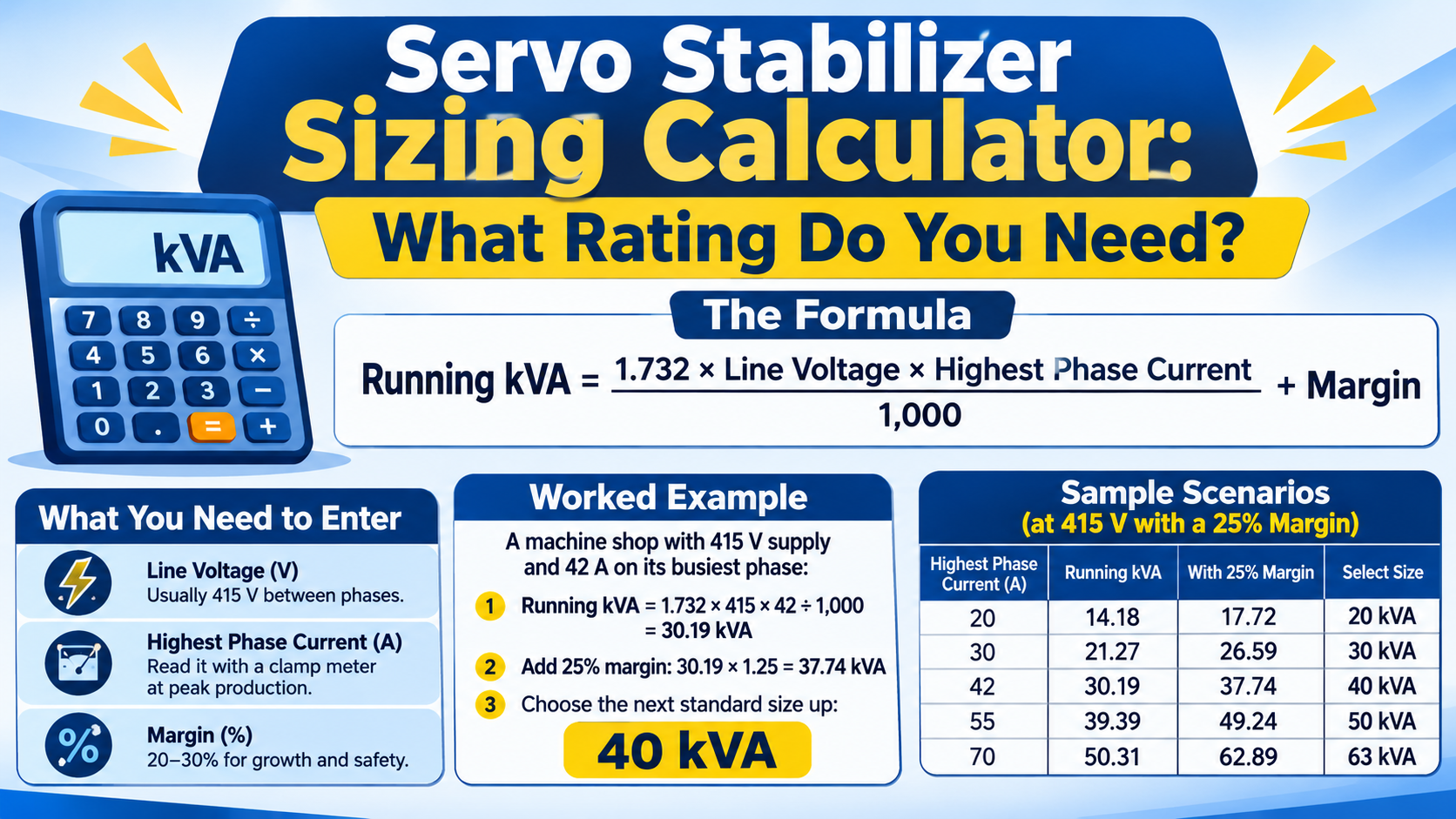
This calculator turns the current on your busiest phase into the stabilizer rating you should ask for. It works for 415 V three-phase plants and takes about two minutes.

The formula in plain language: multiply 1.732 by the line voltage and the highest phase current, divide by 1,000 to get running kVA, then add your spare-capacity margin.

What you need to enter:

  • Line voltage (V): usually 415 V between phases.
  • Highest phase current (A): read it with a clamp meter at peak production.
  • Margin (%): 20- 30% for growth and safety. The example uses 25%.

Worked example: a machine shop with a 415 V supply and 42 A on its busiest phase:

  1. Running kVA = 1.732 × 415 × 42 ÷ 1,000 = 30.19 kVA
  2. Add 25% margin: 30.19 × 1.25 = 37.74 kVA
  3. Choose the next standard size up: 40 kVA

Sample scenarios at 415 V with a 25% margin:

Scenario

Highest phase current

Running kVA

Required kVA

Pick

Small workshop

16 A

11.50

14.38

15 kVA

CNC shop

24 A

17.25

21.56

25 kVA

Machine shop (example)

42 A

30.19

37.74

40 kVA

Packaging plant

60 A

43.13

53.91

60 kVA

If your biggest motor starts direct-on-line, also ask the manufacturer for the unit’s overload rating and how long it can hold it. Starting current is brief, but the stabilizer still has to carry it.

Conclusion: protect the machines that make your money

A reliable stabilizer is not the cheapest one on the quote sheet. It is the one with copper windings, per-phase correction, the right input range, honest test results,s and a service team that picks up the phone.

Start with a week of voltage logging, size the unit with the calculator above, and insist on a witnessed load test. That routine alone avoids most expensive mistakes.

Ready to size a stabilizer for your plant? Share your load details with Vertex Power Solution  : capacity, cooling type, and input range. 
FAQ

What does a servo stabilizer do for factory machines?

It keeps the voltage reaching your machines within a safe band when the supply sags or surges. A control circuit senses the output, and a servo motor moves a carbon brush over a copper-wound transformer to correct it. This protects motors, drives, and controllers from overheating, nuisance trips,s and premature failure.

Is a servo or static stabilizer better for heavy machinery?

Servo stabilizers are usually preferred for heavy machinery because they handle large capacities, wide input swings, and unbalanced phases with smooth output. Static (thyristor) stabilizers respond faster and have no moving parts, so they suit sensitive electronics that cannot tolerate even brief deviations. In short: servo for power, static for speed.

How much extra capacity should I add?

Add 20-30% above the running kVA measured on your busiest phase. This covers load growth, ageing, and short overloads. If your largest motor starts direct-on-line, also ask the manufacturer about overload capacity, or use a star-delta or soft starter to reduce the starting surge.

What input voltage range should I choose?

Choose a range that fully covers the lowest and highest voltages you record at your site. Three-phase industrial units in Indian listings commonly span roughly 300-480 V line-to-line, with a 400-415 V output. Log your supply for a week first, because a range that is too narrow fails exactly when you need it.

How often does a servo stabilizer need maintenance?

Follow the manufacturer’s schedule, but plan regular inspection of carbon brushes, rollers, contacts, and cooling (clean vents or check oil level). Brushes are wear parts and the main moving components. Keep spares on site, and tighten terminals and clear dust at each visit to prevent failures.

How much does a 15 kVA three-phase servo stabilizer cost?

In our November 2026 sample of Indian listings, 15 kVA three-phase units ranged from about ₹33,000 to ₹85,000, averaging near ₹59,000. Air-cooled models sat lower, oil-cooled higher. Confirm GST, warranty, copper weight, and installation charges before comparing quotes, since these differ between sellers.

Leave a Reply

Your email address will not be published. Required fields are marked *