


Introduction
A voltage stabilizer looks like a simple purchase. You note the kVA, collect three quotes, and pick the cheapest one. Then a CNC controller starts resetting, or a motor trips every evening, and the savings disappear. Three-phase units are harder to get right than single-phase ones. One wrong choice can affect an entire production line. This guide covers what to check, what these units cost in India today, and how to size one yourself with a simple calculator.
Why does a three-phase servo stabilizer need extra care?
A three-phase servo stabilizer protects whole machines and lines, so a wrong kVA, input range, or correction type leaves expensive equipment exposed.
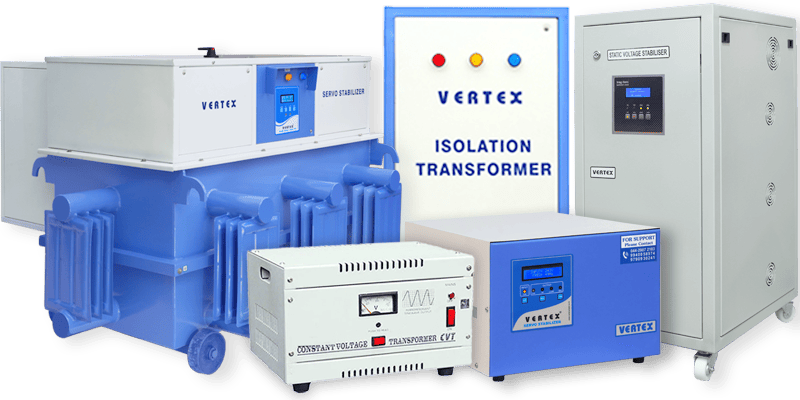
A servo voltage stabilizer corrects a fluctuating incoming supply to a steady output, usually 415 V in three-phase systems. A servo motor moves a carbon brush along a transformer winding to raise or lower the voltage automatically.
It is common with CNC machines, injection moulding, compressors, pumps, lifts, HVAC plants, and lab equipment. These loads dislike low voltage, high voltage, and phase imbalance, and they usually cost far more than the stabilizer.
What should you check before buying a three-phase servo stabilizer?
Check eight things: load size, input range, phase correction type, accuracy and speed, cooling, protections, build quality,y and after-sales support.
1. Is the kVA rating right for your load?
Size the unit on your actual connected load, not a guess. Convert kW to kVA using your power factor, then add a margin for motor starting and future machines. The calculator below does this for you.
Oversizing wastes money. Undersizing causes overload trips. Both are avoidable.
2. Does the input voltage range match your supply?
The input range is the lowest and highest incoming voltage the stabilizer can correct. Three-phase listings in India commonly show ranges such as 300–470 V or 340–460 V (line-to-line).
Pick a range that covers your worst day, not your average day. A wider range handles deeper sags, but check the minimum voltage at which the unit still starts.
3. Do you need independent correction on each phase?
If your phases carry unequal loads, ask for a stabilizer that corrects each phase separately (often sold as an “unbalanced load” type). A balanced-type unit corrects all three phases together and can leave one phase out of tolerance.
Factories with mixed single-phase and three-phase machines usually need independent correction.
4. What are the output accuracy and correction speed?
Accuracy is how closely the output stays to its set value. Many datasheets quote ±1%. Correction speed, given in volts per second, shows how quickly the unit reacts.
Do not accept a vague “high accuracy” line. Ask for the number, and ask whether it applies per phase.
5. Should you choose air-cooled or oil-cooled?
Air-cooled units use a dry-type transformer. Oil-cooled units use an oil-filled one. Neither is universally better.
Feature | Air cooled | Oil cooled |
Cooling method | Natural or fan air | Transformer oil |
Typical use | Clean, indoor, ventilated rooms | Heavy-duty, hot or dusty sites, larger ratings |
Maintenance | Dust cleaning, brush checks | Oil level checks plus brush checks |
Weight and size | Usually lighter | Usually heavier |
Be honest about your site. A hot, dusty plant room changes the answer.
6. Which protections are built in?
Look for over-voltage and under-voltage cut-off, overload and short-circuit protection, and phase failure and phase sequence protection. Add a bypass switch to the list.
A bypass lets you keep production running while the stabilizer is serviced. Many buyers ask for it only after the first breakdown.
7. How good is the build quality?
Check the winding material (copper is the usual preference), the servo motor, the brush, and the control card. Ask whether the controller is microprocessor-based and whether it shows voltages on a digital display.
Open the panel during inspection if you can. Neat wiring and tight terminations say a lot.
8. Who will support you after the sale?
A stabilizer runs for years, so service matters. Ask about warranty length, spare availability, and response time in your city. Warranty terms on listings vary, with one year being common.
If you buy from a servo voltage stabilizer manufacturer directly, you can also ask for customization, such as a special input range, and for factory test reports.
How can you test your site before you buy? (A tip most guides skip)
Log your incoming voltage for seven days before choosing the input range. It costs little and removes guesswork.
Most buying guides tell you to “know your voltage range” but never explain how. Here is a simple method:
- Ask your electrician to record phase-to-phase and phase-to-neutral voltage using a power quality logger or a clamp meter with logging.
- Note readings in the morning, afternoon, peak production hours, and late evening.
- Mark the lowest and highest values, and any dips when a large motor or generator switches in.
- Compare the three phases. A consistent gap points to imbalance.
- Choose an input range that covers the extremes with some room to spare.
Share this log with the supplier. A quote built on real data is far more reliable than one built on a phone call.
What is the average price of a three-phase servo voltage stabilizer in India?
For common industrial ratings of 15 to 40 kVA, most three-phase servo stabilizers are listed between about ₹35,000 and ₹90,000, with averages near ₹58,000 for 15 kVA and ₹78,000 for 40 kVA.
These figures come from marketplace listings I reviewed in November 2026 (IndiaMART, TradeIndia and Smartprix). They are asking prices, not quotes. Extreme outliers were left out.
A single servo voltage stabilizer price quote tells you very little. Cooling type, input range, copper content, brand,d and warranty move the number a lot.
Rating | Typical listed range | Approx. average |
15 kVA, three-phase (all cooling types) | ₹33,000 – ₹87,000 | ₹58,000 |
40 kVA, three-phase (all cooling types) | ₹40,000 – ₹1,30,000 | ₹78,000 |
If you are shopping for a 3-phase voltage stabilizer 15kva, expect the lower end for basic air-cooled units and the upper end for branded, oil-cooled, or customized ones.
The 40 kVA 3-phase servo stabilizer price swings the most. Listings range from the low ₹40,000s to over ₹1.2 lakh, which is a good reason to ask what is inside the panel.
The air-cooled servo voltage stabilizer price is often lower than the oil-cooled equivalent. In my sample, 20 kVA air-cooled units were listed from about ₹40,500 to ₹55,750, and 30 kVA units from about ₹50,500 to ₹65,500.
What else adds to the total cost?
- Installation, cabling, and a proper earthing check
- Bypass panel or isolation transformer, if needed
- Annual maintenance, including brush wear
- GST, which some listings show as extra
Practical tip: ask every supplier for a written quote on the same specification sheet. Then compare like with like.
Buying a Three-Phase Servo Voltage Stabilizer
Calculator: How many kVA do you need?
This calculator converts your connected load in kW into a recommended stabilizer rating in kVA, including a safety margin.
Formula (in plain language)
Required kVA = (Total load in kW ÷ Power factor) × (1 + Safety margin)
Then round up to the next standard size, such as 15, 20, 25, 30, 40, 50, 60, or 75 kVA.
Inputs you need
- Total load (kW): add up the running load of all machines on the stabilizer
- Power factor: check the nameplate or your electricity bill (0.8 to 0.9 is a common working value)
- Safety margin: 20% for steady loads, 25% or more if big motors start often
Worked example
A small workshop runs a CNC machine (14 kW), an air compressor (7.5 kW) and lighting plus tools (2.5 kW).
- Total load = 14 + 7.5 + 2.5 = 24 kW
- Power factor = 0.85, so 24 ÷ 0.85 = 28.24 kVA
- Add a 20% margin: 28.24 × 1.20 = 33.88 kVA
- Round up to the next standard size: 40 kVA
At 415 V, a 40 kVA unit is rated for roughly 55 A per phase (40,000 ÷ 1.732 ÷ 415).
Sample results
Total load (kW) | Power factor | Margin | Calculated kVA | Choose |
10 | 0.90 | 20% | 13.33 | 15 kVA |
12 | 0.80 | 25% | 18.75 | 20 kVA |
24 | 0.85 | 20% | 33.88 | 40 kVA |
45 | 0.85 | 20% | 63.53 | 75 kVA |
If your result sits just above a standard size, go up to the next one.
Conclusion
Start with your own data: connected load, a week of voltage readings, and your site conditions. Then match kVA, input range, cooling, and protections to that data. Price comes last, and total cost matters more than the first quote. Not sure about your sizing? Share your load list and voltage log with the Vertex Power Solution team and ask for a recommendation and a written quote. A short review now is cheaper than a stopped production line later.
FAQ
How do I choose the right kVA for a three-phase servo stabilizer?
Add up your total running load in kW, divide by the power factor to get kVA, then add a 20–25% margin and round up to the next standard size. Use a higher margin when large motors start frequently.
Is a servo stabilizer better than a static stabilizer?
A servo stabilizer typically gives tighter, smoother correction and handles heavy loads well, using a motor-driven mechanism. A static stabilizer has no moving parts and reacts faster. Choose based on your load, accuracy needs, and maintenance preference.
Should I buy an air-cooled or oil-cooled servo stabilizer?
Air-cooled units suit clean, ventilated indoor spaces and are usually lighter. Oil-cooled units suit heavy-duty, hot or dusty sites and larger ratings. Check your ambient conditions and maintenance capability before deciding.
What input voltage range should I choose?
Choose a range that covers the lowest and highest voltage recorded at your site. Three-phase units in India commonly list ranges like 300–470 V. A seven-day voltage log gives the most reliable basis.
Can a three-phase stabilizer run single-phase loads?
Yes, if it corrects each phase independently, often called an unbalanced load type. Distribute single-phase loads evenly across phases where possible. Confirm this capability with the supplier before ordering.
Does a servo stabilizer need regular maintenance?
Yes. Carbon brushes wear, connections loosen, and dust collects. Check terminations soon after installation, then inspect at regular intervals. Oil-cooled units also need oil level checks. Follow your supplier’s maintenance schedule.